Ordinary Council: Attachments
16 December 2014 Page 3

4 December 2014
Shire of Esperance
Ordinary Council Meeting
16 December 2014
Attachments
Ordinary Council: Attachments
16 December 2014 Page 3
4 December 2014
Shire of Esperance
Ordinary Council Meeting
16 December 2014
Attachments
TABLE OF CONTENTS
12.1.2 Local Planning Strategy - Amendment 1
Attachment a: Amendment Document................................................................. 4
12.4.1 Fleet Asset Management Plan 2014
Attachment a: Fleet Asset Management Plan 2014......................................... 187
12.6.1 Information Bulletin - 16 December 2014
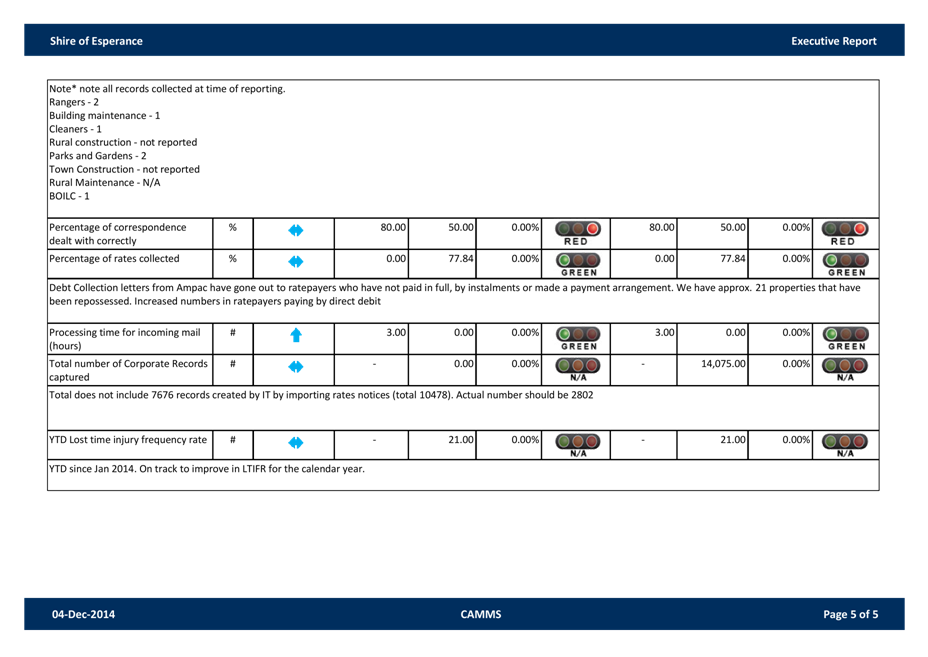
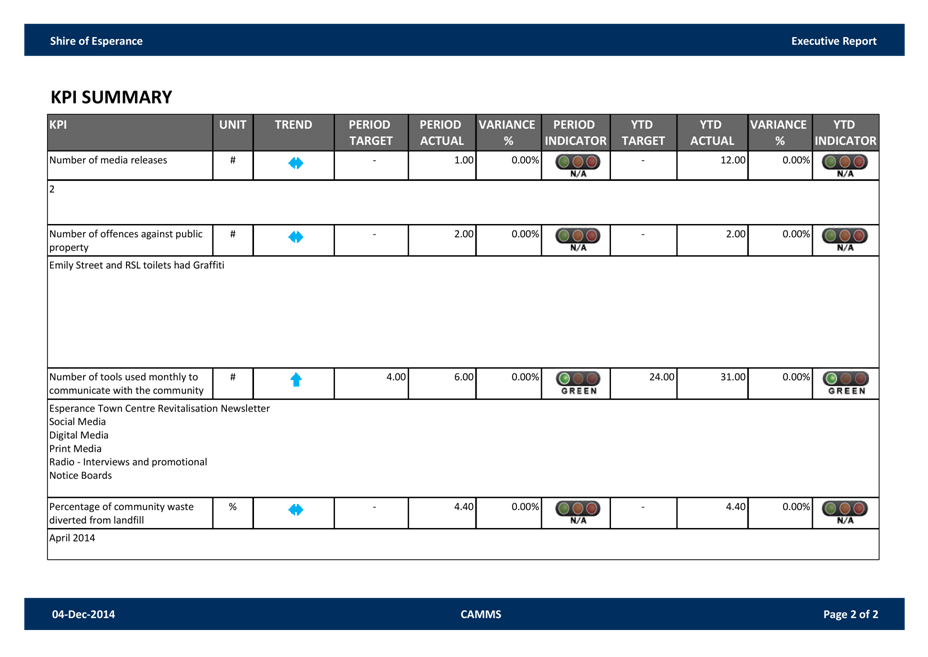
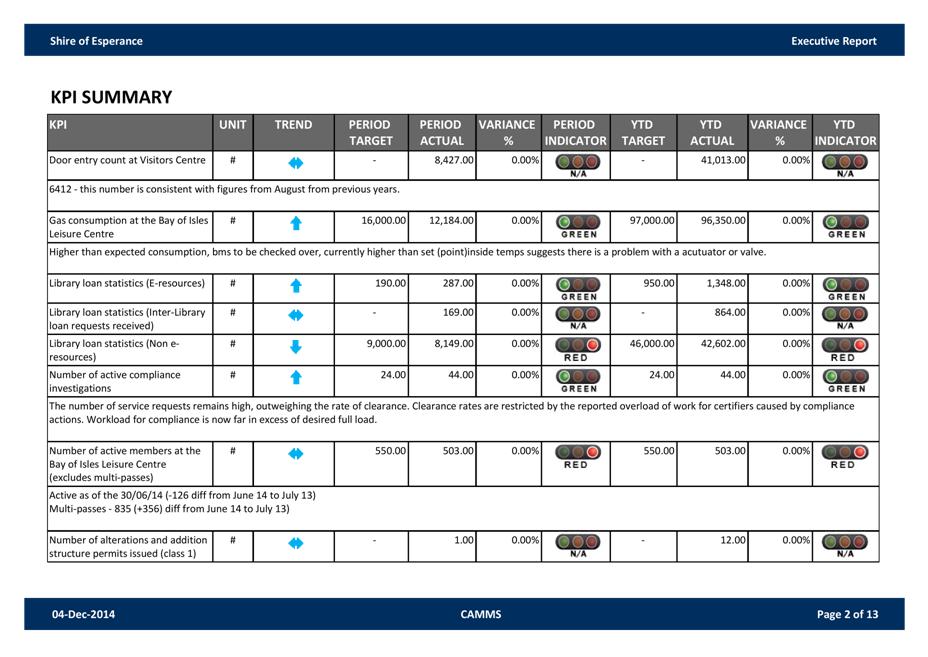
Attachment b: Interplan Report ....................................................................... 228
|
Item: 12.4.1 |
Attachment a.: Fleet Asset Management Plan 2014 |
Shire of Esperance

 Fleet Asset Management Plan
December
2014

Document Control |
Asset Management for Small, Rural or Remote Com munities
|
||||||
|
Document ID: 59_280_110805 am4srrc amp word template v10.4 |
|||||||
|
Rev No |
Date |
Revision Details |
Author |
Reviewer |
Approver |
||
|
Rev 1 |
Jun-2014 |
Initial review 2013 AMP |
BP |
|
|
||
|
Rev 2 |
Aug-2014 |
Review asset register and expenditure |
BP |
|
|
||
|
Rev 3 |
Sep-2014 |
Review funding projections and final data |
BP |
SM |
|
||
|
Rev 4 |
Oct-2014 |
Review Risk Assessment |
BP |
TB, SM, CS |
|
||
|
Rev 5 |
Nov-2014 |
Incorporate review notes |
BP |
SM |
|
||
|
Rev 6 |
Nov-2014 |
Incorporate review notes |
BP |
GH |
|
||

|
Item: 12.4.1 |
Attachment a.: Fleet Asset Management Plan 2014 |
· 1............................................................................................................ EXECUTIVE SUMMARY
· 2...................................................................................................................... INTRODUCTION
· 2.1 Background
· 2.2 Goals and Objectives of Asset Management
· 2.3 Plan Framework
· 2.4 Core and Advanced Asset Management
· 3................................................................................................................. LEVELS OF SERVICE
· 3.1 Community Engagement
· 3.2 Legislative Requirements
· 3.3 Current Levels of Service
· 3.4 Desired Levels of Service
· 4................................................................................................................... FUTURE DEMAND
· 4.1 Demand Forecast
· 4.2 Changes in Technology
· 4.3 Demand Management Plan
· 5............................................................................................. LIFECYCLE MANAGEMENT PLAN
· 5.1 Background Data
· 5.2 Risk Management Plan
· 5.3 Routine Maintenance Plan
· 5.4 Renewal/Replacement Plan
· 5.5 Creation/Acquisition/Upgrade Plan
· 5.6 Disposal Plan
· 6............................................................................................................ FINANCIAL SUMMARY
· 6.1 Financial Statements and Projections
· 6.2 Funding Strategy
· 6.3 Valuation Forecasts
· 7........................................................................................... ASSET MANAGEMENT PRACTICES
· 7.1 Accounting/Financial Systems
· 7.2 Asset Management Systems
· 7.3 Information Flow Requirements and Processes
· 7.4 Standards and Guidelines
· 8............................................................................... PLAN IMPROVEMENT AND MONITORING
· 8.1 Performance Measures
· 8.2 Improvement Plan
· 8.3 Monitoring and Review Procedures
· REFERENCES
· Appendix A Projected 10 year Capital Renewal Works Program
· Appendix B Abbreviations
· Appendix C Glossary
This page is left intentionally blank.
Context
The Shire of Esperance is located on Western Australia’s southeast coast approximately 700 km’s from Perth by road. The Shire has an area of 44,336 square kilometres and extends from Munglinup Beach in the west to Israelite Bay in the east and incorporates Salmon Gums in the north. Esperance is predominately a cropping / grazing agricultural area with a Port that actively services regional agricultural and mining industries.
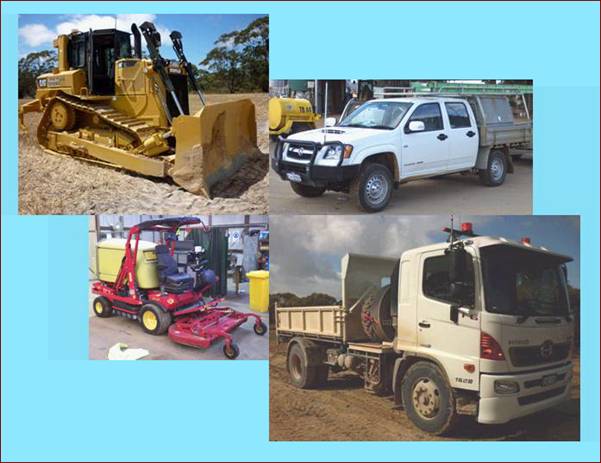
The Shire owns and operates a fleet of plant and equipment that enables it to provide services required by the community. Organisational mobility is essential for moving people, materials and tools to works sites. This mobility enables a range of community services and is essential to productivity and achieving the desired levels of service.
Purpose & Scope
This review follows Councils adoption of the 2013 Fleet Asset Management Plan (AMP) and 10 Year Plant Replacement Program (Item 12.2.2 carried by simple majority Ordinary Council Meeting 26th March 2013).
This AMP has been developed in conjunction with relevant staff and incorporates a revised register of assets, values and useful lives.
Effective Fleet management includes programs to preserve the value of equipment, measuring and minimising un-scheduled servicing, collecting, analysing and reporting data that enables informed asset management decision to be made. The projected cost to provide the services covered by this Asset Management Plan includes operations, maintenance, renewal and upgrade of existing assets over the 10 year planning period.
Fleet assets represent a significant investment for the organisation and in 2014 comprised of 186 assets with:
· A current replacement cost $12,208,604
· A depreciated replacement cost $7,129,549
· An annual depreciation expense $1,208,214
What does it Cost?
The projected cost to provide the services covered by this Asset Management Plan includes operations, maintenance, renewal and upgrade of existing assets over the 10 year planning period is $29,743,110 or $2,974,311 per year.
Based on Council’s adoption of the 10 Year Plant Replacement Program there are no funding gaps in this 10 year plan.
As identified in the IPWEA Plant & Vehicle Management Manual 3rd Edition, the lifecycle plan for fleet assets is about:
· Purchasing assets subject to a business case using whole-of-life costs and utilisation rates.
· Operating assets in a manner they were designed for.
· Maintaining assets in line with manufacturer’s requirements.
· Replacing assets in accordance with optimum replacement principles.
· Disposing of assets in accordance with utilisation and other benchmarks.
· Funding the 10 year replacement program using a reserve developed from internal hire rates.
What we can do
Provide Fleet infrastructure by:
· Reviewing annual budget allocations to reflect the projected renewal expenditure.
· Minimising the impact of peak renewal expenditure through the use of reserve funds and/or renewal plan management.
· Determining agreed service levels and funding strategies over the 10 year planning period.
· Meeting agreed funding levels for operation, maintenance, renewal and upgrade.
· Managing Fleet assets using best practice utilisation and optimisation strategies.
· Undertaking regular reviews of asset values, residuals and renewal projections.
What we cannot do
· Manage new or upgraded asset requirements without reviewing funding gaps and annual budget allocations.
The Next Steps
Actions resulting from this AMP include:
· Maintain data maintenance processes
· Review risk register and treatment plans
· Monitor workshop operations and resources
· Maintain a Fleet Management System
· Review workshop facilities
· Further develop or review Levels of Service
· Document operation and maintenance guidelines
· Further develop financial tracking & reporting
· Integrate Fleet systems with finance for Fair value accounting and Long Term Financial Plan
·
What is an Asset Management Plan?
Asset management planning is a comprehensive process to ensure delivery of services from infrastructure is provided in a financially sustainable manner.
The asset management plan details information about infrastructure assets including actions required to provide an agreed level of service in the most cost effective manner. The Plan defines the services to be provided, how the services are provided and what funds are required to provide the services.
community for costs to the community
Key Assumptions
Key assumptions have been used in the preparation of this AMP, these are presented to enable readers to gain an understanding of the levels of confidence in data used for financial forecasts.
|
Condition |
|||||||||
|
It is assumed through the use of optimisation strategies and the current maintenance regime that all Passenger & Heavy Plant are in Good Condition at the point of disposal. Due to their limited residual value, some Miscellaneous assets may be retained for the balance of their useful service life and their condition may predictably deteriorate up to the point of disposal. The varying levels of operator skills and operating environments may also influence the overall asset condition and residual values. |
|||||||||
|
Financials |
|||||||||
|
Expenditure have been excluded for Homecare, Wylie Bay Landfill, FESA and Airport locations which are separately funded. Renewal projections are in 2013 dollars only. |
|||||||||
|
Renewal expenditure: |
|||||||||
|
2010 |
2011 |
2012 |
2013 |
2014 |
3 yr Avg |
||||
|
Operations |
$1,059,490 |
$1,080,880 |
$1,114,815 |
$1,134,198 |
$1,114,101 |
$1,121,038 |
|||
|
Planned |
$390,626 |
$403,573 |
$275,595 |
$361,361 |
$182,123 |
$273,026 |
|||
|
Reactive |
$26,955 |
$32,596 |
$337,124 |
$411,807 |
$411,603 |
$386,845 |
|||
|
Grand Total |
$1,477,071 |
$1,517,049 |
$1,727,535 |
$1,907,366 |
$1,707,828 |
$1,780,910 |
|||
|
|
|
|
|
|
|||||
|
2010 |
2011 |
2012 |
2013 |
2014 |
3 yr Avg |
||||
|
Heavy |
$1,128,652 |
$1,167,920 |
$1,353,636 |
$1,490,021 |
$1,284,926 |
$1,376,195 |
|||
|
Light |
$227,972 |
$238,435 |
$266,145 |
$298,632 |
$306,370 |
$290,382 |
|||
|
Misc |
$120,448 |
$110,694 |
$107,753 |
$118,714 |
$116,366 |
$114,278 |
|||
|
Grand Total |
$1,477,071 |
$1,517,049 |
$1,727,535 |
$1,907,366 |
$1,707,663 |
$1,780,855 |
|||
|
Asset Data |
|||||||||
|
Data sources: |
2012-13 10 Year Heavy Plant Replacement Program |
||||||||
|
2012-13 10 Year Light Vehicle Replacement Program |
|||||||||
|
Excludes - HACC - Assets are either self funded or funded through external sources |
|||||||||
|
Excludes – Fire & Emergency fleet - funded through the respective organisations |
|||||||||
|
Excludes - Airport Fleet - separately funded and covered by Airport AMP |
|||||||||
|
Excludes – Wylie Bay Landfill Fleet - separately funded, to be included under separate AMP |
|||||||||
|
Year acquired |
|||||||||
|
Based on actual date provided by Fleet management staff |
|||||||||
|
Adjustments made based on knowledge i.e. assets acquired second hand or pre-dating existing records |
|||||||||
|
Values |
|||||||||
|
Values based on 10 Year Light and Heavy Replacement Program |
|||||||||
|
Miscellaneous asset details sourced by Fleet management staff |
|||||||||
|
Useful Life |
|||||||||
|
Useful Life used in the 10 Year light and Heavy Replacement Programs was determined using information provided in the Uniqco Light Fleet review 2009 and IPWEA Plant & Vehicle management Manuals |
|||||||||
|
Methodology |
|||||||||
|
The WALGA Procurement Handbook (current edition) is the guiding document in all supply and tendering processes. |
|||||||||
|
Heavy |
Managed using WALGA preferred suppliers and System.plus assessment tools |
||||||||
|
Misc. |
Managed using local suppliers and System.plus evaluation criteria |
||||||||
|
Light |
Managed using local suppliers and System.plus evaluation criteria |
||||||||
|
Systems.plus |
IPWEA Fleet Management subscription service incorporates utilisation, whole of life and optimisation |
||||||||
|
|
|||||||||
|
The following criteria have been applied or considered in the determination of the replacement schedule and values used in this plan. The methodology is detailed in the “IPWEA Plant and Vehicle Management Manual 3rd Edition”. Reference should be made to this manual for further information. |
|||||||||
|
Whole of life costs |
Projection of future costs using first principles. |
||||||||
|
Utilisation |
A unit of work measure for comparison or benchmarking. |
||||||||
|
Optimisation |
Predicting resale value and costs to maximise the return on investment |
||||||||
|
Down time |
The time that an asset is unavailable for its normal use due to servicing or maintenance. |
||||||||
|
Maintenance failure |
Any servicing or maintenance activity that is not part of regular or planned activities. |
||||||||
|
Purchasing Policy |
Policy outlines purchasing and disposal criteria. |
||||||||
|
Classifications |
|||||||||
|
Heavy |
Graders, loaders, trucks, rollers, road plant |
||||||||
|
Light |
Staff and light operational vehicles |
||||||||
|
Misc. |
Mowers, trailers, caravans, mixed plant |
||||||||
2. INTRODUCTION
2.1 Background
This asset management plan is to demonstrate responsive management of assets (and services provided from assets), compliance with regulatory requirements, and to communicate funding needed to provide the required levels of service.
The asset management plan is to be read with the following associated planning documents:
· Shire of Esperance Strategic Action Plan 2007 – 2027
· Motor Vehicles Policy (HR 001 September 2007)
· Staff Entitlements Policy (HR 002 July 2010)
· Staff use of Shire Equipment for Private Purposes Policy (Exec 009 September 2007)
· Financial Management Policy (Corp 002 September 2007)
· Council Budget (Current Year)
· Shire of Esperance Plan for the Future 2010/11 to 2012/13
· Records Management Policy (Corp 009 July 2010)
· Light Fleet Review (Uniqco November 2009)
· 10 Year Heavy Plant Replacement Program
· 10 Year Light Vehicle Replacement Program
· WALGA Fleet Safety Resource Kit
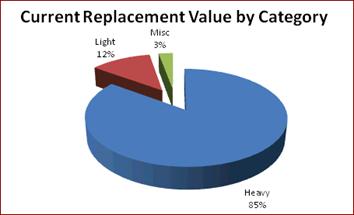
Table 2.1: Assets covered by this Plan
|
Asset category |
Dimension |
Quantity |
Current replacement cost |
Depreciated replacement cost |
Annual depreciation cost |
|
Heavy |
Includes graders, loaders, trucks, rollers, road plant |
119 |
$10,398,576 |
$5,896,770 |
$985,626 |
|
Light |
Staff and light operational vehicles |
42 |
$1,465,975 |
$1,140,219 |
$184,937 |
|
Miscellaneous |
Includes mowers, trailers, small plant |
29 |
$344,053 |
$92,561 |
$37,651 |
|
TOTAL |
|
190 |
$12,208,604 |
$7,129,549 |
$1,208,214 |
·
·
2.2 Goals and Objectives of Asset Management
The Council exists to provide services to its community. The Shire of Esperance owns and operates a fleet of plant and equipment to assist in providing these services. Management of the fleet is therefore critical in ensuring community, strategic and operational service levels are achieved now and in the future.
The key elements of Fleet asset management are:
· Taking a life cycle approach,
· Developing cost-effective management strategies for the long term
· Providing a defined level of service and monitoring performance
· Understanding and meeting the demands of growth
· Managing risks
· Continuous improvement in asset management practices.[1]
The goal of this asset management plan is to:
· Document fleet management processes
· Document the services/service levels to be provided and their costs
· Provide information to support decisions regarding service levels, costs and risks in a financially sustainable manner.
This asset management plan is prepared under the direction of Council’s vision, mission, goals and objectives.
Council’s vision is:
“Esperance is spectacular. We have a vibrant, welcoming community that encourages new people to our region and gives a sense of belonging to those who live here. We value our natural resources and accept the responsibility to manage them for future generations to enjoy. We aim to strengthen and diversify the regions economic base in a way that compliments our social and environmental values. We are strategically located as a diverse and dynamic region that is committed to a sustainable change and growth. Above all, we are a community that makes it happen.”
Council’s values are:
· Professionalism – in the standards and ethics of our actions
· Respect – through courtesy and honesty in our dealings with all people
· Integrity – that builds community trust
· Dedication – of a committed team that works together to provide leadership in the community
· Excellence – in the service that we provide to the community
Council’s Corporate Mission:
The corporate mission articulates the aim and purpose of the Shire. The Corporate Mission is intrinsically linked to the community vision: “The Shire of Esperance, as custodians of community infrastructure, will endeavour to be efficient, sustainable and responsive to community needs. As a leading organisation we will operate in a responsible, transparent and ethical manner
·
·
·
·
·
·
·
·
2.3 Plan Framework
Key elements of the plan are
· Levels of service – specifies the services and levels of service to be provided by council.
· Future demand – how this will impact on future service delivery and how this is to be met.
· Life cycle management – how the organisation will manage its existing and future assets to provide the required services
· Financial summary – what funds are required to provide the services.
· Asset management practices
· Monitoring – how the plan will be monitored to ensure it is meeting the organisation’s objectives.
· Asset management improvement plan
2.4 Core and Advanced Asset Management
This asset management plan is prepared in accordance with the International Infrastructure Management Manual. It is prepared to meet minimum legislative and organisational requirements for sustainable service delivery and long term financial planning and reporting. Core asset management is a ‘top down’ approach where analysis is applied at the ‘system’ or ‘network’ level.
·
3. LEVELS OF SERVICE
3.1 Community Engagement
It is intended that future revisions of the asset management plan will incorporate community engagement on service levels and costs of providing the service. This will assist Council and the community in matching the level of service needed by the community, service risks and consequences with the community’s ability to pay for the service.
3.2 Legislative Requirements
Council has to meet many legislative requirements including Australian and State legislation and State regulations. Relevant legislation is shown in Table 3.2.
Table 3.2: Legislative Requirements
|
Legislation |
Requirement |
|
· Local Government Act |
· Sets out role, purpose, responsibilities and powers of local governments including the preparation of a long term financial plan supported by asset management plans for sustainable service delivery. · |
|
· Disability Services Act (1993) |
· An Act for the establishment of the Disability Services Commission and the Ministerial Advisory Council on Disability, for the furtherance of principles applicable to people with disabilities, for the funding and provision of services to such people that meet certain objectives, for the resolution of complaints by such people, and for related purposes. · |
|
· OSH Act 1984 |
· The guidelines for employees and employers to undertake within the work environment. · |
|
· OSH Regulations 1996 |
· The guidelines for employees and employers to undertake within the work environment. |
|
· Motor Vehicle Standards Act 1989 (Australian Design Rules) |
· The Australian Design Rules (ADRs) are national standards for vehicle safety, anti-theft and emissions. |
3.3 Current Levels of Service
Council is defining service levels in two terms.
Community Levels of Service relate to the service outcomes that are expected by the community and may include safety, quality, quantity, reliability, responsiveness and cost effectiveness.
Technical Levels of Service - Supporting the community service levels are operational or technical measures of performance. These may relate to utilisation, sustainability, maintenance and renewal..
Council will commence the Service Delivery Review process in 2015 and has not yet fully identified services and sub-services, current or desired levels of service. Table 3.3 represents draft measures based on the established NAMS format only.
Table 3.3: Draft Service Levels only
|
Level of Service |
Objective |
Performance Measure |
Desired Level of Service |
Current Level of Service |
|
COMMUNITY LEVELS OF SERVICE |
||||
|
Function |
Provide sufficient fleet assets to meet the communities desired levels of service |
- SOE policies - Best practice principles |
Fleet assets are managed using adopted policies and best practice standards |
Fleet management policies and systems have been implemented and are under continual review |
|
Performance |
Provide a fleet that is functional and operational |
- Maintenance failures - Labour rates - Scheduled / un-scheduled maintenance ratio |
Measure and benchmark with national averages |
Not currently measured |
|
Safety |
Ensure assets are operated, maintained, serviced and repaired to required standards |
Accidents / injuries / near miss statistics |
0 preventable injuries per annum |
Not currently measured |
|
TECHNICAL LEVELS OF SERVICE |
||||
|
Sustainability |
Minimise whole of life costs |
- Fixed / variable costs - Internal Hire rates - Depreciation |
Costs minimised and benchmarked with national averages |
Not currently measured |
|
Utilisation |
Maximise utilisation rates |
- Distance travelled - Plant hours - Service intervals - Optimised renewal
|
Utilisation maximised and benchmarked with national averages
|
Not currently measured |
|
Renewal |
Renewal completed on-time and within budget |
Renewals in accordance with Vehicle Replacement Plans
|
Renewal within annual budgets |
Annual review for fluctuations in replacement and residual values |
3.4 Desired Levels of Service
Desired level of service will be determined using various sources including residents, feedback to Councillors and staff, service requests and correspondence. Council has yet to quantify current or proposed levels of service. This will be done in future revisions of this asset management plan and incorporate performance measures identified in the Service Delivery Review process.
4. FUTURE DEMAND
4.1 Demand Forecast
Demand may be affected by population growth, seasonal use of the Shire’s road network and by factors including availability of resources such as gravel. This in turn may affect haul distances, types of plant required, plant renewal frequency and the budget. The Shires ability to meet any future desired level of service from Fleet infrastructure will be managed through successive reviews of the asset management plan.
It is envisaged that the community’s expectation of service will be met by the Shire’s current and proposed fleet management plans.
4.2 Changes in Technology
Changes in technology may result from variations to manufacturer’s vehicle specifications, performance and/or safety ratings but are not forecast to have significant impact on the delivery of services covered by this plan. Technology developments in GPS tracking may lead to efficiencies and will be investigated in future revisions of the AMP.
4.3 Demand Management Plan
New services are managed through a combination of managing existing assets, upgrading of existing assets and providing new assets to meet demand. Demand management practices may include non-asset solutions, insuring against risks and managing failures.
Non-asset solutions focus on providing the required service without the need for council to own the assets. Examples of non-asset solutions may include the sharing of assets and resources with neighbouring or other organisations.
There are no current agreements with regard to resource sharing.
There are no new donated assets identified in this plan.
Acquiring new assets will commit council to fund ongoing operations and maintenance costs for the period that the service provided from the assets is required. These future costs are identified and considered in developing forecasts of future operations and maintenance costs.
5. LIFECYCLE MANAGEMENT PLAN
The lifecycle management plan outlines how Council plans to manage and operate the assets at the agreed levels of service (defined in Section 3) while optimising life cycle costs.
5.1 Background Data
5.1.1 Physical parameters
The assets covered by this asset management plan are shown in Table 2.1.
Assets, including many major plant items operating outside the Esperance townsite may remain in the field for extended periods. Fleet assets not approved for private use are returned and secured within one of the Shire depots daily. Employees may be approved under Shire Policy HR001 for private use of Light operational vehicles.
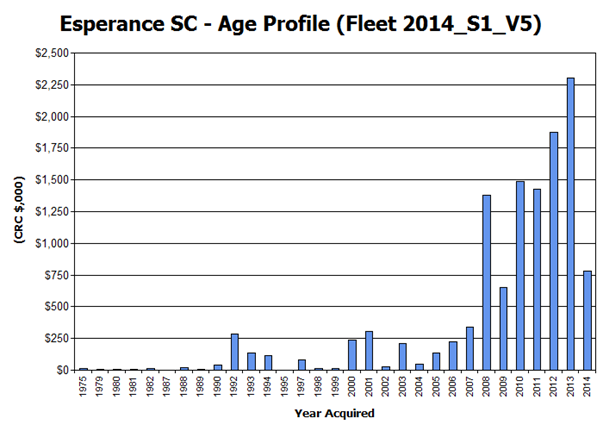
The age profile of the assets include in this AM Plan is shown in Figure 2.
Figure 2: Asset Age Profile
5.1.2 Asset capacity and performance
Known service performance deficiencies are detailed in Table 5.1.2 below.
Table 5.1.2: Known Service Performance Deficiencies
|
Area |
Service Deficiency |
|
Fleet maintenance facilities |
Review of workshop to include diagnostic facilities
|
|
Fleet maintenance staff |
Review of workshop resources to support current and future maintenance schedules
|
|
Fleet Management Systems |
Monitor Fleet Management System to ensure adequate planning and reporting capability
|
This plan assumes that all assets are to be renewed. Future reviews of this plan may include rationalisation of assets.
5.1.3 Asset condition
Condition is measured using a 1 – 5 rating system as detailed in Table 5.1.3.
The condition grade of individual fleet assets has not been assessed.
It is assumed through the use of optimisation strategies that all Light and Heavy plant are Condition 3 at the designated point of disposal. Some items of Misc. plant may be retained for the balance of their practical service life and their condition may predictably deteriorate up to that point.
5.1.4 Asset valuations
The value of assets recorded in the asset register as at 22/10/2012 covered by this asset management plan is shown below.
Current Replacement Cost $12,208,604 (Current replacement cost of all assets)
Depreciable Amount $ 8,633,424 (Current replacement cost – Residual)
Depreciated Replacement Cost $ 7,129,549 (CRC – accumulated depreciation)
Annual Depreciation Expense $ 1,208,214 (CRC – Residual / Useful Life)
Council’s sustainability reporting compares the rate of an annual asset consumption to asset renewal and upgrade.
Asset Consumption Ratio 58.4% (Depreciated Replacement/Current Replacement)
A Department of Local Government measure with a target of between 50 and 75%. A ratio less than 50% indicates a rapid deterioration of assets, greater than 75% may indicate an over investment in the asset base.
Asset Sustainability Ratio 98.8% (Renewal expenditure/Depreciation exp)
A Department of Local Government measure with a target of between 90 and 110%. A ratio less than 90% may indicate under investment in renewal, greater than 110% may indicate over investment in renewal.
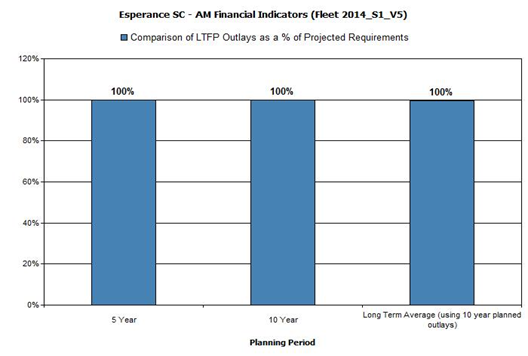
Asset Renewal Funding Ratio 100.0% (NPV planned renewal over 10 yrs/NPV required renewal 10 yrs)
A Department of Local Government measure with a target of between 95 and 105%. The ratio indicates the financial capacity to continue to provide existing levels of service in the future without additional operating expenses above that currently projected.
To provide services in a financially sustainable manner, Council will need to ensure that it is renewing assets at the rate they are being consumed over the medium-long term and funding the life cycle costs for all new assets and services in its long term financial plan.
5.1.5 Asset hierarchy
An asset hierarchy provides a framework for structuring data in an information system to assist in collection of data, reporting information and making decisions. The hierarchy includes the asset class and component used for asset planning and financial reporting and service level hierarchy used for service planning and delivery.
Table 5.1.5: Asset Service Hierarchy
|
Service Hierarchy |
Service Level Objective |
|
Heavy |
Provide and maintain fleet assets which enable major operational and construction tasks to be completed. Assets comply with all relevant standards and specifications.
|
|
Light |
Provide and maintain passenger and light operational vehicles to manufacturer’s specifications so as to ensure the safety of staff and public. Ensure the maximum utilisation and lowest whole of life costs while minimising environmental impacts. Assets comply with all relevant standards and specifications.
|
|
Misc. |
Provide and maintain minor fleet assets to enable operational tasks to be completed in a safe manner. Assets comply with all relevant standards and specifications.
|
5.2 Risk Management Plan
An assessment of risks associated with service delivery from infrastructure assets has identified critical risks that will result in loss or reduction in service from infrastructure assets or a ‘financial shock’ to the organisation. The risk assessment process identifies credible risks, the likelihood of the risk event occurring, the consequences should the event occur, develops a risk rating, evaluates the risk and develops a risk treatment plan for non-acceptable risks.
Critical risks, being those assessed as ‘Very High’ - requiring immediate corrective action and ‘High’ – requiring prioritised corrective action identified in the Infrastructure Risk Management Plan are summarised in Table 5.2.
Table 5.2: Critical Risks and Existing Controls
|
What can Happen |
Risk Rating (VH, H) |
Existing Controls |
|
There are no reportable risks currently for this asset class |
||
The risk assessment for this asset class has been prepared and reviewed in conjunction with the Shire’s OSH/Risk Management Officer and the relevant stakeholders. The risk register details are available by contacting the relevant officer.
5.3 Routine Maintenance Plan
Routine maintenance is the regular on-going work that is necessary to keep assets operating, including instances where portions of the asset fail and need immediate repair to make the asset operational again.
5.3.1 Maintenance plan
Maintenance includes scheduled and un-scheduled work activities.
Un-scheduled maintenance is repair work carried out in response to service requests and management/supervisory directions. Scheduled maintenance is regular servicing and repair work that is managed through the Fleet Management System.
Maintenance activities include inspection, assessing the condition against failure/breakdown experience, prioritising, scheduling, actioning the work and reporting what was done to develop a maintenance history and improve maintenance and service delivery performance.
Table 5.3.1: Maintenance Expenditure Trends
|
Category |
2010 |
2011 |
2012 |
2013 |
2014 |
|
Fuels & Oils |
$834,384 |
$898,255 |
$954,665 |
$981,593 |
$996,788 |
|
Ground Engaging Tools |
$26,955 |
$27,334 |
$30,026 |
$20,094 |
$16,129 |
|
Insurances |
$66,419 |
$1,822 |
$72,804 |
$50,537 |
$85,000 |
|
Lease Payments |
$2,260 |
$1,818 |
$6,225 |
$8,700 |
$4,150 |
|
Parts & Repairs Scheduled Maintenance |
$303,231 |
$315,559 |
$132,796 |
$210,637 |
$73,016 |
|
Parts & Repairs Unscheduled Maintenance |
$3,736 |
$277,637 |
$351,082 |
$312,912 |
|
|
Registrations |
$16,179 |
$17,964 |
$18,404 |
$19,052 |
$44,785 |
|
Scheduled Maintenance Labour |
$1,337 |
$37,106 |
$38,935 |
$43,171 |
|
|
Tyres, Tubes etc |
$87,600 |
$86,677 |
$105,693 |
$111,788 |
$65,933 |
|
Unscheduled Maintenance Labour |
$1,526 |
$29,461 |
$40,631 |
$82,400 |
|
|
Workshop labour |
$143,600 |
$161,021 |
$62,718 |
$74,316 |
$68,379 |
|
Grand Total |
$1,480,628 |
$1,517,049 |
$1,727,535 |
$1,907,366 |
$1,792,663 |
Current maintenance expenditure levels reflect the actual costs to meet required service levels. Future revision of this asset management plan will include linking required maintenance expenditures with required service levels.
Assessment and prioritisation of reactive maintenance is undertaken by Management and operational staff.
Maintenance response times for all assets under this AMP are prioritised relevant to the nature of any fault, the asset affected and services provided. The safety and health of the community and staff are given the highest priority and maintenance tasks are undertaken accordingly.
5.3.2 Standards and specifications
Maintenance work is carried out in accordance with the following Standards and Specifications.
· Motor Vehicles Standards Act 1989
· Dept of Infrastructure and Transport - Australian Design Rules 3rd Edition
· Australian Dangerous Goods Code 7th Edition
· Road Traffic Act 1974
· Road Traffic (Vehicle Standards) Regulations 2002
· Road Traffic (Vehicle Standards) Rules 2002
· Road Traffic (Towed Agricultural Implements) Regulations 1995
· Vehicles – Information Bulletins (Safety and Standards) and Vehicle Standards Bulletins (VSB’s) published through the Department of Transport WA
· Manufacturers vehicle specifications
5.3.3 Summary of future operations and maintenance expenditures
Future operations and maintenance expenditure requires review in line with desired levels of service. Planned maintenance schedules will be required and should trend in line with the value of the asset stock as shown in Figure 4. Note that all costs are shown in 2013/14 dollar values.
Figure
4: Projected Operations and Maintenance Expenditure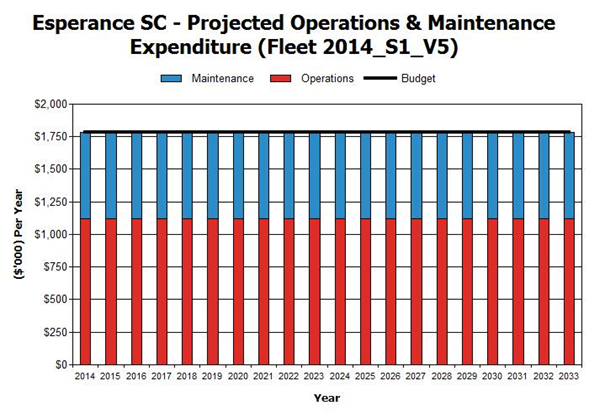
5.4 Renewal/Replacement Plan
Fleet renewal expenditure may include the major refurbishment or the complete replacement of an existing asset in any category. Purchase or provision of fleet assets other than existing is considered new expenditure.
5.4.1 Renewal plan
Renewal planning for Fleet assets may involve calculating optimum replacement using various data including downtime, repair and maintenance costs, resale values, utilisation based on distance travelled or engine time.
Calculating the optimum replacement point ensures maximum resale value, avoids increased maintenance and repair costs and in the long term reduces annual plant replacement costs.
The Shire’s Fleet Asset management system ensures renewal is based on the principals for Fleet Asset Management detailed in the IPWEA Plant and Vehicle Management Manual (current edition).
5.4.2 Renewal standards
Renewal work is carried out as per 5.3.2 Maintenance standards.
5.4.3 Summary of projected renewal expenditure
Projected future renewal expenditures are forecast to increase over time as the asset stock ages. The costs are summarised in Figure 5.
Figure 5:
Projected Capital Renewal Expenditure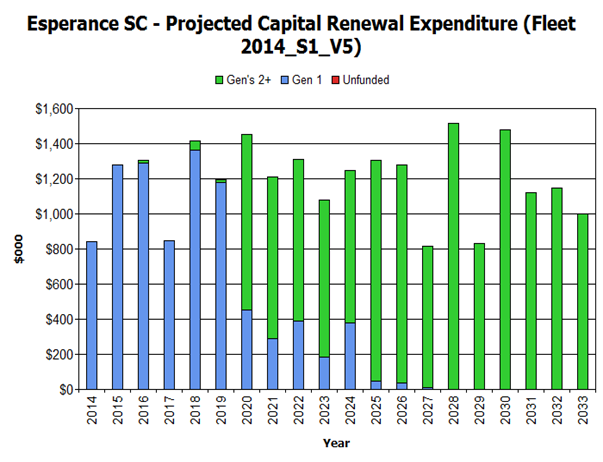
5.5 Creation/Acquisition/Upgrade Plan
Refer to Council’s adopted 10 Year Fleet Renewal Plan.
5.5.1 Selection criteria
The priority for new or upgrade proposals may vary depending on the nature, scale and location of the asset and utilises the IPWEA Systems Plus Fleet Management System optimisation calculations, whole of life cost calculations and vehicle comparison tools.
5.5.2 Standards and specifications
Standards and specifications for new assets and for upgrade/expansion of existing assets are the same as those for renewal shown in Section 5.4.2.
5.5.3 Summary of projected upgrade/new assets expenditure
Projected upgrades or new assets are detailed in the 10 year Fleet Replacement program.
5.6 Disposal Plan
This plan assumes that all assets are to be renewed. Disposal of Light and Heavy fleet assets typically involves trade-in at the time of asset replacement. Miscellaneous plant items may have little or no residual value or disposal costs. Disposal or non-renewal may be considered when identifying options for the management of assets in a later stage of planning and may include decommissioning, sale or relocation.
6. FINANCIAL SUMMARY
This section contains the financial requirements resulting from all the information presented in the previous sections of this asset management plan. The financial projections will be improved as further information becomes available on desired levels of service and current and projected future asset performance.
6.1 Financial Statements and Projections
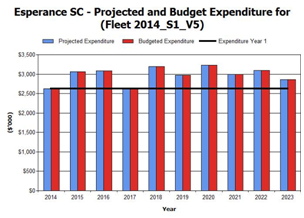
The financial projections are shown in Figure 7 for Projected Operations, Projected Total Maintenance and Projected Renewal expenditure against the Projected Current Budget funding.
Figure 7: Projected Operating and Capital Expenditure and Budget
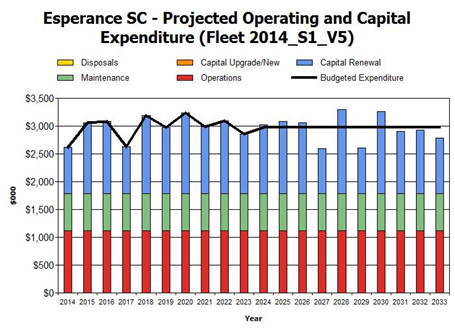
Figure 7a: Asset Management Indicators
6.1.1 Financial sustainability in service delivery
Light Vehicles and Heavy Plant plans have been developed using utilisation and optimisation strategies based on IPWEA’s System Plus Fleet Management System and are combined with Miscellaneous plant to develop the 10 Year Fleet renewal program.
Life cycle costs (or whole of life costs) are the average costs that are required to sustain the service levels over the asset life. Life cycle costs include operations, maintenance and renewal expenditure. Life cycle costs can be compared to life cycle expenditure to give an indicator of sustainability in service provision and will vary depending on the timing of asset renewals. A shortfall between life cycle cost and life cycle expenditure is the life cycle gap.
Figure 8 shows the projected renewal from the Renewal Plan in Appendix B together with the budgeted renewal and renewal gap. Fleet Management renewal projections are based on a 10 year plan only and matching projected expenditure beyond 2023 has not been included in this AMP.
Figure 8: Projected Fleet Renewal and Budget expenditure showing Renewal Gap
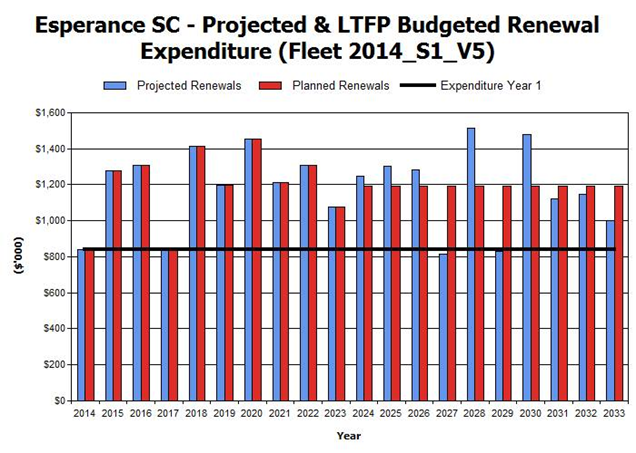
Table 6.1.1 shows the projected asset renewals in the 10 year planning period from Appendix B. The projected asset renewals are compared to budgeted renewal expenditure in the capital works program and capital renewal expenditure in year 1 of the planning period in Figure 8. Projections beyond the 10 year plan are based on estimations only.
Table 6.1.1: Projected and Budgeted Renewals and Expenditure Shortfall
|
Year |
Projected Renewals |
Planned Renewal Budget |
Renewal Funding Shortfall (-ve Gap, +ve Surplus) |
Cumulative Shortfall (-ve Gap, +ve Surplus) |
|
2014 |
$840,000 |
$840,000 |
$0 |
$0 |
|
2015 |
$1,277,000 |
$1,277,000 |
$0 |
$0 |
|
2016 |
$1,307,000 |
$1,307,000 |
$0 |
$0 |
|
2017 |
$848,000 |
$848,000 |
$0 |
$0 |
|
2018 |
$1,414,000 |
$1,414,000 |
$0 |
$0 |
|
2019 |
$1,197,000 |
$1,197,000 |
$0 |
$0 |
|
2020 |
$1,452,000 |
$1,452,000 |
$0 |
$0 |
|
2021 |
$1,213,000 |
$1,213,000 |
$0 |
$0 |
|
2022 |
$1,310,000 |
$1,310,000 |
$0 |
$0 |
|
2023 |
$1,076,000 |
$1,076,000 |
$0 |
$0 |
Note: An negative shortfall indicates a funding gap, a positive shortfall indicates a surplus.
Providing services in a sustainable manner will require matching of projected asset renewals to meet agreed service levels with planned capital works programs and available revenue. A gap between projected asset renewals and planned asset renewals indicates that further work is required to manage required service levels and the funding gap.
This review follows Councils adoption of the 2013 Fleet Asset Management Plan (AMP) and 10 Year Plant Replacement Program (Item 12.2.2 carried by simple majority Ordinary Council Meeting 26th March 2013). Projected renewal expenditure will need to be assessed where significant variations occur and returned to Council for funding consideration.
6.1.2 Expenditure projections for long term financial plan
Table 6.1.2 shows the projected expenditures for the 10 year long term financial plan.
New assets and disposals are detailed in the 10 year Fleet Management Plan.
Table 6.1.2: Expenditure Projections for Long Term Financial Plan
|
Year |
Operations |
Maintenance |
Projected Capital Renewal |
|
2014 |
$1,121,000 |
$660,000 |
$839,880 |
|
2015 |
$1,121,000 |
$660,000 |
$1,276,580 |
|
2016 |
$1,121,000 |
$660,000 |
$1,306,550 |
|
2017 |
$1,121,000 |
$660,000 |
$848,280 |
|
2018 |
$1,121,000 |
$660,000 |
$1,413,820 |
|
2019 |
$1,121,000 |
$660,000 |
$1,197,100 |
|
2020 |
$1,121,000 |
$660,000 |
$1,452,060 |
|
2021 |
$1,121,000 |
$660,000 |
$1,212,890 |
|
2022 |
$1,121,000 |
$660,000 |
$1,309,620 |
|
2023 |
$1,121,000 |
$660,000 |
$1,076,330 |
|
Sub-total |
$11,210,000 |
$6,600,000 |
$11,933,110 |
|
10 year total cost |
$29,743,110 |
||
|
Annual total cost |
$2,974,311 |
||
6.2 Funding Strategy
Projected expenditure identified in Section 6.1 is to be funded from future operating and capital budgets.
6.3 Valuation Forecasts
Asset values are not forecast to increase significantly as a result of new or renewed assets.
Figure 9: Projected Asset Values
·
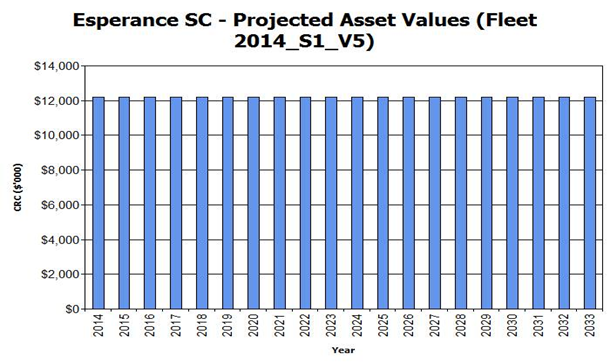
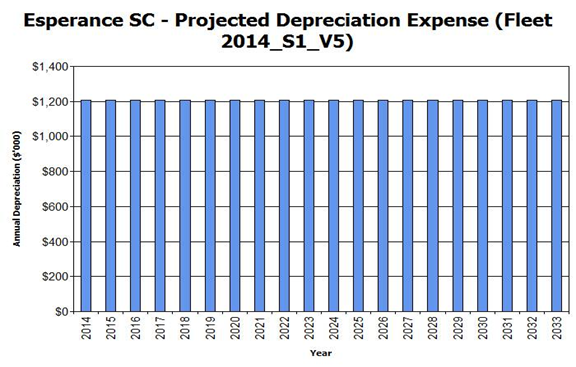
Figure 10: Projected Depreciation Expense
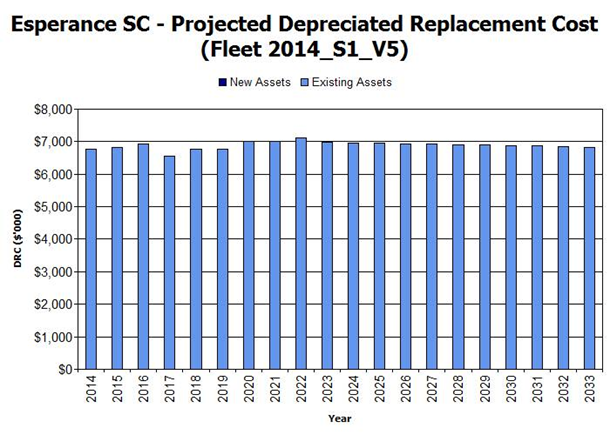
The depreciated replacement cost (current replacement cost less accumulated depreciation) will vary over the forecast period depending on the rates of addition of new assets, disposal of old assets and consumption and renewal of existing assets.
Figure 11: Projected Depreciated Replacement Cost
7. ASSET MANAGEMENT PRACTICES
7.1 Accounting/Financial Systems
7.1.1 Accounting and financial systems
The current financial package provided by Civica is Authority. BIS is utilized for financial reporting.
7.1.2 Accountabilities for financial systems
Accountability for the finance system resides with the Director Corporate Resources with the Manager Financial Services having prime responsibility for system maintenance and development
7.1.3 Accounting standards and regulations
All local governments in Western Australia are required to prepare financial statements in accordance with the Local Government Act 1995, Local Government (Financial Management) Regulations 1996 and applicable Australian Accounting Standards (as they apply to local governments and not-for-profit entities).
7.1.4 Capital/maintenance threshold
Council has adopted a capitalisation materiality level of $5,000 for all asset classes. (Resolution S0308-1269). Items of plant and equipment that fall below this have been included to ensure the network value has been included in future renewal projections. Assets below the materiality limit that have not been identified in this AMP may include hand tools, power tools, gardening equipment and some other minor plant.
7.1.5 Required changes to accounting financial systems arising from this AM Plan
There are no proposed changes to the accounting/financial systems resulting from this asset management plan. The restructure of the existing general ledger/chart of accounts took place in June 2014 and will facilitate improved asset management reporting in future revisions of this plan.
7.2 Asset Management Systems
7.2.1 Asset management system
The Shire of Esperance has adopted the NAMS.Plus format for Asset Management and has undertaken the relevant training modules as a base for managing infrastructure asset data and the production of Asset Management Plans. A review of Asset Management Information Systems is expected in 2014/15.
7.2.2 Asset registers
Asset data is currently managed through Authority and through the IPWEA Systems plus Fleet Management System. Information collected may vary according to asset class but will include Asset ID, Name, description, year acquired, condition and current replacement cost as a minimum.
7.2.3 Linkage from asset management to financial system
The financial systems are not intrinsically linked to the Asset Management data. It is anticipated that future Asset Management information systems may be linked to financial accounting systems.
7.2.4 Accountabilities for asset management system and data
The Asset Management system and processes are managed through a Strategic Group within the Shire who give direction to Officers to ensure assets are audited, associated plans are developed and Asset Management processes are further developed and implemented
7.2.5 Required changes to asset management system arising from this AM Plan
As the Asset Management systems and processes are still being developed there are no direct changes resulting from the AMP.
7.3 Information Flow Requirements and Processes
The key information flows into this asset management plan are:
· Council strategic and operational plans,
· Service requests from the community,
· Network assets information,
· The unit rates for categories of work/materials,
· Current levels of service, expenditures, service deficiencies and service risks,
· Projections of various factors affecting future demand for services and new assets acquired by Council,
· Future capital works programs,
· Financial asset values.
The key information flows from this asset management plan are:
· The projected Works Program and trends,
· The resulting budget and long term financial plan expenditure projections,
· Financial sustainability indicators.
These will impact the Long Term Financial Plan, Strategic Longer-Term Plan, annual budget and departmental business plans and budgets.
7.4 Standards and Guidelines
Standards, guidelines and policy documents referenced in this asset management plan are:
· IPWEA “International Infrastructure Management Manual”
· Australian Standards
· Relevant accounting and Fair Value standards
· Department of Local Government Integrated Planning and Reporting Framework and Guidelines
· Shire of Esperance Asset Management Strategy 2012 to 2014
· Shire of Esperance Strategic Community Plan 2012 – 2022
· Shire of Esperance Corporate Business Plan 2014/15 – 2017/18
· Shire of Esperance Long Term Financial Plan
· Shire of Esperance Infrastructure Asset Management Plan
8. PLAN IMPROVEMENT AND MONITORING
8.1 Performance Measures
The effectiveness of the asset management plan can be measured in the following ways:
· The degree to which the required cashflows identified in this asset management plan are incorporated into the organisation’s long term financial plan and Community/Strategic Planning processes and documents,
· The degree to which 1-5 year detailed works programs, budgets, business plans and organisational structures take into account the ‘global’ works program trends provided by the asset management plan;
8.2 Improvement Plan
A separate “Asset Management Strategy 2012 to 2014” has been adopted by Council. This document details the status and goals for Asset Management and sets out an action plan to achieve them. This document is due for review in 2014.
The asset management improvements generated from this asset management plan are shown in Table 8.2.
Table 8.2: Improvement Plan
|
Task No |
Task |
Responsibility |
Timeline |
|
1 |
Monitor procedures to ensure the Asset Register is maintained and accurate |
Asset Management |
2014/15 |
|
2 |
Review risk register periodically and implement any treatment plans. |
Asset Management |
On-going |
|
3 |
Ensure adequate workshop resources are available to support the fleet maintenance schedule |
Asset Management |
On-going |
|
4 |
Ensure the Fleet Management System continues to support best fleet management practices |
Asset Management |
On-going |
|
5 |
Monitor and implement Service Delivery Review recommendations |
Corporate Resources Asset Management |
On-going |
|
6 |
Review the integration of the fleet asset register with the financial systems for long term planning |
Asset Management Corporate Resources |
2014/15 |
8.3 Monitoring and Review Procedures
This asset management plan will be reviewed during annual budget preparation and amended to recognise any material changes in service levels and/or resources available to provide those services as a result of the budget decision process.
A full review of this Asset Management Plan is expected within 5 years.
REFERENCES
IPWEA Plant and Vehicle Management Manual 3rd edition
International Infrastructure Management Manual – International Edition 2011
Shire of Esperance ‘Annual Plan and Budget’
Shire of Esperance ‘Asset Management Policy’
Shire of Esperance ‘Asset Management Strategy 2012 to 2014’
Shire of Esperance ‘Financial Management Policy 2007’
Shire of Esperance ‘Records Management Policy 2010’
Shire of Esperance ‘HR 001 – Motor Vehicles’
Shire of Esperance ‘ECEC 009 – Staff use of Shire Equipment for Private Purposes’
Relevant accounting and Fair Value standards
Department of Local Government Integrated Planning and Reporting Framework and Guidelines
Shire of Esperance Strategic Community Plan 2012 – 2022
Shire of Esperance Corporate Business Plan 2014/15 – 2017/18
Shire of Esperance Long Term Financial Plan
Shire of Esperance Infrastructure Asset Management Plan
DVC, 2006, Asset Investment Guidelines, Glossary, Department for Victorian Communities, Local Government Victoria, Melbourne, http://www.dpcd.vic.gov.au/localgovernment/publications-and-research/asset-management-and-financial.
IPWEA, 2006, International Infrastructure Management Manual, Institute of Public Works Engineering Australia, Sydney, www.ipwea.org.au.
IPWEA, 2008, NAMS.PLUS Asset Management Institute of Public Works Engineering Australia, Sydney, www.ipwea.org.au/namsplusError! Hyperlink reference not valid..
IPWEA, 2009, Australian Infrastructure Financial Management Guidelines, Institute of Public Works Engineering Australia, Sydney, www.ipwea.org.au/AIFMG.
IPWEA, 2011, Asset Management for Small, Rural or Remote Communities Practice Note, Institute of Public Works Engineering Australia, Sydney, www.ipwea.org.au/AM4SRRC.
|
Item: 12.4.1 |
Attachment a.: Fleet Asset Management Plan 2014 |
Appendix A Projected 10 year Capital Renewal Works Program
|
Esperance - Appendix A Projected 10 Year Capital Renewal Program |
Net Capital Expenditure (2013 dollars) |
|||||||||||
|
Category |
Alias |
Description |
2014 |
2015 |
2016 |
2017 |
2018 |
2019 |
2020 |
2021 |
2022 |
2023 |
|
Heavy |
AE1 |
AE1 Alroh Tracaire 3pt. PTO Aerator |
|
|
|
$0 |
|
|
|
|
|
|
|
|
B7 |
B7 2007 Sewell B200 PTO Road Broom |
|
|
|
$8,609 |
|
|
|
|
|
|
|
|
B8 |
B8 2007 Sewell TB2000 Trailer Road Broom |
|
|
|
$41,040 |
|
|
|
|
|
|
|
|
C23 |
C23 1992 Modern Twin Berth Caravan |
|
$132,127 |
|
|
|
|
|
|
|
|
|
|
C24 |
C24 1992 Modern Twin Berth Caravan |
|
|
$132,127 |
|
|
|
|
|
|
|
|
|
C25 |
C25 1993 Modern Twin Berth Caravan |
|
|
|
$128,221 |
|
|
|
|
|
|
|
|
C26 |
C26 1994 Modern Ablution Caravan |
|
|
|
|
$106,367 |
|
|
|
|
|
|
|
C27 |
C27 1997 Modern Single Berth Caravan |
|
|
|
|
|
|
|
$80,642 |
|
|
|
|
C28 |
C28 2001 Elross Twin Berth Caravan |
|
|
|
|
|
$100,797 |
|
|
|
|
|
|
C29 |
C29 2001 Elross Ablution Caravan |
|
|
|
|
|
|
$86,112 |
|
|
|
|
|
C30 |
C30 2005 Single Berth Caravan |
|
|
|
|
|
|
|
|
$41,850 |
|
|
|
C31 |
C31 2006 Elross Single Berth Caravan |
|
|
|
|
|
|
|
|
|
$44,929 |
|
|
D11 |
D11 2012 Caterpillar D6T XL Bulldozer |
|
|
|
|
$294,604 |
|
|
|
|
|
|
|
FR9 |
FR9 2013 Hamm HD12W Vibratory Road Roller |
|
|
|
|
|
|
$30,978 |
|
|
|
|
|
G39 |
G39 2008 Caterpillar 12M Grader - Condingup |
$266,104 |
|
|
|
|
|
$266,104 |
|
|
|
|
|
G40 |
G40 2009 Caterpillar 12M Grader - Cascades |
|
$288,545 |
|
|
|
|
|
$288,545 |
|
|
|
|
G41 |
G41 2010 Caterpillar 12M Grader - Grass Patch |
|
|
$248,331 |
|
|
|
|
|
$248,331 |
|
|
|
G42 |
G42 2011 Caterpillar 12M Grader - Central |
|
|
|
$224,295 |
|
|
|
|
|
$224,295 |
|
|
G43 |
G43 2012 Caterpillar 12M Grader - Construction |
|
|
|
|
$207,399 |
|
|
|
|
|
|
|
G44 |
G44 2013 Caterpillar 12M Grader - Construction |
|
|
|
|
|
$207,345 |
|
|
|
|
|
|
GM4 |
GM4 2013 Howard Pegasus 493 PTO Roller Mower |
|
|
|
|
|
|
$52,995 |
|
|
|
|
|
L48 |
L48 2007 Caterpillar 416E Backhoe Loader |
$97,715 |
|
|
|
|
|
|
$97,715 |
|
|
|
|
L50 |
L50 2008 Caterpillar 416E Backhoe Loader |
|
$126,144 |
|
|
|
|
|
|
$126,144 |
|
|
|
L52 |
L52 2008 Caterpillar 256C Skid Steer Loader |
|
$62,269 |
|
|
|
|
|
$62,269 |
|
|
|
|
L54 |
L54 2008 Caterpillar 930H Front End Loader |
|
|
$196,737 |
|
|
|
|
|
$196,737 |
|
|
|
L55 |
L55 2010 Caterpillar 924H T/C Front End Loader |
|
|
|
$203,542 |
|
|
|
|
|
$203,542 |
|
|
L56 |
L56 2012 Caterpillar 924H T/C Front End Loader |
|
|
|
|
|
$170,363 |
|
|
|
|
|
|
L58 |
L58 2013 JCB 155 Skid Steer Loader |
|
|
|
|
|
$28,358 |
|
|
|
|
|
|
L59 |
L59 2013 Caterpillar 432F TC Backhoe Loader |
|
|
|
|
|
$111,528 |
|
|
|
|
|
|
L60 |
L60 2013 Caterpillar 432F TC Backhoe Loader |
|
|
|
|
|
$111,528 |
|
|
|
|
|
|
LL5 |
LL5 2003 SFM Tri-Axle Low Loader |
$62,722 |
|
|
|
|
|
|
|
|
|
|
|
MR 14 |
MR14 2008 Ammann AP240 Multi-Wheel Roller |
|
|
|
|
$137,331 |
|
|
|
|
|
|
|
MR16 |
MR16 2012 Bomag BW25RH Multi-Wheel Roller |
|
|
|
|
|
|
|
|
$150,345 |
|
|
|
MR17 |
MR17 2013 Bomag BW25RH Multi-Wheel Roller |
|
|
|
|
|
|
|
|
|
$138,545 |
|
|
RB2 |
RB2 1993 Broons BH1220 Rockbuster |
|
|
$67,340 |
|
|
|
|
|
|
|
|
|
SL5 |
SL5 99 Howard PEHD 3pt. PTO Rota Slasher (Town) |
|
|
|
|
|
$11,464 |
|
|
|
|
|
|
T100 |
T100 2007 Mitsubishi Fuso FM65 Medium Tip Truck |
|
|
$90,240 |
|
|
|
|
|
|
|
|
|
T101 |
T101 2009 Mitsubishi Fuso FM65 Tip Truck |
|
|
|
|
$82,100 |
|
|
|
|
|
|
|
T102 |
T102 2009 Mitsubishi Fuso FS500 8-Wheel Tip Truck |
|
$192,444 |
|
|
|
|
$192,444 |
|
|
|
|
|
T103 |
T103 2009 Mitsubishi Fuso FS500 8-Wheel Tip Truck |
|
$192,444 |
|
|
|
|
$192,444 |
|
|
|
|
|
T104 |
T104 2010 Nissan GW470 Prime Mover |
|
|
$127,711 |
|
|
|
|
$127,711 |
|
|
|
|
T105 |
T105 2011 Hino FY3248 8-Wheel Tip Truck |
|
|
|
|
|
|
$165,760 |
|
|
|
|
|
T107 |
T107 2012 Isuzu NPR300 SiTec Medium Tip Truck |
|
|
|
|
|
|
$56,881 |
|
|
|
|
|
T108 |
T108 2013 Mitsubishi Fuso FV500 Prime Mover |
|
|
|
|
$123,030 |
|
|
|
|
$123,030 |
|
|
T109 |
T109 2012 Mitsubishi Fuso FS500 8-Wheel Tip Truck |
|
|
|
|
$160,746 |
|
|
|
|
$160,746 |
|
|
T110 |
T110 2012 Mitsubish Fuso FM600 Tip Truck |
|
|
|
|
|
|
|
$85,585 |
|
|
|
|
T111 |
T111 2013 Hino 300 Series Dual Cab Tip Truck |
|
|
|
|
|
|
|
$22,621 |
|
|
|
|
T112 |
T112 2014 Isuzu NPR300 Tip Truck |
|
|
|
|
|
|
|
|
$30,801 |
|
|
|
T113 |
T113 2014 Hino FG1628 Medium Tip Truck |
|
|
|
|
|
|
|
|
$80,734 |
|
|
|
T114 |
T114 2014 Hino FG1628 Medium Tip Truck |
|
|
|
|
|
|
|
|
$88,237 |
|
|
|
T99 |
T99 2008 Isuzu FVR 950 Medium Tip Truck |
|
|
$81,015 |
|
|
|
|
|
|
|
|
|
TC25 |
TC25 2000 New Holland TM125 4WD Tractor - RB2 |
|
$135,423 |
|
|
|
|
|
|
|
|
|
|
TC30 |
TC30 2007 New Holland TS115A FWA Tractor - Rural |
$79,459 |
|
|
|
|
|
|
$79,459 |
|
|
|
|
TC33 |
TC33 2011 Gianni Ferrari Turbo 4 60" Mower |
|
|
$57,320 |
|
|
|
|
$57,320 |
|
|
|
|
TC34 |
TC34 2012 John Deere 1445 72" Mower |
|
|
|
$30,575 |
|
|
|
|
$30,575 |
|
|
|
TC35 |
TC35 2014 New Holland TD5-100 4WD Tractor - Town |
|
|
|
|
|
|
$48,957 |
|
|
|
|
|
TR17 |
TR17 1979 Andrei 1200L Fuel Tanker Single Axle |
|
|
|
|
|
$6,442 |
|
|
|
|
|
|
TR19 |
TR19 2004 Flemco Vehicle Carrier Dual Axle |
|
|
|
|
|
$8,063 |
|
|
|
|
|
|
TR21 |
TR21 1980 Morris 1200L Fuel Tanker Dual Axle |
|
|
|
|
|
$6,196 |
|
|
|
|
|
|
TR24 |
TR24 2013 3" Water Pump Single Axle |
$0 |
$0 |
$0 |
$0 |
$0 |
|
|
|
|
|
|
|
TR30 |
TR30 1987 Custom 4x7 Boxtop Trailer Single Axle |
|
|
|
|
|
$3,332 |
|
|
|
|
|
|
TR36 |
TR36 1992 Bitumen Spraying Trailer |
$18,161 |
|
|
|
|
|
|
|
|
|
|
|
TR37 |
TR37 1993 5x7 Boxtop Trailer Single Axle |
|
|
|
|
|
$2,790 |
|
|
|
|
|
|
TR40 |
TR40 1994 Sign Trailer Dual Axle |
|
|
|
|
|
$3,515 |
|
|
|
|
|
|
TR43 |
TR43 1988 Bobcat Trailer Dual Axle |
|
|
|
|
|
$16,566 |
|
|
|
|
|
|
TR46 |
TR46 2998 Custom 3" Water Pump Single Axle |
|
|
|
|
|
$8,024 |
|
|
|
|
|
|
TR48 |
TR48 2001 Custom 3200L Fuel Tanker Dual Axle |
|
|
|
|
|
$7,483 |
|
|
|
|
|
|
TR49 |
TR49 2001 Custom 8x4 Rubbish Trailer Dual Axle |
$0 |
|
|
|
|
|
|
|
|
|
|
|
TR51 |
TR51 2001 Custom 8x5 Boxtop Sign Trailer Dual Axle |
|
|
|
|
|
$4,874 |
|
|
|
|
|
|
TR52 |
TR52 2001 Custom 8x5 Boxtop Sign Trailer Dual Axle |
|
|
|
|
|
$4,874 |
|
|
|
|
|
|
TR53 |
TR53 2001 Custom 3200L Fuel Tanker Dual Axle |
|
|
|
|
|
$7,483 |
|
|
|
|
|
|
TR54 |
TR54 2002 Bobcat & Profiler 9t Trailer Single Axle |
|
|
|
|
|
$20,664 |
|
|
|
|
|
|
TR55 |
TR55 2003 GM3900 Linelaser Sprayer Single Axle |
|
|
$7,498 |
|
|
|
|
|
|
|
|
|
TR56 |
TR56 2003 1500L Water Tanker Dual Axle |
|
|
|
|
|
$5,229 |
|
|
|
|
|
|
TR57 |
TR57 2003 Custom 3200L Fuel Tanker Dual Axle |
|
|
|
|
|
$6,766 |
|
|
|
|
|
|
TR58 |
TR58 2004 Custom 8x4 Boxtop Trailer Dual Axle |
|
|
|
|
|
$3,876 |
|
|
|
|
|
|
TR69 |
TR69 2008 Custom 1500L Fuel Tanker Dual Axle |
|
|
|
|
|
$5,164 |
|
|
|
|
|
|
TR71 |
TR71 Graco Line Laser Sprayer Single Axle |
|
|
|
|
|
$12,792 |
|
|
|
|
|
|
TR73 |
TR73 2009 Solar Traffic Mgmt Lights Single Axle |
|
|
|
|
|
$15,230 |
|
|
|
|
|
|
TR74 |
TR74 2009 Solar Traffic Mgmt Lights Single Axle |
|
|
|
|
|
$15,230 |
|
|
|
|
|
|
TR77 |
TR77 2011 Solar Traffic Mgmt Lights Single Axle |
|
|
|
|
|
$14,845 |
|
|
|
|
|
|
TR78 |
TR78 2011 Solar Traffic Mgmt Lights Single Axle |
|
|
|
|
|
$14,845 |
|
|
|
|
|
|
TR79 |
TR79 2012 8x5 Graffiti Trailer Dual Axle |
|
|
|
|
|
$11,792 |
|
|
|
|
|
|
TR81 |
TR81 2013 Custom 3" Water Pump Single Axle |
|
|
|
|
|
$5,150 |
|
|
|
|
|
|
TR82 |
TR82 2013 Custom 7x4 Boxtop Trailer Single Axle |
|
|
|
|
|
$2,575 |
|
|
|
|
|
|
TT5 |
TT5 2005 SFM Tandem Axle Semi Tipper Trailer |
|
$43,193 |
|
|
|
|
|
|
|
|
|
|
VR 11 |
VR11 2008 Hamm T3411 Vibratory Roller |
$119,824 |
|
|
|
|
|
$119,824 |
|
|
|
|
|
VR12 |
VR12 2008 Hamm T3411 Vibratory Roller |
$113,257 |
|
|
|
|
|
$113,257 |
|
|
|
|
|
WC2 |
WC2 2011 Tri Axle Semi Trailer 30000L Water Tanker |
|
|
|
|
|
$34,173 |
|
$98,345 |
|
|
|
|
WT4 |
WT4 Water Tanker No 4 8500L |
|
|
$12,197 |
|
|
|
|
|
|
|
|
|
WT5 |
WT5 Water Tanker No 5 (F/Glass) 1200L |
|
|
|
|
|
$6,098 |
|
|
|
|
|
|
WT6 |
WT6 Water Tanker -11000L |
$0 |
|
|
|
|
|
|
|
|
|
|
Light |
LV547 |
LV547 2010 Holden Colorado D/C W/B DSL Man 4x4 |
|
$22,543 |
|
|
|
|
$22,543 |
|
|
|
|
|
LV549 |
LV549 2010 Toyota Hilux S/C T/T DSL Man 4x4 |
|
$33,016 |
|
|
|
|
$33,016 |
|
|
|
|
|
LV552 |
LV552 2011 Subaru Forester S/W PET Man AWD |
|
|
$24,703 |
|
|
|
|
$24,703 |
|
|
|
|
LV553 |
LV553 2011 Suzuki Grand Vitara SUV PET Man 4x4 |
|
|
$23,505 |
|
|
|
|
$23,505 |
|
|
|
|
LV555 |
LV555 2011 Nissan Navara S/C T/T DSL Man 4x4 |
|
|
$18,740 |
|
|
|
|
$18,740 |
|
|
|
|
LV557 |
LV557 2011 Nissan Navara S/C T/T DSL Man 4x4 |
|
|
$19,075 |
|
|
|
|
$19,075 |
|
|
|
|
LV558 |
LV558 2011 Holden Colorado LX D/C T/T DSL Man 4x4 |
|
|
$23,199 |
|
|
|
|
$23,199 |
|
|
|
|
LV559 |
LV559 2011 Nissan Patrol SUV DSL Man 4x4 |
|
|
$22,889 |
|
|
|
|
$22,889 |
|
|
|
|
LV560 |
LV560 2011 Holden Commodore VE Omega S/W PET Auto |
|
|
$29,947 |
|
|
|
|
$29,947 |
|
|
|
|
LV562 |
LV562 2011 Isuzu D-Max D/C W/B DSL Man 4x4 |
|
|
$20,878 |
|
|
|
|
$20,878 |
|
|
|
|
LV563 |
LV563 2011 Toyota Hilux D/C W/B DSL Auto 4x4 |
|
|
|
$29,927 |
|
|
|
|
$29,927 |
|
|
|
LV564 |
LV564 2011 Toyota Hiace Mini-Bus DSL Man |
|
|
|
$30,791 |
|
|
|
|
$30,791 |
|
|
|
LV566 |
LV566 2011 Toyota Camry Altise Sedan PET Auto |
|
|
$17,222 |
|
|
|
$17,222 |
|
|
|
|
|
LV567 |
LV567 2012 Isuzu D-Max D/C T/T DSL Man 4x4 |
|
|
|
$27,864 |
|
|
|
|
$27,864 |
|
|
|
LV569 |
LV569 2012 Toyota Hilux D/C T/T DSL Man 4x4 |
|
|
|
$22,409 |
|
|
|
|
$22,409 |
|
|
|
LV570 |
LV570 2012 Isuzu D-Max S/C T/T DSL Man 2x4 |
|
|
|
$18,020 |
|
|
|
|
$18,020 |
|
|
|
LV571 |
LV571 2012 Holden Colorado D/C T/T DSL Man 4x4 |
|
$16,803 |
|
|
$16,803 |
|
|
$16,803 |
|
|
|
|
LV572 |
LV572 2012 Holden Colorado D/C W/B DSL Man 4x4 |
|
|
|
$17,109 |
|
|
|
|
$17,109 |
|
|
|
LV573 |
LV573 2012 Toyota Prado SUV DSL Auto 4x4 |
|
|
|
$23,074 |
|
|
|
|
$23,074 |
|
|
|
LV574 |
LV574 2012 Holden Colorado S/C T/T Man DSL 4x4 |
|
|
|
$17,794 |
|
|
|
|
$17,794 |
|
|
|
LV575 |
LV575 2012 Ford Territory TX SUV DSL Auto 2X4 |
|
|
|
$8,417 |
|
|
|
|
$8,417 |
|
|
|
LV576 |
LV576 2013 Toyota Hilux D/C W/B DSL Auto 4x4 |
|
|
|
|
$18,399 |
|
|
|
|
$18,399 |
|
|
LV577 |
LV577 2013 Toyota Kluger KX-R SUV PET Man 4X4 |
|
|
|
|
$10,910 |
|
|
|
|
$10,910 |
|
|
LV578 |
LV578 2013 Nissan Pathfinder SUV DSL Auto 4x4 |
|
|
|
|
$31,554 |
|
|
|
|
$31,554 |
|
|
LV579 |
LV579 2013 Toyota Hilux D/C T/T DSL Man 4x4 |
|
|
|
|
$17,805 |
|
|
|
|
$17,805 |
|
|
LV580 |
LV580 2013 Toyota Hilux D/C W/B DSL Man 4x4 |
|
|
|
|
$18,399 |
|
|
|
|
$18,399 |
|
|
LV581 |
LV581 2013 Toyota Hilux D/C W/B DSL Man 4x4 |
|
|
$19,331 |
|
|
$19,331 |
|
|
$19,331 |
|
|
|
LV583 |
LV583 2013 Isuzu D-Max S/C T/T DSL Man 4x2 |
|
|
|
|
$16,153 |
|
|
|
|
$16,153 |
|
|
LV585 |
LV585 2013 Isuzu D-Max S/C T/T DSL Man 4x4 |
|
|
|
|
$19,791 |
|
|
|
|
$19,791 |
|
|
LV587 |
LV587 2013 Holden Colorado D/C T/T DSL Man 4x4 |
|
|
|
|
$19,946 |
|
|
|
|
$19,946 |
|
|
LV588 |
LV588 2013 Isuzu D-Max SP/C T/T DSL Man 4x4 |
|
|
|
|
$18,411 |
|
|
|
|
$18,411 |
|
|
LV590 |
LV590 2014 Holden Colorado S/C T/T Man 2x2 |
|
|
|
|
|
$14,723 |
|
|
|
|
|
|
LV591 |
LV591 2014 Hyundai Active i40 Sedan DSL Auto |
|
|
|
|
$19,976 |
|
|
|
$19,976 |
|
|
|
LV592 |
LV592 2014 Mitsubishi Triton D/C Well DSL Man 4x4 |
|
|
|
|
|
$11,076 |
|
|
|
|
|
|
LV593 |
LV593 2014 Hyundai Active i40 Sedan DSL Auto |
|
|
|
|
$19,976 |
|
|
|
$19,976 |
|
|
|
LV594 |
LV594 2014 Hyundai Active i40 Sedan DSL Auto |
|
|
|
|
$19,976 |
|
|
|
$19,976 |
|
|
|
LV595 |
LV595 2014 Hyundai Active i40 Sedan DSL Auto |
|
|
|
|
$19,976 |
|
|
|
$19,976 |
|
|
|
LV596 |
LV596 2014 Mitsubishi Triton D/C T/T DSL Man 4x4 |
|
|
|
|
|
$16,810 |
|
|
|
|
|
|
LV597 |
LV597 2014 Mitsubishi Triton D/C T/T DSL Man 4x4 |
|
|
|
|
|
$21,185 |
|
|
|
|
|
|
LV598 |
LV598 2014 Toyota Prado VX SUV DSL Auto 4x4 |
|
|
|
|
|
$32,684 |
|
|
|
|
|
|
LV599 |
LV599 2014 Mitsubishi Triton D/C T/T DSL Man 4x4 |
|
|
|
$9,874 |
|
|
$9,874 |
|
|
$9,874 |
|
|
LV600 |
LV600 2014 Holden Commodore Evoke S/W PET Auto |
|
|
|
|
|
$24,850 |
|
|
|
|
|
Misc |
BL1 |
BL1 Road Blowers |
|
|
|
|
|
|
$7,441 |
|
|
|
|
|
BP2 |
BP2 Boring Plant Mounted On TR82 |
|
|
|
$6,720 |
|
|
|
|
|
|
|
|
BS1 |
BS1 Stubby Bricksaws |
|
|
$4,776 |
|
|
|
|
|
|
|
|
|
BS2 |
BS2 Bricksaws |
|
$6,896 |
|
|
$6,896 |
|
|
$6,896 |
|
|
|
|
COM1 |
COMP1 West Air Crisby WP16 Air Compressor |
|
|
|
|
|
|
$3,602 |
|
|
|
|
|
CS1 |
CS1 Chainsaws |
$15,627 |
|
$15,627 |
|
$15,627 |
|
$15,627 |
|
$15,627 |
|
|
|
DT1 |
DT1 Dethatchers (Turf Airators) |
|
$4,045 |
|
|
|
|
|
|
|
|
|
|
HHA1 |
HHA1 Hand Held Augers |
|
$8,441 |
|
|
|
|
$8,441 |
|
|
|
|
|
HT |
HT Hedge Trimmers |
|
$487 |
|
|
$487 |
|
|
$487 |
|
|
|
|
LE1 |
LE1 Lawn Edgers |
|
$1,310 |
|
|
$1,310 |
|
|
$1,310 |
|
|
|
|
LM1 |
LM1 Self Propelled Mowers & Catchers |
|
$2,939 |
|
|
|
|
$2,939 |
|
|
|
|
|
LP1 |
LP1 Olymian Gel 17.5KVA Skid Mounted Generator |
$34,606 |
|
|
|
|
|
|
|
|
|
|
|
LP2 |
LP2 Allight 23KVA Generator Set - Rural Const. |
|
|
$40,537 |
|
|
|
|
|
|
|
|
|
MS1 |
MS1 Isas Metal Spreader - Truck Mounted |
|
|
|
|
|
$21,503 |
|
|
|
|
|
|
PC1 |
PC1 Poison Cart - Ute Mounted |
|
|
|
|
|
$2,688 |
|
|
|
|
|
|
RH1 |
RH1 Rotavator |
$4,751 |
|
|
|
|
|
|
|
|
|
|
|
RHA1 |
RHA1 Rotary Hammers |
|
$4,244 |
|
|
$4,244 |
|
|
$4,244 |
|
|
|
|
SE13 |
SE13 All Compactors & Whackers |
|
|
|
|
|
$36,792 |
|
|
|
|
|
|
SU1 |
SU1 Accord Seeding Unit |
$9,501 |
|
|
|
|
|
|
|
|
|
|
|
WP2 |
WP2 6 inch Water Pump |
$18,151 |
|
|
|
|
|
|
|
|
|
|
|
WS1 |
WS1 Whipper Snippers |
|
|
$5,600 |
|
$5,600 |
|
$5,600 |
|
$5,600 |
|
|
|
WT11 |
WT11 Weed Spraying Unit |
|
$3,262 |
|
|
|
|
|
|
|
|
|
|
|
|
|
|
|
|
|
|
|
|
|
|
|
|
|
|
2014 |
2015 |
2016 |
2017 |
2018 |
2019 |
2020 |
2021 |
2022 |
2023 |
|
|
|
Heavy |
$757,242 |
$1,172,589 |
$1,020,516 |
$636,282 |
$1,111,577 |
$995,454 |
$1,325,756 |
$1,000,212 |
$993,754 |
$895,087 |
|
|
|
Light |
$0 |
$72,362 |
$219,489 |
$205,279 |
$268,075 |
$140,659 |
$82,655 |
$199,739 |
$294,640 |
$181,242 |
|
|
|
Misc |
$82,636 |
$31,624 |
$66,540 |
$6,720 |
$34,164 |
$60,983 |
$43,650 |
$12,937 |
$21,227 |
$0 |
|
|
|
Grand Total |
$839,878 |
$1,276,575 |
$1,306,545 |
$848,281 |
$1,413,816 |
$1,197,096 |
$1,452,061 |
$1,212,888 |
$1,309,621 |
$1,076,329 |
|
|
|
|
|
|
|
|
|
|
|
|
|
|
|
|
|
2013 as adopted (2013 dollars) |
$1,587,066 |
$1,232,975 |
$1,725,062 |
$1,263,266 |
$1,341,706 |
$1,173,376 |
$1,280,396 |
$1,227,797 |
$1,275,841 |
|
|
|
|
Variation |
-$747,188 |
$43,600 |
-$418,517 |
-$414,985 |
$72,110 |
$23,720 |
$171,665 |
-$14,909 |
$33,780 |
|
|
Item: 12.4.1 |
Attachment a.: Fleet Asset Management Plan 2014 |
|
AAAC |
Average annual asset consumption |
|
AMP |
Asset management plan |
|
ARI |
Average recurrence interval |
|
BOD |
Biochemical (biological) oxygen demand |
|
CRC |
Current replacement cost |
|
CWMS |
Community wastewater management systems |
|
DA |
Depreciable amount |
|
EF |
Earthworks/formation |
|
IRMP |
Infrastructure risk management plan |
|
LCC |
Life Cycle cost |
|
LCE |
Life cycle expenditure |
|
MMS |
Maintenance management system |
|
PCI |
Pavement condition index |
|
RV |
Residual value |
|
SS |
Suspended solids |
|
vph |
Vehicles per hour |
|
SOE |
Shire of Esperance |
Appendix C Glossary
Annual service cost (ASC)
1) Reporting actual cost
The annual (accrual) cost of providing a service including operations, maintenance, depreciation, finance/opportunity and disposal costs less revenue.
2) For investment analysis and budgeting
An estimate of the cost that would be tendered, per annum, if tenders were called for the supply of a service to a performance specification for a fixed term. The Annual Service Cost includes operations, maintenance, depreciation, finance/ opportunity and disposal costs, less revenue.
Asset
A resource controlled by an entity as a result of past events and from which future economic benefits are expected to flow to the entity. Infrastructure assets are a sub-class of property, plant and equipment which are non-current assets with a life greater than 12 months and enable services to be provided.
Asset class
A group of assets having a similar nature or function in the operations of an entity, and which, for purposes of disclosure, is shown as a single item without supplementary disclosure.
Asset condition assessment
The process of continuous or periodic inspection, assessment, measurement and interpretation of the resultant data to indicate the condition of a specific asset so as to determine the need for some preventative or remedial action.
Asset management (AM)
The combination of management, financial, economic, engineering and other practices applied to physical assets with the objective of providing the required level of service in the most cost effective manner.
Average annual asset consumption (AAAC)*
The amount of an organisation’s asset base consumed during a reporting period (generally a year). This may be calculated by dividing the depreciable amount by the useful life (or total future economic benefits/service potential) and totalled for each and every asset OR by dividing the carrying amount (depreciated replacement cost) by the remaining useful life (or remaining future economic benefits/service potential) and totalled for each and every asset in an asset category or class.
Borrowings
A borrowing or loan is a contractual obligation of the borrowing entity to deliver cash or another financial asset to the lending entity over a specified period of time or at a specified point in time, to cover both the initial capital provided and the cost of the interest incurred for providing this capital. A borrowing or loan provides the means for the borrowing entity to finance outlays (typically physical assets) when it has insufficient funds of its own to do so, and for the lending entity to make a financial return, normally in the form of interest revenue, on the funding provided.
Capital expenditure
Relatively large (material) expenditure, which has benefits, expected to last for more than 12 months. Capital expenditure includes renewal, expansion and upgrade. Where capital projects involve a combination of renewal, expansion and/or upgrade expenditures, the total project cost needs to be allocated accordingly.
Capital expenditure - expansion
Expenditure that extends the capacity of an existing asset to provide benefits, at the same standard as is currently enjoyed by existing beneficiaries, to a new group of users. It is discretionary expenditure, which increases future operations and maintenance costs, because it increases the organisation’s asset base, but may be associated with additional revenue from the new user group, eg. extending a drainage or road network, the provision of an oval or park in a new suburb for new residents.
Capital expenditure - new
Expenditure which creates a new asset providing a new service/output that did not exist beforehand. As it increases service potential it may impact revenue and will increase future operations and maintenance expenditure.
Capital expenditure - renewal
Expenditure on an existing asset or on replacing an existing asset, which returns the service capability of the asset up to that which it had originally. It is periodically required expenditure, relatively large (material) in value compared with the value of the components or sub-components of the asset being renewed. As it reinstates existing service potential, it generally has no impact on revenue, but may reduce future operations and maintenance expenditure if completed at the optimum time, eg. resurfacing or resheeting a material part of a road network, replacing a material section of a drainage network with pipes of the same capacity, resurfacing an oval.
Capital expenditure - upgrade
Expenditure, which enhances an existing asset to provide a higher level of service or expenditure that will increase the life of the asset beyond that which it had originally. Upgrade expenditure is discretionary and often does not result in additional revenue unless direct user charges apply. It will increase operations and maintenance expenditure in the future because of the increase in the organisation’s asset base, eg. widening the sealed area of an existing road, replacing drainage pipes with pipes of a greater capacity, enlarging a grandstand at a sporting facility.
Capital funding
Funding to pay for capital expenditure.
Capital grants
Monies received generally tied to the specific projects for which they are granted, which are often upgrade and/or expansion or new investment proposals.
Capital investment expenditure
See capital expenditure definition
Capitalisation threshold
The value of expenditure on non-current assets above which the expenditure is recognised as capital expenditure and below which the expenditure is charged as an expense in the year of acquisition.
Carrying amount
The amount at which an asset is recognised after deducting any accumulated depreciation / amortisation and accumulated impairment losses thereon.
Class of assets
See asset class definition
Component
Specific parts of an asset having independent physical or functional identity and having specific attributes such as different life expectancy, maintenance regimes, risk or criticality.
Cost of an asset
The amount of cash or cash equivalents paid or the fair value of the consideration given to acquire an asset at the time of its acquisition or construction, including any costs necessary to place the asset into service. This includes one-off design and project management costs.
Current replacement cost (CRC)
The cost the entity would incur to acquire the asset on the reporting date. The cost is measured by reference to the lowest cost at which the gross future economic benefits could be obtained in the normal course of business or the minimum it would cost, to replace the existing asset with a technologically modern equivalent new asset (not a second hand one) with the same economic benefits (gross service potential) allowing for any differences in the quantity and quality of output and in operating costs.
Depreciable amount
The cost of an asset, or other amount substituted for its cost, less its residual value.
Depreciated replacement cost (DRC)
The current replacement cost (CRC) of an asset less, where applicable, accumulated depreciation calculated on the basis of such cost to reflect the already consumed or expired future economic benefits of the asset.
Depreciation / amortisation
The systematic allocation of the depreciable amount (service potential) of an asset over its useful life.
Economic life
See useful life definition.
Expenditure
The spending of money on goods and services. Expenditure includes recurrent and capital.
Fair value
The amount for which an asset could be exchanged, or a liability settled, between knowledgeable, willing parties, in an arms length transaction.
Funding gap
A funding gap exists whenever an entity has insufficient capacity to fund asset renewal and other expenditure necessary to be able to appropriately maintain the range and level of services its existing asset stock was originally designed and intended to deliver. The service capability of the existing asset stock should be determined assuming no additional operating revenue, productivity improvements, or net financial liabilities above levels currently planned or projected. A current funding gap means service levels have already or are currently falling. A projected funding gap if not addressed will result in a future diminution of existing service levels.
Heritage asset
An asset with historic, artistic, scientific, technological, geographical or environmental qualities that is held and maintained principally for its contribution to knowledge and culture and this purpose is central to the objectives of the entity holding it.
Impairment Loss
The amount by which the carrying amount of an asset exceeds its recoverable amount.
Infrastructure assets
Physical assets that contribute to meeting the needs of organisations or the need for access to major economic and social facilities and services, eg. roads, drainage, footpaths and cycleways. These are typically large, interconnected networks or portfolios of composite assets. The components of these assets may be separately maintained, renewed or replaced individually so that the required level and standard of service from the network of assets is continuously sustained. Generally the components and hence the assets have long lives. They are fixed in place and are often have no separate market value.
Investment property
Property held to earn rentals or for capital appreciation or both, rather than for:
(a) use in the production or supply of goods or services or for administrative purposes; or
(b) sale in the ordinary course of business.
Key performance indicator
A qualitative or quantitative measure of a service or activity used to compare actual performance against a standard or other target. Performance indicators commonly relate to statutory limits, safety, responsiveness, cost, comfort, asset performance, reliability, efficiency, environmental protection and customer satisfaction.
Level of service
The defined service quality for a particular service/activity against which service performance may be measured. Service levels usually relate to quality, quantity, reliability, responsiveness, environmental impact, acceptability and cost.
Life Cycle Cost
1. Total LCC The total cost of an asset throughout its life including planning, design, construction, acquisition, operation, maintenance, rehabilitation and disposal costs.
2. Average LCC The life cycle cost (LCC) is average cost to provide the service over the longest asset life cycle. It comprises annual operations, maintenance and asset consumption expense, represented by depreciation expense. The Life Cycle Cost does not indicate the funds required to provide the service in a particular year.
Life Cycle Expenditure
The Life Cycle Expenditure (LCE) is the actual or planned annual operations, maintenance and capital renewal expenditure incurred in providing the service in a particular year. Life Cycle Expenditure may be compared to average Life Cycle Cost to give an initial indicator of life cycle sustainability.
Loans / borrowings
See borrowings.
Maintenance
All actions necessary for retaining an asset as near as practicable to its original condition, including regular ongoing day-to-day work necessary to keep assets operating, eg road patching but excluding rehabilitation or renewal. It is operating expenditure required to ensure that the asset reaches its expected useful life.
• Planned maintenance
Repair work that is identified and managed through a maintenance management system (MMS). MMS activities include inspection, assessing the condition against failure/breakdown criteria/experience, prioritising scheduling, actioning the work and reporting what was done to develop a maintenance history and improve maintenance and service delivery performance.
• Reactive maintenance
Unplanned repair work that is carried out in response to service requests and management/supervisory directions.
• Significant maintenance
Maintenance work to repair components or replace sub-components that needs to be identified as a specific maintenance item in the maintenance budget.
• Unplanned maintenance
Corrective work required in the short-term to restore an asset to working condition so it can continue to deliver the required service or to maintain its level of security and integrity.
Maintenance and renewal gap
Difference between estimated budgets and projected required expenditures for maintenance and renewal of assets to achieve/maintain specified service levels, totalled over a defined time (e.g. 5, 10 and 15 years).
Maintenance and renewal sustainability index
Ratio of estimated budget to projected expenditure for maintenance and renewal of assets over a defined time (eg 5, 10 and 15 years).
Maintenance expenditure
Recurrent expenditure, which is periodically or regularly required as part of the anticipated schedule of works required to ensure that the asset achieves its useful life and provides the required level of service. It is expenditure, which was anticipated in determining the asset’s useful life.
Materiality
The notion of materiality guides the margin of error acceptable, the degree of precision required and the extent of the disclosure required when preparing general purpose financial reports. Information is material if its omission, misstatement or non-disclosure has the potential, individually or collectively, to influence the economic decisions of users taken on the basis of the financial report or affect the discharge of accountability by the management or governing body of the entity.
Modern equivalent asset
Assets that replicate what is in existence with the most cost-effective asset performing the same level of service. It is the most cost efficient, currently available asset which will provide the same stream of services as the existing asset is capable of producing. It allows for technology changes and, improvements and efficiencies in production and installation techniques
Net present value (NPV)
The value to the organisation of the cash flows associated with an asset, liability, activity or event calculated using a discount rate to reflect the time value of money. It is the net amount of discounted total cash inflows after deducting the value of the discounted total cash outflows arising from eg the continued use and subsequent disposal of the asset after deducting the value of the discounted total cash outflows.
Non-revenue generating investments
Investments for the provision of goods and services to sustain or improve services to the community that are not expected to generate any savings or revenue to the Council, eg. parks and playgrounds, footpaths, roads and bridges, libraries, etc.
Operations expenditure
Recurrent expenditure, which is continuously required to provide a service. In common use the term typically includes, eg power, fuel, staff, plant equipment, on-costs and overheads but excludes maintenance and depreciation. Maintenance and depreciation is on the other hand included in operating expenses.
Operating expense
The gross outflow of economic benefits, being cash and non cash items, during the period arising in the course of ordinary activities of an entity when those outflows result in decreases in equity, other than decreases relating to distributions to equity participants.
Pavement management system
A systematic process for measuring and predicting the condition of road pavements and wearing surfaces over time and recommending corrective actions.
PMS Score
A measure of condition of a road segment determined from a Pavement Management System.
Rate of annual asset consumption
A measure of average annual consumption of assets (AAAC) expressed as a percentage of the depreciable amount (AAAC/DA). Depreciation may be used for AAAC.
Rate of annual asset renewal
A measure of the rate at which assets are being renewed per annum expressed as a percentage of depreciable amount (capital renewal expenditure/DA).
Rate of annual asset upgrade
A measure of the rate at which assets are being upgraded and expanded per annum expressed as a percentage of depreciable amount (capital upgrade/expansion expenditure/DA).
Recoverable amount
The higher of an asset's fair value, less costs to sell and its value in use.
Recurrent expenditure
Relatively small (immaterial) expenditure or that which has benefits expected to last less than 12 months. Recurrent expenditure includes operations and maintenance expenditure.
Recurrent funding
Funding to pay for recurrent expenditure.
Rehabilitation
See capital renewal expenditure definition above.
Remaining useful life
The time remaining until an asset ceases to provide the required service level or economic usefulness. Age plus remaining useful life is useful life.
Renewal
See capital renewal expenditure definition above.
Residual value
The estimated amount that an entity would currently obtain from disposal of the asset, after deducting the estimated costs of disposal, if the asset were already of the age and in the condition expected at the end of its useful life.
Revenue generating investments
Investments for the provision of goods and services to sustain or improve services to the community that are expected to generate some savings or revenue to offset operating costs, eg public halls and theatres, childcare centres, sporting and Fleet facilities, tourist information centres, etc.
Risk management
The application of a formal process to the range of possible values relating to key factors associated with a risk in order to determine the resultant ranges of outcomes and their probability of occurrence.
Section or segment
A self-contained part or piece of an infrastructure asset.
Service potential
The total future service capacity of an asset. It is normally determined by reference to the operating capacity and economic life of an asset. A measure of service potential is used in the not-for-profit sector/public sector to value assets, particularly those not producing a cash flow.
Service potential remaining
A measure of the future economic benefits remaining in assets. It may be expressed in dollar values (Fair Value) or as a percentage of total anticipated future economic benefits. It is also a measure of the percentage of the asset’s potential to provide services that is still available for use in providing services (Depreciated Replacement Cost/Depreciable Amount).
Strategic Longer-Term Plan
A plan covering the term of office of councillors (4 years minimum) reflecting the needs of the community for the foreseeable future. It brings together the detailed requirements in the council’s longer-term plans such as the asset management plan and the long-term financial plan. The plan is prepared in consultation with the community and details where the council is at that point in time, where it wants to go, how it is going to get there, mechanisms for monitoring the achievement of the outcomes and how the plan will be resourced.
Specific Maintenance
Replacement of higher value components/sub-components of assets that is undertaken on a regular cycle including repainting, building roof replacement, cycle, replacement of air conditioning equipment, etc. This work generally falls below the capital/ maintenance threshold and needs to be identified in a specific maintenance budget allocation.
Sub-component
Smaller individual parts that make up a component part.
Useful life
Either:
(a) the period over which an asset is expected to be available for use by an entity, or
(b) the number of production or similar units expected to be obtained from the asset by the entity.
It is estimated or expected time between placing the asset into service and removing it from service, or the estimated period of time over which the future economic benefits embodied in a depreciable asset, are expected to be consumed by the council.
Value in Use
The present value of future cash flows expected to be derived from an asset or cash generating unit. It is deemed to be depreciated replacement cost (DRC) for those assets whose future economic benefits are not primarily dependent on the asset's ability to generate net cash inflows, where the entity would, if deprived of the asset, replace its remaining future economic benefits.