
16 September 2016
Shire
of Esperance
Ordinary
Council
NOTICE
OF MEETING AND AGENDA
An Agenda Briefing Session of the Shire of Esperance will
be held at Council Chambers on 20 September 2016 commencing at 1pm to brief
Council on the matters set out in the attached agenda.
An Ordinary Council meeting of the Shire of Esperance
will be held at Council Chambers on 27 September 2016 commencing at 4pm to
consider the matters set out in the attached agenda.
W M (Matthew) Scott
Chief Executive Officer
DISCLAIMER
No responsibility whatsoever is implied or accepted by the
Shire of Esperance for any act, omission or statement or intimation occurring
during Council or Committee meetings. The Shire of Esperance disclaims any
liability for any loss whatsoever and howsoever caused arising out of reliance
by any person or legal entity on any such act, omission or statement or
intimation occurring during Council or Committee meetings. Any person or legal
entity who acts or fails to act in reliance upon any statement, act or omission
made in a Council or Committee meeting does so at that person’s or legal
entity’s own risk.
In particular and without derogating in any way from the
broad disclaimer above, in any discussion regarding any planning application or
application for a licence, any statement or intimation of approval made by a
member or officer of the Shire of Esperance during the course of any meeting is
not intended to be and is not to be taken as notice of approval from the Shire
of Esperance. The Shire of Esperance warns that anyone who has any application
lodged with the Shire of Esperance must obtain and should only rely on written
confirmation of the outcome of the application, and any conditions attaching to
the decision made by the Shire of Esperance in respect of the application.
ETHICAL DECISION
MAKING AND CONFLICTS OF INTEREST
Council is committed to a code of conduct and all decisions
are based on an honest assessment of the issue, ethical decision-making and
personal integrity. Councillors and staff adhere to the statutory requirements
to declare financial, proximity and impartiality interests and once declared
follow the legislation as required.
ATTACHMENTS
Please be advised that in order
to save printing and paper costs, all attachments referenced in this paper are
available in the original Agenda document for this meeting.
 Disclosure of Financial, Proximity
or Impartiality Interests
Disclosure of Financial, Proximity
or Impartiality Interests
Local
Government Act 1995 – Section 5.65, 5.70 and 5.71 and Local
Government (Administration) Regulation 34C
Agenda Briefing ¨
Ordinary Council Meeting ¨
Both Meetings ¨
 Name of Person Declaring the Interest:

 Position:
Date
of Meeting:
Position:
Date
of Meeting:
This form is provided to
enable members and officers to disclose an Interest in the matter in accordance
with the regulations of Section 5.65, 5.70 and 5.71 of the Local Government Act
and Local Government (Administration) Regulation 34C.
|
Interest
Disclosed
 Item
No: Item
No:
 Subject: Subject:
Nature of Interest:
Type of
Interest:
Financial
Proximity
Impartiality
|
|
Interest
Disclosed
Item
No:
Subject:
Nature of Interest:
Type of
Interest:
Financial
Proximity
Impartiality
|
|
Interest
Disclosed
Item
No:
Subject:
Nature of Interest:
Type of
Interest:
Financial
Proximity
Impartiality
|

 Signature: Date:
|
Office Use Only:
 Entered
into interest Register: Entered
into interest Register:
Officer
Date
|
 Declaration of
Interest (Notes for Your Guidance)
Declaration of
Interest (Notes for Your Guidance)
A member who has a Financial Interest in any
matter to be discussed at a Council or Committee Meeting, which will be
attended by the member, must disclose the nature of the interest:
a) In a written notice given to the Chief Executive
Officers before the Meeting or;
b) At the Meeting, immediately before the matter is
discussed.
A member, who makes a disclosure in respect to an
interest, must not:
c) Preside at the part of the Meeting, relation to the
matter or;
d) Participate in, or be present during any discussion
or decision-making procedure relative to the matter, unless to the extent that
the disclosing member is allowed to do so under Section 5.68 or Section 5.69 of
the Local Government Act 1995.
Notes on Financial Interest (For your Guidance)
The following notes are a basic guide for Councillors
when they are considering whether they have a Financial Interest in a matter.
1. A Financial Interest requiring disclosure occurs when
a Council decision might advantageously or detrimentally affect the Councillor
or a person closely associated with the Councillor and is capable of being
measured in money terms. There are expectations in the Local Government
Act 1995 but they should not be relied on
without advice, unless the situation is very clear.
2. If a Councillor is a member of an Association (which
is a Body Corporate) with not less than 10 members i.e sporting, social,
religious ect, and the Councillor is not a holder of office of profit or a
guarantor, and has not leased land to or from the club, i.e, if the Councillor
is an ordinary member of the Association, the Councillor has a common and not a
financial interest in any matter to that Association.
3. If an interest is shared in common with a significant
number of electors and ratepayers, then the obligation to disclose that
interest does not arise. Each case need to be considered.
4. If in doubt declare.
5. As stated in (b) above, if written notice disclosing
the interest has not been given to the Chief Executive Officer before the
meeting, then it must be given when the
matter arises in the Agenda, and immediately before the matter is discussed.
6. Ordinarily the disclosing Councillor must leave the
meeting room before discussion commences. The only exceptions are:
6.1
Where the Councillor discloses
the extent of the interest, and Council carries a motion under
s.5.68(1)(b)(ii) of the Local Government Act; or
6.2
Where the Minister allows the
Councillor to participate under s.5.69(3) of the Local Government Act, with or
without conditions.
Interests Affecting Proximity
1) For the purposes of this subdivision, a person has a
proximity interest in a matter if the matter concerns;
a)
a proposed change to a planning
scheme affecting land that adjoins the person’s land;
b)
a proposed change to the zoning
or use of land that adjoins the person’s land; or
c)
a proposed development (as defined
in section 5.63(5)) of land that adjoins the person’s land.
2) In this section, land (the proposal land) adjoins a
person’s land if;
a)
The proposal land, not being a
thoroughfare, has a common boundary with the person’s land;
b)
The proposal land, or any part of
it, is directly across a thoroughfare from, the person’s land; or
c)
The proposal land is that part of
a thoroughfare that has a common boundary with the person’s land.
3) In this section a reference to a person’s land
is a reference to any land owned by the person or in which the person has any
estate or interest.
Interests Affecting Impartiality
Definition: An interest that would give rise to a reasonable
belief that the impartiality of the person having the interest would be
adversely affected, but does not include an interest as referred to in Section
5.60 of the ‘Act’.
A member who has an Interest Affecting Impartiality in any matter to
be discussed at a Council or Committee Meeting, which will be attended by the
member, must disclose the nature of the interest;
a) In a written notice given to the Chief Executive
Officers before the Meeting or;
b) At the Meeting, immediately before the matter is
discussed.
Impact of an Impartiality Closure
There are very different outcomes resulting from
disclosing an interest affecting impartiality compared to that of a financial
interest. With the declaration of a financial interest, an elected member
leaves the room and does not vote.
With the declaration of this new type of interest, the
elected member stays in the room, participates in the debate and votes. In
effect then, following disclosure of an interest affecting impartiality, the
member’s involvement in the Meeting continues as if no interest existed.
SHIRE OF ESPERANCE
AGENDA
Ordinary
Council Meeting
TO BE HELD IN Council Chambers ON 27 September 2016
COMMENCING
AT 4pm
1. OFFICIAL OPENING
2. ATTENDANCE
Members
Cr V Brown President Rural
Ward
Cr N Bowman Deputy
President Rural Ward
Cr J Parsons Town
Ward
Cr P Griffiths Town
Ward
Cr K Hall Town
Ward
Cr L McIntyre Town
Ward
Cr R Padgurskis Town
Ward
Cr B Stewart, JP Town
Ward
Cr B Parker Rural
Ward
Shire
Officers
Mr W
M (Matthew) Scott Chief
Executive Officer
Mr S
Burge Director
Corporate Resources
Mr
M Walker Director
Asset Management
Mr T
Sargent Director
External Services
Mr
R Hindley Manager
Strategic Planning & Land Projects
Miss
S Fitzgerald Administration
Officer
Members
of the Public & Press
3. APOLOGIES & NOTIFICATION OF
GRANTED LEAVE OF ABSENCE
4. APPLICATIONS FOR LEAVE OF ABSENCE
5. ANNOUNCEMENTS BY THE PERSON PRESIDING
WITHOUT DISCUSSION
6. DECLARATION OF MEMBERS INTERESTS
6.1 Declarations
of Financial Interests – Local Government Act Section 5.60a
6.2 Declarations
of Proximity Interests – Local Government Act Section 5.60b
6.3 Declarations
of Impartiality Interests – Admin Regulations Section 34c
7. PUBLIC QUESTION TIME
8. PUBLIC ADDRESSES / DEPUTATIONS
9. Petitions
10. CONFIRMATION OF MINUTES
|
That
the Minutes of the Ordinary Council Meeting of the 23 August 2016, the
Special Council Meeting of the 30 August 2016, and the Special Council
Meeting of the 13 September 2016 be confirmed as true and correct records.
Voting Requirement Simple Majority
|
11. DELEGATES’ REPORTS WITHOUT
DISCUSSION
12. MATTERS REQUIRING A DETERMINATION OF
COUNCIL
12.1 External Services
Item: 12.1.1
Development
Application - Rotary Wishing Well - Lot 991 The Esplanade, Esperance
|
Author/s
|
Peter Wilks
|
Senior Planning Officer
|
|
Authorisor/s
|
Richard Hindley
|
Manager Planning & Land Projects
|
File Ref: D16/21621
Applicant
Gary Ramm as representative of The Rotary Club of
Esperance (Inc.)
Location/Address
Lot 991 The Esplanade, Esperance
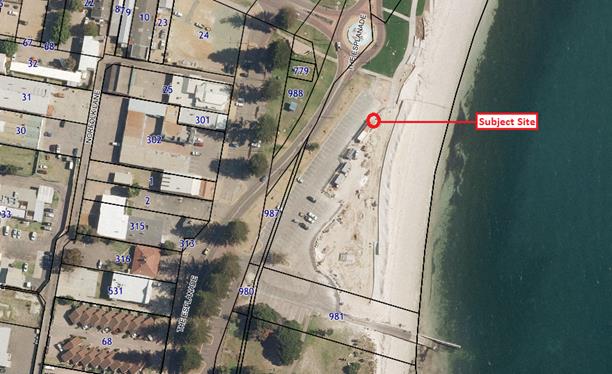
Executive Summary
For Council to consider Development Application
10.2016.3291.1 for a Wishing Well at Lot 991 The Esplanade, Esperance.
Recommendation in Brief
That Council approve Development Application
10.2016.3291.1 for a Wishing Well at Lot 991 The Esplanade, Esperance subject
to conditions.
Background
Correspondence was
received on 2 June 2016 from Mr Gary Ramm, asking what the application
requirements were for a proposal by The Esperance Rotary Club (Inc.) for the
construction of a Wishing Well on the Esperance Foreshore Reserve. Upon
discussions with Manager Strategic Planning and Land Projects and Director
External Services, it was determined that the best course of action was to
refer to initial proposal to Council to determine whether Council would support
the placement of the wishing well at the proposed location.
At the Ordinary Council Meeting held
on 28 June 2016, Council resolved to:
1. Authorise the
CEO to sign the application forms for the proposed Rotary Club of Esperance Inc
Wishing Well to be located on the Esperance Foreshore Reserve (Reserve 27318).
2. Apply the
following riders in addition to any development application determined under
delegated authority:
a. The Rotary Club
of Esperance Inc is to accept all liability associated with the location of the
wishing well;
b. All
maintenance of the wishing well is to be at the expense of the Rotary Club of
Esperance Inc;
c. The
removal of the wishing well is to be at the expense of the Rotary Club of
Esperance Inc should the removal of the wishing well be required; and
d. Any other cost
associated with the development will be at Rotary Club of Esperance Inc
expense.
e. The Shire of
Esperance (Councillors & Staff) and the Rotary Club of Esperance Inc
discuss and investigate alternative sites on reserve 27318.
3. Future requests
for development applications for development (not land use) on Reserve 27318
will be subject to the consent of Council unless associated with lease that has
the prior approval of Council.
Subsequently on 26 August 2016, a
formal application was submitted by Gary Ramm as representative of The Rotary Club of
Esperance (Inc.).
The Rotary Club of Esperance (Inc.) have also
requested that the fees be waived for this application.
Officer’s Comment
As part of the planning
for the Esperance Townsite Foreshore Redevelopment Master Plan, provisions were
made for a number of items of public art with no new artworks or monuments to
be placed until such time as the maintenance agreement had expired. A number of
requests have since been received for varying artworks and monuments on the
foreshore which have been refused as the maintenance agreement was still in
effect.
It is noted that this is
the first request for such a monument to be received since the maintenance
agreement expired.
As Wishing Well will be used to raise
funds for the local Community by The Rotary Club of Esperance (Inc.), it is
recommended that the development application and building services standard
application fees are waived to demonstrate Councils support for this service.
Options
Option 1: That Council approve Development
Application 10.2016.3291 for a Wishing Well on Reserve 27318 (Lot 991) The
Esplanade,
Esperance subject to the following conditions:
1. Development shall be carried out and
fully implemented in accordance with the details indicated on the stamped
approved plan(s) unless otherwise required or agreed in writing by the Shire of
Esperance (Planning Services).
2. The provision of all services,
including augmentation of existing services, necessary as a consequence of any
proposed development shall be at the cost of the developer and at no cost to
the Shire of Esperance.
3. The development hereby approved must
not create community safety concerns, or otherwise adversely affect the amenity
of the subject locality.
and the following Advice
Notes:
1. The
applicant is to liaise with Shire of Esperance (Parks and Gardens) to ascertain
the location of any and all shire infrastructure prior to the commencement of
works.
2. Any requirement to move,
relocate, repair or adjust existing shire infrastructure is to be at the cost
of the applicant.
3. The Rotary Club
of Esperance (Inc.) is to accept all liability associated with the location of
the wishing well;
4. Maintenance or
removal of the wishing well is to be at the expense of the Rotary Club of
Esperance (Inc.);
5. Any other cost
associated with the development will be at Rotary Club of Esperance (Inc.)
expense
6. It
is the responsibility of the developer to search the title of the property to
ascertain the presence of any easements and/or restrictive covenants that may
apply.
7. Horizon
Power has requested the Shire to advise Applicants that Horizon Power has
certain restrictions regarding the installation of conductive materials near
its network assets. Applicants are advised to contact Horizon Power’s
Esperance office to ascertain whether any of Horizon Power’s restrictions
affect their proposed development.
This is the
officer’s recommendation.
Option 2: That Council refuse Development Application
10.2016.3291 for a Wishing Well at Lot 991 The Esplanade, Esperance on the grounds that it
would create a precedence for further development on the Foreshore and is not
in accordance with the Esperance Townsite Foreshore Redevelopment Master Plan.
Consultation
Nil
Financial Implications
If the Application fee is waived $147.00 of fees will be
forgone.
On-going maintenance is to be cost of the Rotary Club of Esperance
(Inc.)
Asset Management Implications
On-going maintenance is to be cost of the Rotary Club of Esperance
(Inc.)
Statutory Implications
The statutory implications associated with this item are
· Planning and Development Act 2005
· Local Planning Scheme No. 23
Policy Implications
Nil
Strategic Implications
Strategic Community Plan 2012 - 2022
Economic
Facilitate and guide high
quality and efficient building and development across the Shire
A community with high
quality and efficient buildings and development
Environmental Considerations
Nil
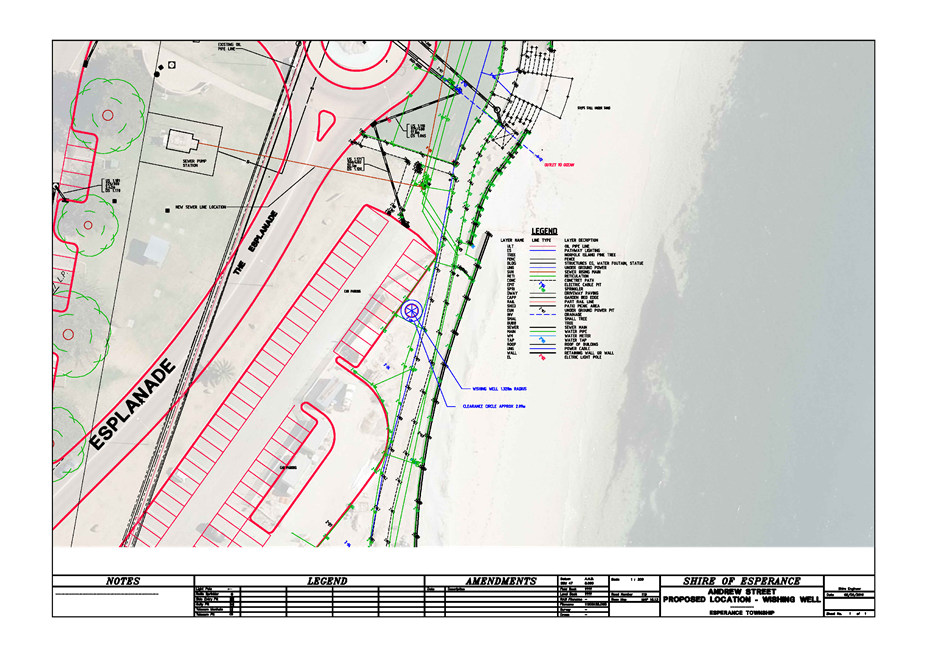
Attachments
|
a.
|
Site Plan
|
|
|
b.
|
Elevations
|
|
|
Officer’s Recommendation
That Council:
1. Approve
Development Application 10.2016.3291 for a Wishing Well on Reserve 27318 (Lot
991) The Esplanade, Esperance subject to the following conditions:
i. Development
shall be carried out and fully implemented in accordance with the details
indicated on the stamped approved plan(s) unless otherwise required or agreed
in writing by the Shire of Esperance (Planning Services).
ii. The provision
of all services, including augmentation of existing services, necessary as a
consequence of any proposed development shall be at the cost of the developer
and at no cost to the Shire of Esperance.
iii. The development
hereby approved must not create community safety concerns, or otherwise
adversely affect the amenity of the subject locality by reason of (or the
appearance or emission of) smoke, fumes, noise, vibration, odour, vapour,
dust, waste water, waste products or other pollutants.
and the following Advice Notes:
i. The
applicant is to liaise with Shire of Esperance (Parks and Gardens) to
ascertain the location of any and all shire infrastructure prior to the
commencement of works.
ii. Any
requirement to move, relocate, repair or adjust existing shire infrastructure
is to be at the cost of the applicant.
iii. The Rotary Club of
Esperance (Inc.) is to accept all liability associated with the location of
the wishing well;
iv. Maintenance or
removal of the wishing well is to be at the expense of the Rotary Club of
Esperance (Inc.);
v. Any
requirement to move, relocate, repair or adjust existing shire infrastructure
is to be at the cost of the applicant.
vi. It is the
responsibility of the developer to search the title of the property to
ascertain the presence of any easements and/or restrictive covenants that may
apply.
vii. Horizon Power has
requested the Shire to advise Applicants that Horizon Power has certain
restrictions regarding the installation of conductive materials near its
network assets. Applicants are advised to contact Horizon Power’s
Esperance office to ascertain whether any of Horizon Power’s restrictions
affect their proposed development.
2. Waive the
Development Application fees for Application Ref: 10.2016.3291 for a Wishing
Well on Reserve 27318 (Lot 991) The Esplanade, Esperance.
Voting Requirement Simple Majority
|
27 September 2016 Page
15
27 September 2016 Page
17

27 September 2016 Page
19
Item: 12.1.2
Esperance
Coastal Hazard Adaptation Strategy
|
Author/s
|
Richard Hindley
|
Manager Planning & Land Projects
|
|
Authorisor/s
|
Terry Sargent
|
Director External Services
|
File Ref: D16/21340
Applicant
Internal (Statutory Division)
Location/Address
Esperance Bay frontage of the Esperance Townsite
excluding the Port and Bandy Creek Boat Harbour
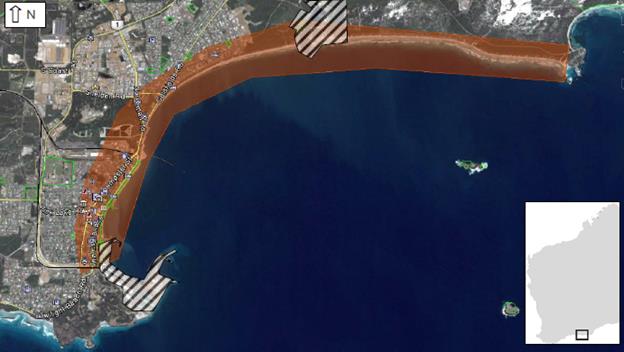
Executive Summary
For Council to receive the Esperance Coastal Hazard Adaptation
Strategy that has been prepared by BMT JFA Consultants on the behalf of the
Shire of Esperance.
Recommendation in Brief
That Council receive the Esperance Coastal Hazard Adaptation
Strategy.
Background
Coastal zones are vulnerable to
adverse impacts from inundation and erosion hazards. The extent of the hazards
is expected to increase in the future as it would be exacerbated by the
projected sea level rise associated with climate change.
Despite the uncertainty surrounding
the magnitude and extent of the adverse impact of combined sea level rise and
storm surge, early consideration of coastal hazards and the adaptation and
management of appropriate planning responses can provide economic,
environmental and social benefits.
The Esperance Coastal Hazard
Adaptation Strategy aims at reducing vulnerability to coastal hazards in the
developed and planned to be developed coastal zone of Esperance, and build the
long-term adaptive capacity of the Esperance community to manage coastal hazard
risk. The preparation of this strategy will assist in managing the
environmental significance of the Esperance coastline and the protection,
conservation and enhancement of the coastal values of the project area, by
ensuring that coastal hazard risk management and adaptation is appropriately
planned for.
The approach taken in the Strategy is fully consistent with
the State Planning Strategy and recognises the settlement strategies of the
Local Planning Strategy. Aspects of this strategy have already been
incorporated into draft Local Planning Scheme No. 24.
Officer’s Comment
The objectives of the Esperance Coastal Hazard Adaptation
Strategy are:
· To meet the requirements of the State
Planning Policy No. 2.6 State Coastal Planning Policy (WAPC, 2013) that are to:
– Ensure that development and the
location of coastal facilities takes into account coastal processes, landform
stability, coastal hazards, climate change and biophysical criteria
– Ensure the identification of
appropriate areas for the sustainable use of the coast for housing, tourism,
recreation, ocean access, maritime industry, commercial and other activities
– Provide for public coastal foreshore
reserves and access to them on the coast
– Protect, conserve and enhance coastal
zone values, particularly in areas of landscape, biodiversity and ecosystem
integrity, indigenous and cultural significance
· To provide a long term pathway to
reduce vulnerability to coastal hazards and build the long-term adaptive
capacity of the Esperance community to manage coastal hazard risk and to adapt
· To identify effective management and
adaptation measures and how these can be incorporated into short and longer
term decision making
· To be developed through a broad and
iterative engagement process that nurtures ownership of the challenges ahead
and the pathways to meet those challenges
· To be satisfactory to Department of
Planning, Department of Transport, Western Australian Planning Commission and
Department of Park and Wildlife.
The overarching aim of the project
is:
To reduce vulnerability to coastal hazards in the developed and planned
to be developed coastal zone of Esperance, and build the long-term adaptive
capacity of the Esperance community to manage coastal hazard risk.
It should be noted that the context
of this report is consistent with State Planning Policy No. 2.6 State Coastal
Planning Policy which is incorporated into Local Planning Scheme No. 23 by
reference.
The WA Planning Commission Statement
of Planning Policy No. 2.6: State Coastal Planning Policy provides guidance for
the incorporation of mean sea level change in the determination of a coastal
setback for new development.
As the rate of sea level rise is
projected to increase through the 21st century, it is recommended that the Fourth Assessment Report of the
Intergovernmental Panel on Climate Change projections for sea level rise up to 2100 be extended to
2110 to provide an estimate for a 100 year planning time frame. As a simple
estimate it is recommended that this be done by assuming that the rate of
global average sea level rise beyond 2100 will be a continuation of the rate of
rise between 2090 to 2100.
The guidance does not consider the changes to extreme water
levels which will occur as a result of sea level rise. However, future sea
level rise will increase the frequency, and potentially severity, of existing
storm inundation events and these impacts will need to be considered for new
and existing development.
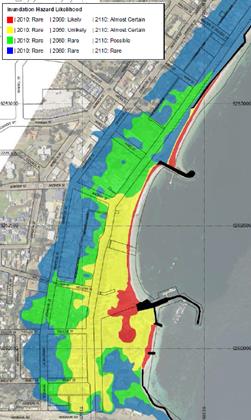
The Strategy uses a risk framework to assess the impact of
coastal process in accordance with SPP 2.6 and give high level guidance on the
adaptation measures that are available (Attachment A – under separate
cover). More detailed planning will be required in certain circumstances in the
future.
Consultation
Councillors and Public through a workshop 8 March 2016
Department of Planning
Department of Transport
Department of Parks and Wildlife
Financial Implications
The financial implications arising from this report will be
dependent on the adaptation option that is pursued, examples of which are
contained within the Strategy.
Asset Management Implications
Not applicable at this stage.
Statutory Implications
Outcomes of this Strategy may be incorporated into the Local
Planning Framework.
Policy Implications
Nil
Strategic Implications
Strategic Community Plan 2012 - 2022
Environment
Plan for and adapt to changes in our climate and the impacts
of increased water and energy vulnerability
A Shire which address the challenges
and opportunities presented by climate change and water and energy
vulnerability
Environmental Considerations
The Strategy assists in managing the environmental
significance of the Esperance coastline and the protection, conservation and
enhancement of the coastal values of the project area, by ensuring that coastal
hazard risk management and adaptation is appropriately planned for.
Attachments
|
a.
|
Esperance Coastal Hazard Adaptation
Strategy - Under Separate Cover
|
|
|
Officer’s Recommendation
That Council receive the Esperance
Coastal Hazard Adaptation Strategy.
Voting Requirement Simple Majority
|
27 September 2016 Page
23
Item: 12.1.3
Local
Planning Policy - Planning Compliance
|
Author/s
|
Richard Hindley
|
Manager Planning & Land Projects
|
|
Authorisor/s
|
Terry Sargent
|
Director External Services
|
File Ref: D16/21416
Applicant
Internal (Statutory Division)
Location/Address
Shire of Esperance
Executive Summary
For Council to consider proceeding with the amendment
of the Local Planning Policy – Planning Compliance without modification
under Clauses 4 and 5(1) of the Deemed Provisions (set out in the Planning
and Development (Local Planning Schemes) Regulations 2015 Schedule 2).
Recommendation in Brief
That Council proceed with the Local Planning Policy - Planning Compliance
without modification as per Attachment A in accordance with Clauses 4 and 5(1) of
the Deemed Provisions (set out in the Planning and Development (Local
Planning Schemes) Regulations 2015 Schedule 2).
Background
At the April 2015 Ordinary
Meeting of Council it was resolved (O0415-040):
That Council adopt the Local Planning Policy – Planning
Compliance with modifications in accordance with Clause 2.4.2 (b) of Local
Planning Scheme No. 23 as per Attachment A
Since this policy has been in place
it has become apparent that there are a number of scenarios where the
provisions of the policy cannot adequately address non-compliant development
and land use.
At the July 2016 Ordinary Meeting of
Council it was resolved (O0716-007):
That Council amend the Local Planning Policy – Planning
Compliance as per Attachment A in accordance with Clause 4 of the Deemed
Provisions (set out in the Planning and Development (Local Planning Schemes)
Regulations 2015 Schedule 2).
The amended policy has been prepared to provide a
consistent and easily identifiable approach to dealing with all planning
compliance matters and seeks to ensure there is transparency in all dealings.
During the advertising period no submissions were made on the amended policy.
Officer’s Comment
The objectives of this policy are to:
1. Define
whether a particular compliance matter is under the jurisdiction of the Shire;
2. Identify
the general criteria by which it is determined whether to take compliance
action or not;
3. Identify
specific circumstances where no further action will be taken;
4. Identify
in what instances a Planning Infringement Notice is issued;
5. Identify
in what instances a Directions Notice is issued; and
6. Outline
the general compliance procedure including the issue of infringements and
prosecution.
The original policy outlined one approach to addressing
non-compliance. The revised policy creates a different approach and now
classifies actions as follows:
1. Non
Compliance with a Condition of a Planning Approval
2. Other
Circumstances
· Minor Planning Offence
· Major Planning Offence
· Offence after advice stating that
approval is required
The procedure outlined in the Policy is:
4.1 Non Compliance
with a Condition of a Planning Approval
a. A letter will be sent seeking
clarification on the breach and provide an opportunity for the non compliance to be addressed voluntarily within
28 days or other appropriate time period given the nature of the non compliance. If the matter is not rectified in
the specified timeframe:
b. A letter is issued with a draft of an
Infringement requiring that the matter be rectified within 28 days or a $500
infringement will be issued;
c. A $500 Planning Infringement Notice
will be issued;
d. In the case of a major planning
offence as outlined under 4.2.2 in lieu of 4.1(b and c) a letter is issued with
a draft Directions Notice requiring that the matter be rectified within 28 days
or a Directions Notice will be issued; or
e. A Direction Notice will be issued
requiring the compliance matter to be resolved in line with the requirements of
Section 214 of the Planning and Development Act 2005 (this may include
obtaining retrospective development approval, stopping an unapproved use,
removing an unapproved structure or undertaking the prescribed work). If the
matter is not resolved, then the matter may proceed to legal action.
4.2 Other
Circumstances
In all other circumstances
4.2.1 For a minor planning offence (a minor
planning offence is a breach of the Scheme which has minimal impact on the
community, a community member, or the environment. The breach may be able to be
resolved in a relatively short timeframe without any further impact on the
community or the environment once compliance has been reached:
a. The investigating officer is to
negotiate with the alleged offender to reach compliance within a timeframe
commensurate with the non-compliance;
b. If Compliance is not achieved with
the specified timeframe a $500 Planning Infringement Notice will be issued;
c. A Direction Notice will be issued
requiring the compliance matter to be resolved within four (4) months (this may
include obtaining retrospective development approval, stopping an unapproved
use, removing an unapproved structure or undertaking the prescribed work). If
after four (4) months the matter remains unresolved, then the matter will be
referred to Council for consideration of the commencement of legal action.
4.2.2 For a major planning offence (a major
planning offence is a breach of the Scheme that significantly impacts or risks
the health and safety of the community, a community member, or the environment.
It may also be the case whether the issue cannot be resolved in a relatively
short time frame or where the alleged offender is not willing to cooperate or
negotiate to achieve compliance:
a. The investigating officer is
to negotiate with the alleged offender to reach compliance within a timeframe
commensurate with the non-compliance;
b. A Direction Notice will be
issued requiring the compliance matter to be resolved within four (4) months
(this may include obtaining retrospective development approval, stopping an
unapproved use, removing an unapproved structure or undertaking the prescribed
work). If after four (4) months the matter remains unresolved, then the matter
will be referred to Council for consideration of the commencement of legal action.
4.2.3 For a minor or major planning offence that
occurs after advice stating that the use/development needs to be approved
before commencing or if the offence is a repeat of an earlier offence:
a. A $500 Planning Infringement
Notice will be issued.
The policy then outlines the
circumstances where action may or may not be taken. Where action is taken a
clear procedure is established which will allow the administration to ensure
that all compliance actions will be undertaken in a consistent manner.
The aim is to achieve compliance
either by seeking retrospective planning approval or undertaking works to bring
something into compliance. The issuance of a Planning Infringement Notice or
Directions Notice is only used where there is not progress towards resolving a
non compliance.
There is one exception to this in the final category being an
offence occurring after advice has been given stating that approval is required
without that approval being obtained. There have been a number of uses,
generally short term in nature (an example being the inflatable circus signs
that were recently prolific around Esperance) that have occurred after being
advised that planning approval has been required. In these instances it is
proposed to issue a Planning Infringement Notice as the first point of contact.
Consultation
As this policy is being amended under Clause 4 of the Deemed Provisions
(set out in the Planning and Development (Local Planning Schemes)
Regulations 2015 Schedule 2 the policy was advertised for 21 days between
the 5th August 2016 closing on the 26th August 2016. No
submissions were received.
Financial Implications
The financial implications arising from this report are a
potential increase in infringement income and potential increases in legal fee
if prosecution for non-compliance is undertaken.
Asset Management Implications
Nil
Statutory Implications
Division 2 of Part 2 of the Deemed Provisions (set out in the
Planning and Development (Local Planning Schemes) Regulations 2015 Schedule 2)
Planning and Development Act 2005
Policy Implications
This item relates to policy development.
Local Planning Policies are guidelines used to assist the
local government in making decisions under the Local Planning Scheme and may
address land use as well as development requirements. Although Local Planning
Policies are not part of the Local Planning Scheme they must be consistent
with, and cannot vary, the intent of the Local Planning Scheme provisions. In
considering an application for Planning Approval, the local government must
have due regard to a Local Planning Policy as required under Clauses 3(5) and
67 of the Deemed Provisions (set out in the Planning and Development (Local
Planning Schemes) Regulations 2015 Schedule 2.
Strategic Implications
Strategic Community Plan 2012 - 2022
Economic
Facilitate and guide high
quality and efficient building and development across the Shire
A community with high
quality and efficient buildings and development
Environmental Considerations
Nil
Attachments
|
a.
|
Local Planning Policy - Planning
Compliance
|
|
|
Officer’s Recommendation
That Council proceed
with the Local Planning Policy - Planning Compliance without modification as
per Attachment A in accordance with Clauses 4 and 5(1) of the Deemed
Provisions (set out in the Planning and Development (Local Planning
Schemes) Regulations 2015 Schedule 2).
Voting Requirement Simple Majority
|
27 September 2016 Page
27
|
Policy
Name:
|
Planning Compliance
|
|
Objective:
|
To provide
a standardised process for planning compliance within the Shire of Esperance
and to provide clear criteria for officers making decisions relating to
compliance.
|
|
Key
Words
|
Planning Compliance, Compliance
|
|
Statutory
Compliance
|
Local Planning Scheme No. 23
|
POLICY
Objectives
The objectives of this policy are
to:
1. Define
whether a particular compliance matter is under the jurisdiction of the Shire;
2. Identify
the general criteria by which it is determined whether to take compliance
action or not;
3. Identify
specific circumstances where no further action will be taken;
4. Identify
in what instances a Planning Infringement Notice is issued;
5. Identify
in what instances a Directions Notice is issued; and
6. Outline
the general compliance procedure including the issue of infringements and
prosecution.
Operation of the Policy
Unless the relevant legislation
provides otherwise or the Chief Executive Officer following legal advice
determines otherwise, the owner(s) or occupier(s) of the property or other
applicable person(s) that are in breach of the relevant legislation shall be the
subject of compliance action in accordance with this policy.
The statutes in respect of which
this policy will operate include the Planning and Development Act 2005 and
Shire of Esperance Local Planning Scheme No. 23.
The policy assumes the precedence
of planning over building compliance matters in most instances (except for
dangerous buildings).
Separate action may be undertaken
under the Building Act 2011 concurrently with any action undertaken under this
Policy.
Policy Statement
Compliance matters will be
investigated in the following order:
1.0 Jurisdiction
On receipt or notification of any
compliance issue, the jurisdiction of the Shire of Esperance will first be
determined.
Any compliance issue falling
outside the jurisdiction of the Shire of Esperance will be referred to the
authority with jurisdiction for action, and any complainant advised as such. No
further action will be taken by the Shire of Esperance.
In the case of development that has
occurred prior to 27 September 1991 no action will be taken by the Shire unless
documentation relating to the development is on file. This is due to the
accidental destruction of some planning approvals prior 1990 and the date
coincides with the gazettal of Town Planning Scheme No. 22.
2.0 Priority
Where a Shire Officer has
reasonable grounds to believe that non-compliant activity may be occurring on
land within the Shire, compliance issues will be progressed in accordance with
the following priorities (in order), irrespective of the number or frequency of
complaints received:
a) Any
matter that presents a danger or other circumstances that demand an immediate
response.
b) Any
matter involving irreversible and permanent damage to a building or place on
the State Register of Heritage Places or a Heritage List established under
Local Planning Scheme No. 23, or to the natural environment.
c) All
other compliance issues not meeting these priorities will be progressed in the
order in which they arise.
Complaints relating to compliance
issues are:
1. Required
to be in writing and include specific details of the compliance matter;
2. Complaints
not in writing that are file noted or included in a running sheet; or
3. Identified
during any compliance audit undertaken by the Shire.
Anonymous complaints cannot be
investigated as it is not possible to undertake due process to ensure
procedural fairness.
3.0 Circumstances
Where the Shire May Take No Further Compliance Action
The Shire may, following the
consideration of a report and having regard to any legal or technical advice,
resolve to take no further compliance action in the following circumstances.
3.1 Uncertainty of Compliance
Where, after reasonable
investigation, it is uncertain that a matter is compliant with planning or
building requirements, or it is uncertain whether it is capable of enforcement
owing to:
a) A
lack of precision in the plans / documents of any relevant approval; or
b) A
lack of certainty at the time of development as to the legal status of the
development or the requirement to obtain approval; or
c) Any
other legal consideration.
3.2 Matter Considered Trivial or
Insignificant
Where there is a breach of planning
or building requirements and the matter may reasonably be considered trivial or
insignificant.
For the purposes of this policy, a
matter will be considered to be trivial or insignificant only where the extent
of the non-compliance is minor to the point where the distinction between
complying and not complying with the relevant legislation is unnoticeable other
than to a person well versed in the relevant law;
3.3 Other Circumstances
Where it has been established that
a breach of planning or building requirements has occurred and that the breach
is neither trivial nor insignificant, The Executive Manager Statutory Division
or Manager Development Compliance may determine not to take action where a
matter meets all of the following criteria:
a) It
can be established that the development the subject of the breach has been in
existence for a substantial time period; and
b) The
development has no apparent impact on the amenity of adjoining properties, the
streetscape, or the locality; and
c) The
development is, in the opinion of the Principal Building Coordinator, or other
appropriately qualified officer, structurally sound.
3.4 Historic Usage
In situations where a use has been
in operation since before 1990 it is considered unreasonable to consider that
documentary evidence of land use approval will still exist due to potential
destructions and changes to business ownership. This will only apply when the
Shire has no records in relation to the relevant approvals.
4.0 Compliance
Procedure
If part 3.0 of the policy above is
not satisfied, the following will apply in sequence:
4.1
Non Compliance with a Condition of a Planning Approval
a) A
letter will be sent seeking clarification on the breach and provide an
opportunity for the non compliance to be addressed voluntarily within 28 days
or other appropriate time period given the nature of the non compliance. If the
matter is not rectified in the specified timeframe:
b) A
letter is issued with a draft of an Infringement requiring that the matter be
rectified within 28 days or a $500 infringement will be issued;
c) A
$500 Planning Infringement Notice will be issued;
d) In
the case of a major planning offence as outlined under 4.2.2 in lieu of 4.1(b
and c) a letter is issued with a draft Directions Notice requiring that the
matter be rectified within 28 days or a Directions Notice will be issued; or
e) A
Direction Notice will be issued requiring the compliance matter to be resolved
in line with the requirements of Section 214 of the Planning and Development
Act 2005 (this may include obtaining retrospective development approval,
stopping an unapproved use, removing an unapproved structure or undertaking the
prescribed work). If the matter is not resolved, then the matter may proceed to
legal action.
4.2 Other
Circumstances
In
all other circumstances
4.2.1 For
a minor planning offence (a minor planning offence is a breach of the Scheme
which has minimal impact on the community, a community member, or the
environment. The breach may be able to be resolved in a relatively short
timeframe without any further impact on the community or the environment once
compliance has been reached:
a) The
investigating officer is to negotiate with the alleged offender to reach
compliance within a timeframe commensurate with the non-compliance;
b) If
Compliance is not achieved with the specified timeframe a $500 Planning Infringement
Notice will be issued;
c) A
Direction Notice will be issued requiring the compliance matter to be resolved
within four (4) months (this may include obtaining retrospective development
approval, stopping an unapproved use, removing an unapproved structure or
undertaking the prescribed work). If after four (4) months the matter remains
unresolved, then the matter will be referred to Council for consideration of
the commencement of legal action.
4.2.2 For
a major planning offence (a major planning offence is a breach of the Scheme
that significantly impacts or risks the health and safety of the community, a
community member, or the environment. It may also be the case whether the issue
cannot be resolved in a relatively short time frame or where the alleged
offender is not willing to cooperate or negotiate to achieve compliance:
a) The
investigating officer is to negotiate with the alleged offender to reach
compliance within a timeframe commensurate with the non-compliance;
b) A
Direction Notice will be issued requiring the compliance matter to be resolved
within four (4) months (this may include obtaining retrospective development
approval, stopping an unapproved use, removing an unapproved structure or
undertaking the prescribed work). If after four (4) months the matter remains
unresolved, then the matter will be referred to Council for consideration of
the commencement of legal action.
4.2.3 For
a minor offence that occurs after advice stating that the use/development needs
to be approved before commencing or if the offence is a repeat of an earlier
offence:
a) A
$500 Planning Infringement Notice will be issued.
4.3 All
notices must comply with legislative requirements including notification of the
right of appeal to the State Administrative Tribunal
4.4 Where
legal action is being contemplated consideration must be given to admissible
evidence that establishes the offence beyond all reasonable doubt.
Consideration must also be given to whether or not there is a reasonable
prospect of conviction.
5.0 Discretionary
Criteria
Where there are extenuating
circumstances to depart from the terms of this policy, the Development
Compliance Officer will prepare a report which will be referred to the
Executive Management Team, having regard to the following general criteria:
a) Whether
it is in the public interest of the proper and orderly development and use of
land that the applicable law(s) should generally be complied with;
b) The
impact of the contravention of the law on the affected locality and environment.
This includes a consideration of whether the breach complained of is purely
technical in nature which is unnoticeable other than to a person well versed in
the relevant law;
c) Those
factual circumstances in which the contravention of the law took place;
d) The
time which has elapsed since development was undertaken in contravention of the
law;
e) The
expense and inconvenience which would be involved in remedying the
contravention of the law;
f) The
extent of amenity impact the contravention may have on adjoining properties and
the locality; and
g) Any
potential liability the Shire is subject to if compliance is not resolved.
If the Discretionary Criteria are
acted on they will be reported to Council via the monthly Information Bulletin.
NOTE
1: An Planning
Infringement Notice must be issued within 6 months of the Shire determining that an
offence has occurred.
NOTE
2: A
planning prosecution must commence within 12 months of the Shire determining
that an offence has occurred.
NOTE
3: Failure to
comply with a Direction Notice is an offence under Section 214(7) of the
Planning and Development Act 2005. Under Section 223 of the Act, a person
who commits an offence under this Act is liable to a fine of $200,000 and in
the case of a continuing offence, a further penalty of $25,000 for each day on
which the offence continues.
NOTE
4: A
Direction Notice issued under Section 214 of the Planning and Development Act
2005 is generally issued with a term not less than 60 days.
NOTE
5: The
person(s) to whom a Direction Notice has been issued, may within twenty eight
(28) days of the date of service of the Direction Notice, apply to the State
Administrative Tribunal for a review of the decision. The
contact details for the State Administrative Tribunal will be set out at the
end of a Direction Notice.
27 September 2016 Page
32
Item: 12.1.4
Community
Grants Program - Request for Repurpose of Funds
|
Author/s
|
Lynda Horn
|
Community Development Officer
|
|
Authorisor/s
|
Terry Sargent
|
Director External Services
|
File Ref: D16/20800
Applicant
R&SL Esperance Sub Branch
Location/Address
N/A
Executive Summary
The R&SL Esperance Sub Branch are seeking a
repurpose of grant funds allocated in the 2016/2017 Community Grants Program.
Recommendation in Brief
That Council accepts the R&SL Esperance Sub Branch
proposed change of project and approves Community Grant Program funding to the
value of $5,282.50 for the hire of the Civic Centre and interactive display.
Background
At the Ordinary Council
meeting on 28 June 2016 (O0616-029), Council allocated under the Community
Grants Program Events Category, the R&SL Esperance Sub Branch Entrenchment
Project up to $10,000 towards the hire cost of the Civic Centre.
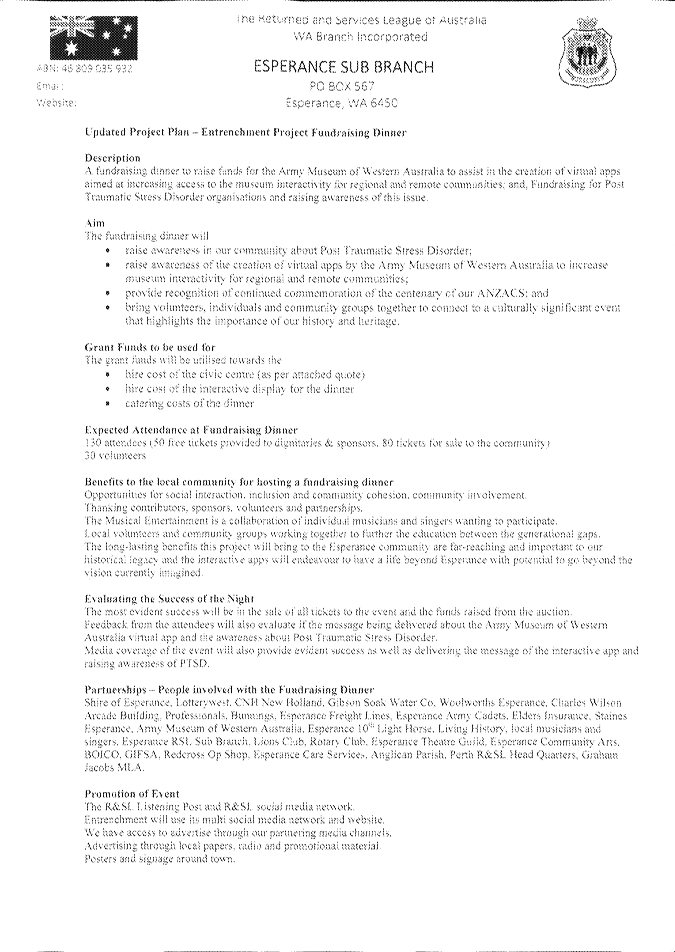
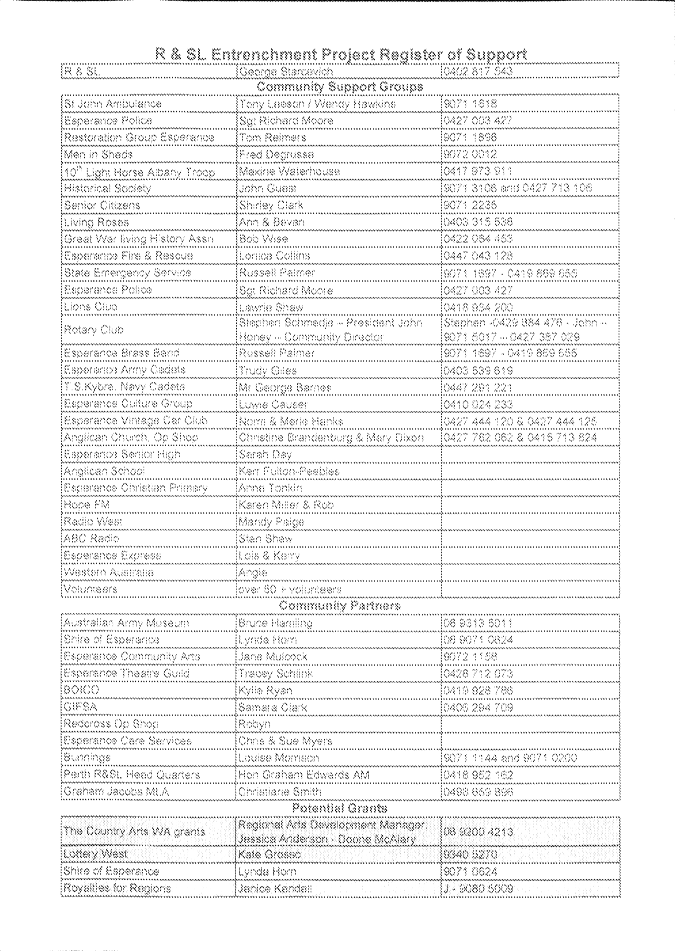
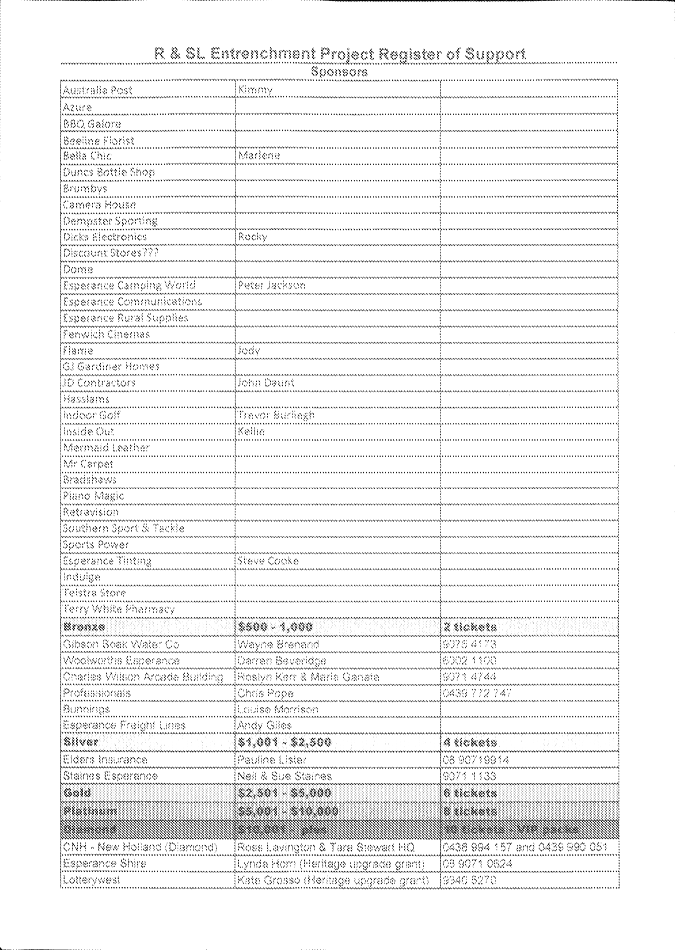
The Community Grants
Program application from the R&SL Esperance Sub Branch, details the
Entrenchment Project as a theatre production based on a family exposed to war.
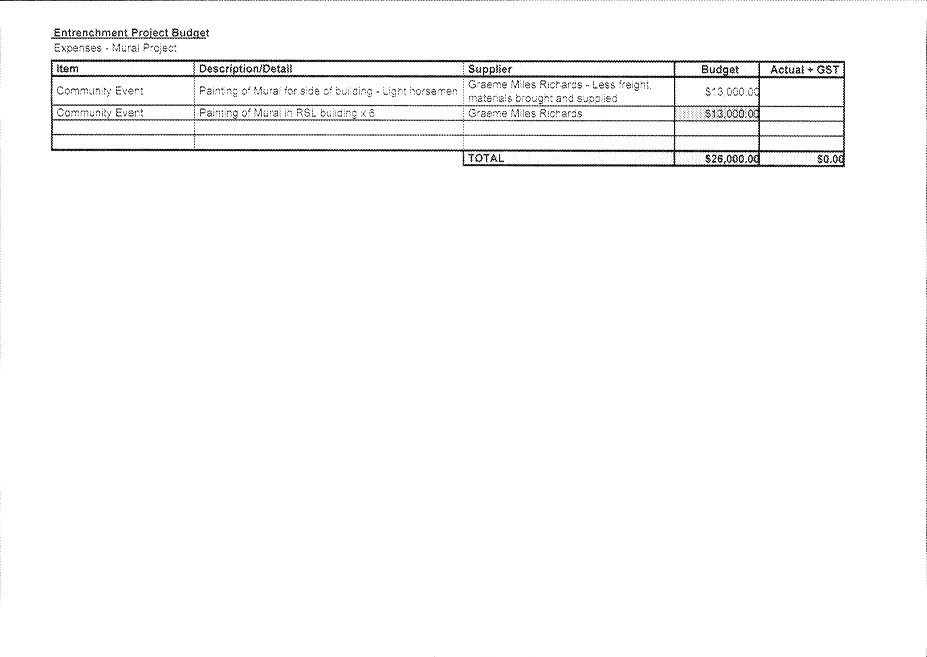
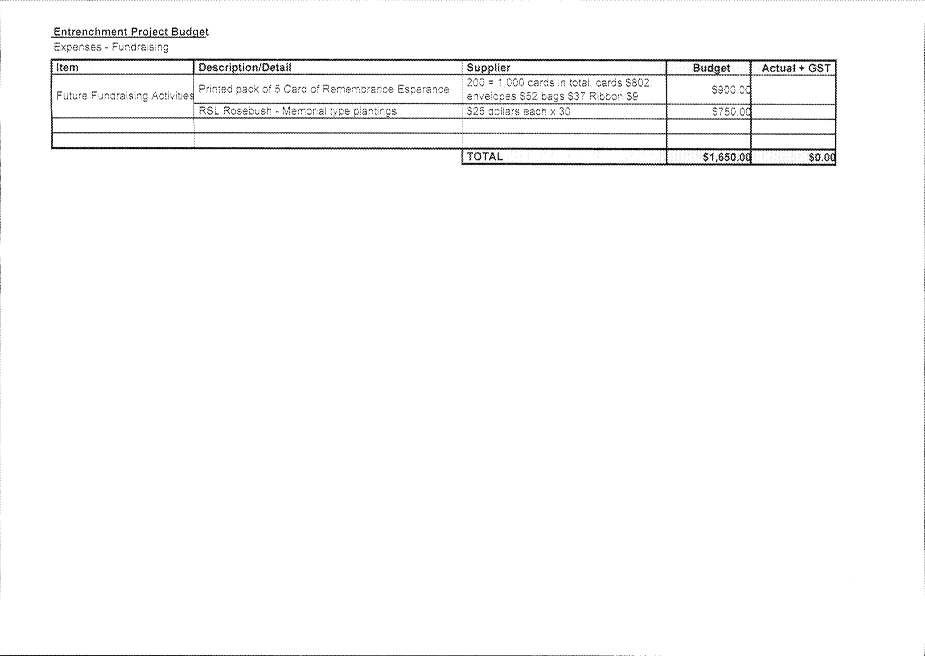
In addition, further
components of the community project involve murals and subsequent fundraising
for the Army Museum of Western Australia Virtual Apps creation and Post
Traumatic Stress Disorder (PTSD) organisations.
The theatre production
required additional grant funding to ensure its development and actual
performance. Unfortunately the R&SL Esperance Sub Branch has not been able
to secure additional funding for the theatre production and has taken time to
reassess their position and focus. The decision has been made to postpone the
theatre production until 2018, which will enable additional time to seek
further support and financial assistance.
The R&SL Esperance Sub
Branch are still continuing with their project and are seeking to repurpose the
grant fund allocation in support of these continuing efforts. Rather than
conducting a theatre performance the organisation is now focused on hosting a
fundraising dinner on Friday 11 November to raise funds for the Army Museum of
Western Australia Virtual Apps creation and Post Traumatic Stress Disorder
(PTSD) organisations and raising awareness of PTSD within the Esperance
community.
The fundraising dinner
event will involve an auction, provide musical performances from the theatre
production as entertainment and an interactive military display. The
organisation is also offering the interactive military display for inclusion in
the Freedom of Entry event and community markets on the 12th
November weekend.
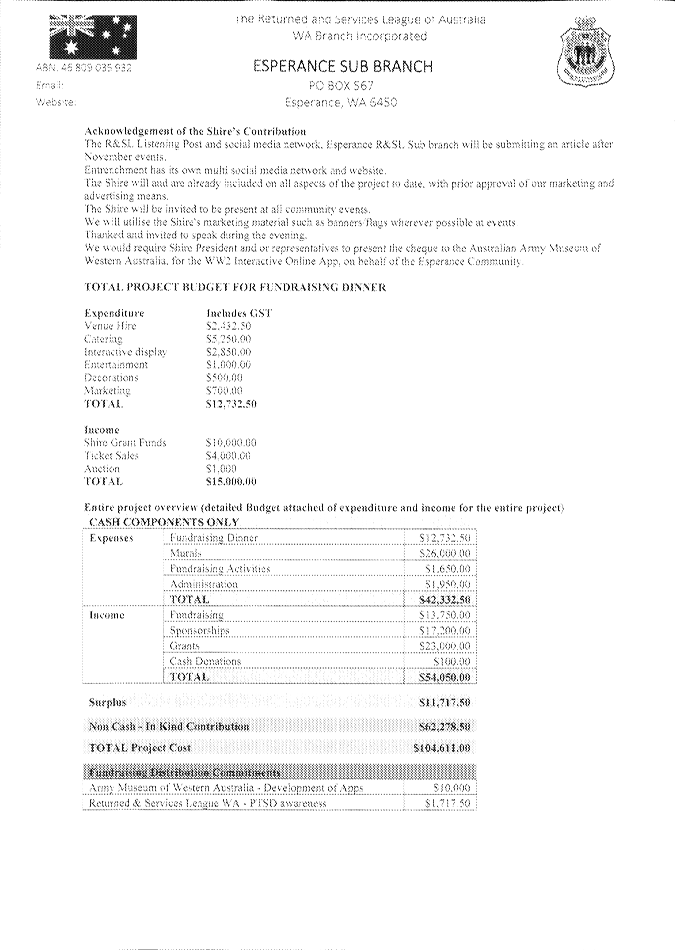
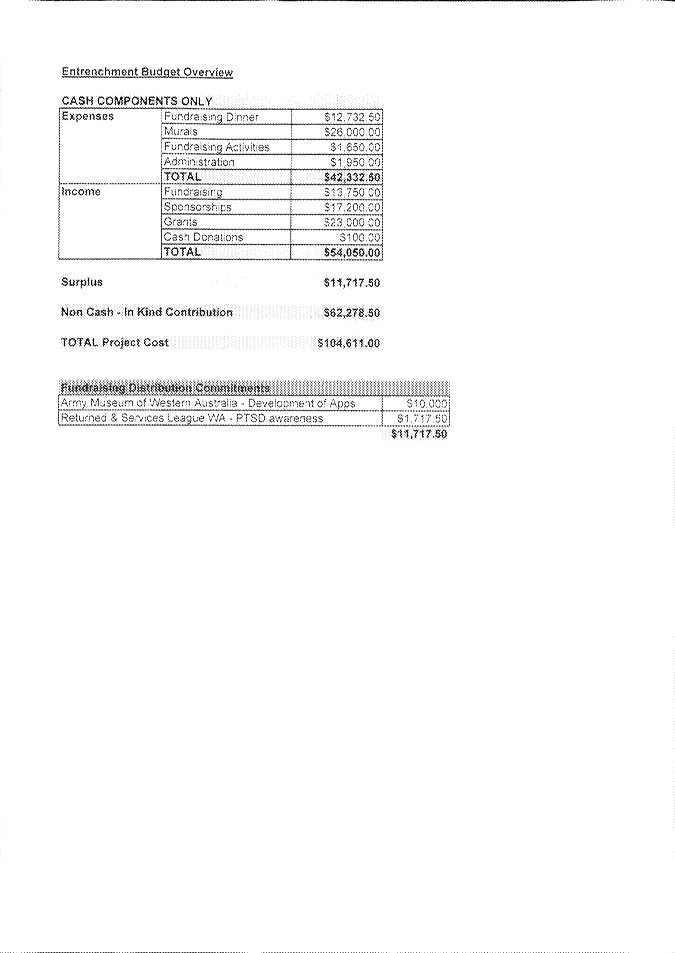
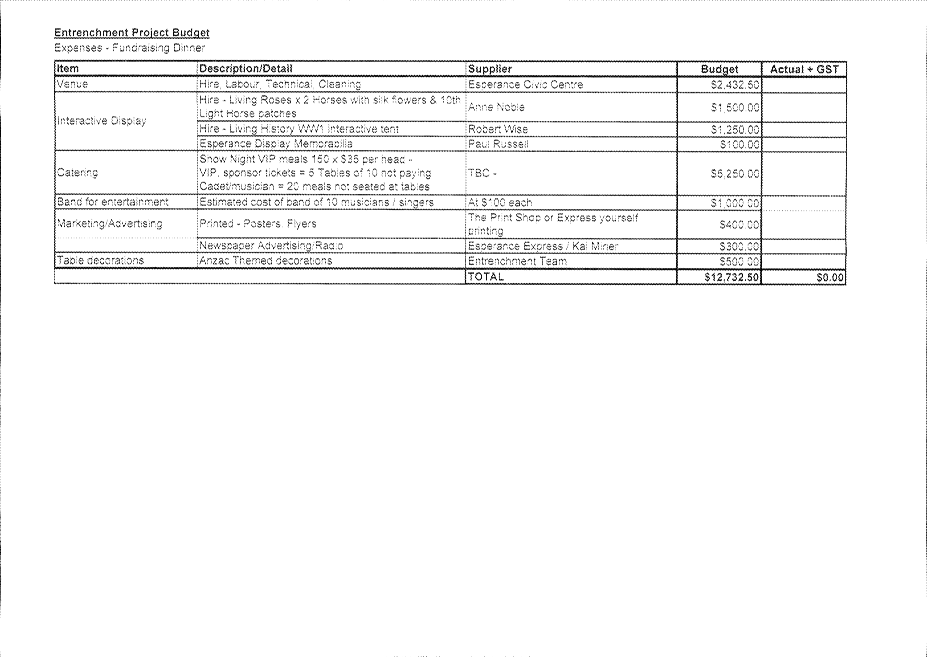
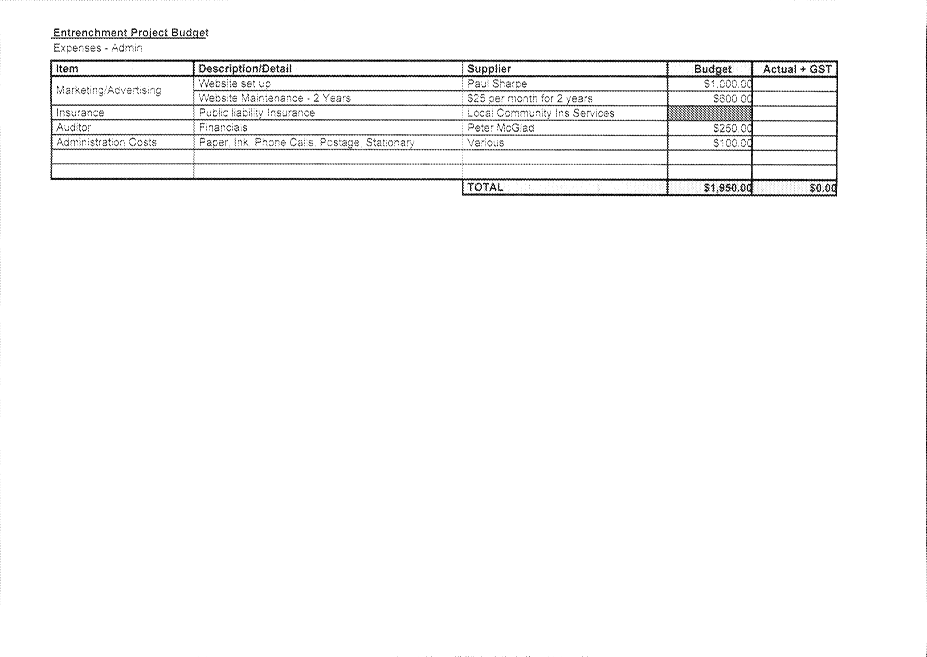
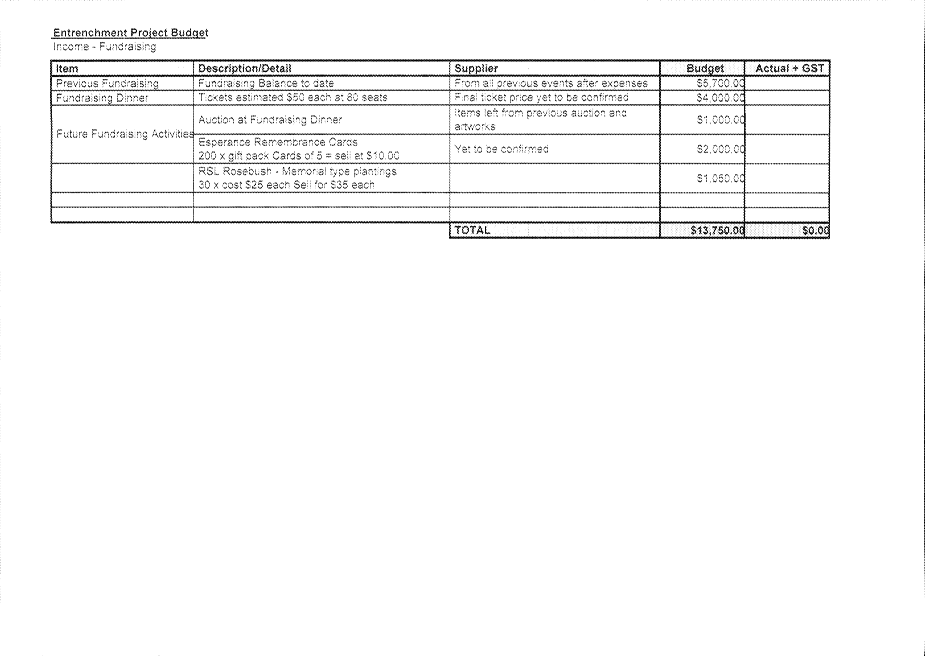
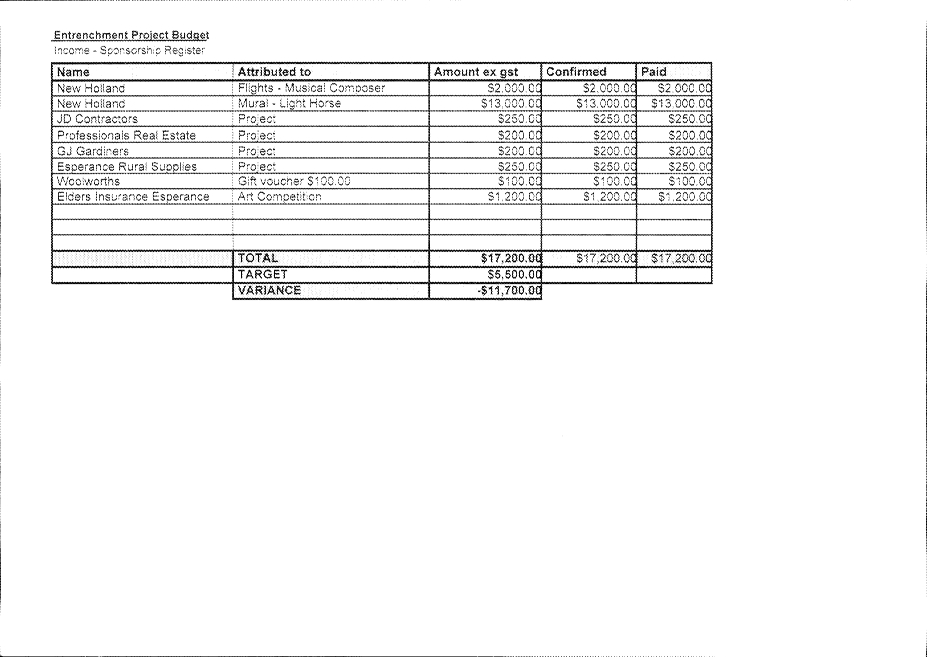
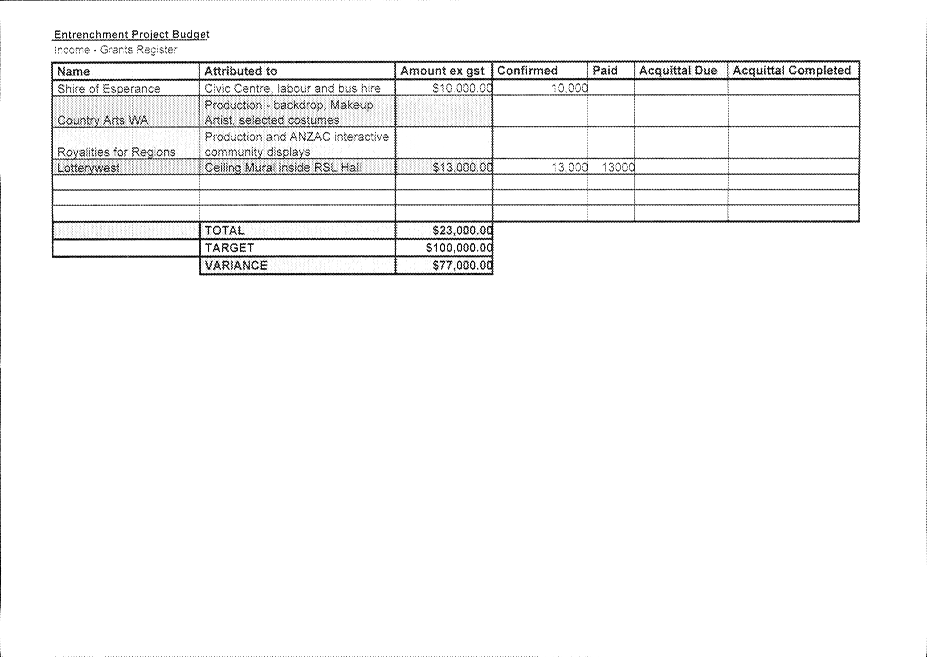
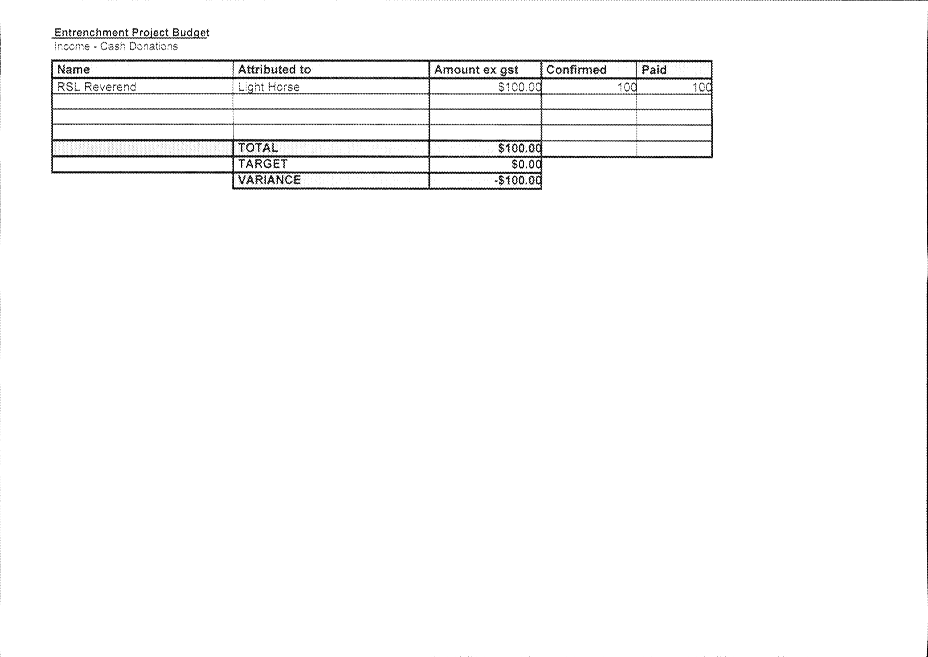
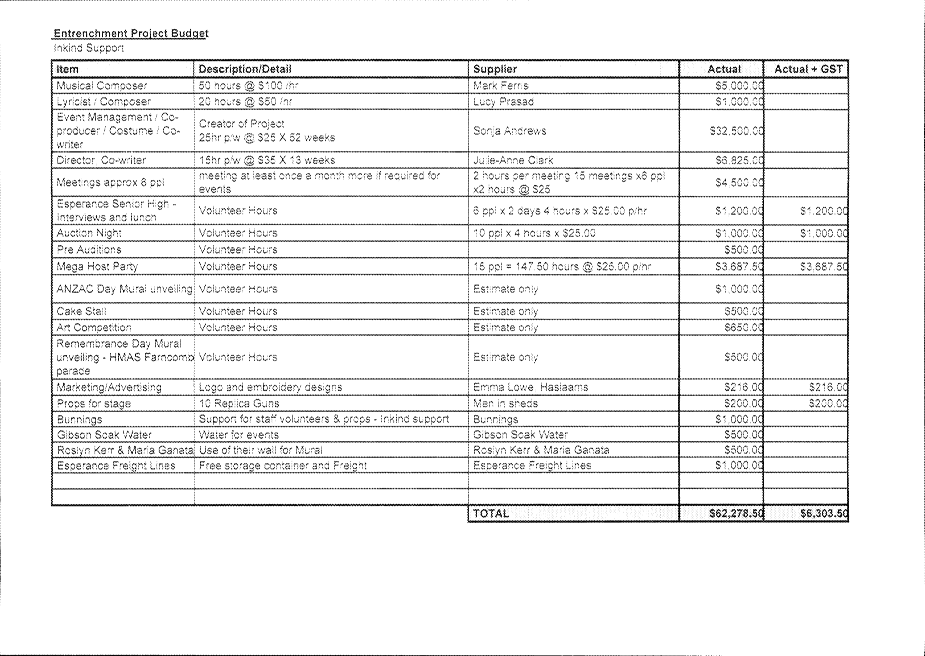
The R&SL Esperance Sub Branch have submitted an
updated project plan and budget (see attachment A). The updated project plan
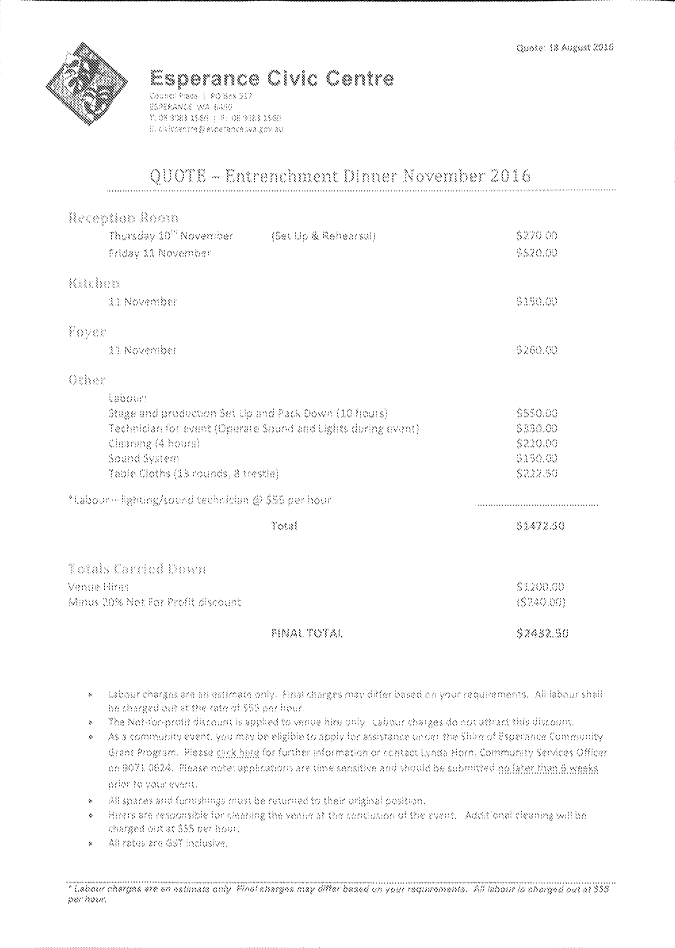
requests that the grant funds be set at $10,000 and the repurpose of the grant
funds towards the Civic Centre venue hire (quoted at $2,432.50), costs of
catering (quoted at $5,250.00) and cost of the Interactive display (quoted at
$2,850.00) for the fundraising dinner.
Officer’s Comment
The Community Grants Program
guidelines state the following:
· Grants provided under the Community
Grants Program must only be spent on the project as approved by Council;
· If the situation arises where the
event, project, activity or attendance does not occur the monies shall be
reimbursed to the Shire in full;
· Any changes to the project that would
result in funding being expended other than as detailed in the application may
not be undertaken without prior written approval from the Shire;
While the project has changed from
the initial application, the R&SL Esperance Sub Branch are committed
towards achieving their desired outcomes. Continued Shire support of this
project can be achieved, in line with the original approval, through the hire
of the Civic Centre. Additional support of the project can be achieved through
funding to hire of the interactive display, which will provide a wider
community benefit with the display being used at the community events on the
Thursday evening Freedom of Entry and Saturday Markets.
If Council does not support the
officer’s recommendation the alternative options are:
1. Does
not support the proposed change of project and withdraws funding;
2. Supports
the change of project at an alternate level of funding to the amount
recommended by officers.
Consultation
N/A
Financial Implications
An allocation of up to $10,000 has already been included in
the 2016/2017 annual budget, so there are no financial implications on this
occasion.
Asset Management Implications
N/A
Statutory Implications
N/A
Policy Implications
N/A
Strategic Implications
Strategic Community Plan 2012 - 2022
Social
Encourage and support
volunteers and community groups
Active and growing
volunteer and community groups
Corporate Business Plan 2013/2014 – 2016/2017
1.4.1 Manage the Community Grants Program
Environmental Considerations
N/A
Attachments
|
a.
|
Request for Repurpose of Grant
Funds Letter from RSL
|
|
|
Officer’s Recommendation
That Council accepts the R&SL Esperance Sub Branch
proposed change of project and approves Community Grants Program funding to
the value of $5,282.50 for hire of the Civic Centre and interactive display.
Voting Requirement Simple Majority
|
27 September 2016 Page
35


27 September 2016 Page
41
27 September 2016 Page
51
27 September 2016 Page
53
Item: 12.1.5
Novation
of Contract - Tender 02/08 Waste and Recycling Collection Services
|
Author/s
|
Scott McKenzie
|
Manager Council Enterprises
|
|
Authorisor/s
|
Terry Sargent
|
Director External Services
|
File Ref: D16/21641
Applicant
Cleanaway Pty Ltd
Location/Address
N/A
Executive Summary
Warren Blackwood Waste has recently been purchased by
Cleanaway Pty Ltd, requiring the contract to be novated to Cleanaway Pty Ltd.
Recommendation in Brief
That Council authorise the Common Seal to be affixed
to the Novation of Contract Document for the Provision of Waste and Recycling
Collection Services as per Tender 02/08 from Warren Blackwood Waste to
Cleanaway Pty Ltd.
Background
Tender 02/08 for the Provision of Waste and Recycling
Collection Services was considered by Council during the Ordinary Council
Meeting held on 24th February 2009. The 5 year tender was
awarded to Warren Blackwood Waste and expired on 30th June 2014.
Under the terms of the Tender, Warren Blackwood were
offered a 5 year extension to 30th June 2019 during the Ordinary
Council Meeting on 25th February 2014. This was duly accepted
by Warren Blackwood Waste.
Officer’s Comment
Warren Blackwood recently entered into a binding sale
agreement to sell certain assets to Cleanaway Pty Ltd. The assets subject
to the sale included certain contracts and these contracts are required to be
novated to Cleanaway Pty Ltd so that the service can continue.
Effectively, any reference to Warren Blackwood Waste
within the tender documentation becomes Cleanaway Pty Ltd. There is no
extension to the contract dates or amendment to charges.
Consultation
Nil
Financial Implications
Nil
Asset Management Implications
Nil
Statutory Implications
The Common Seal can only be affixed to documents following
authorisation by Council as per Section 9.49A(4) of the Local Government Act
1995.
Policy Implications
Nil
Strategic Implications
Strategic Community Plan 2012 - 2022
Environment
Sustainably manage our
waste, water, energy use and facilities and investigate opportunities to reduce
their impacts on our environment
A sustainable and
progressive approach to managing the impacts of waste, water and energy use on
the environment
Corporate Business Plan 2013/2014 – 2016/2017
2.5.5 Manage waste and recycling facilities and programs
Environmental Considerations
Nil
Attachments
|
a.
|
Novation of Contract Document -
Warren Blackwood to Cleanaway - Confidential
|
|
|
Officer’s Recommendation
That Council authorise the Common
Seal to be affixed to the Novation of Contract Document for the Provision of
Waste and Recycling Collection Services as per Tender 02/08 from Warren
Blackwood Waste to Cleanaway Pty Ltd
Voting Requirement Simple Majority
|
27 September 2016 Page
55
Item: 12.1.6
Development Application
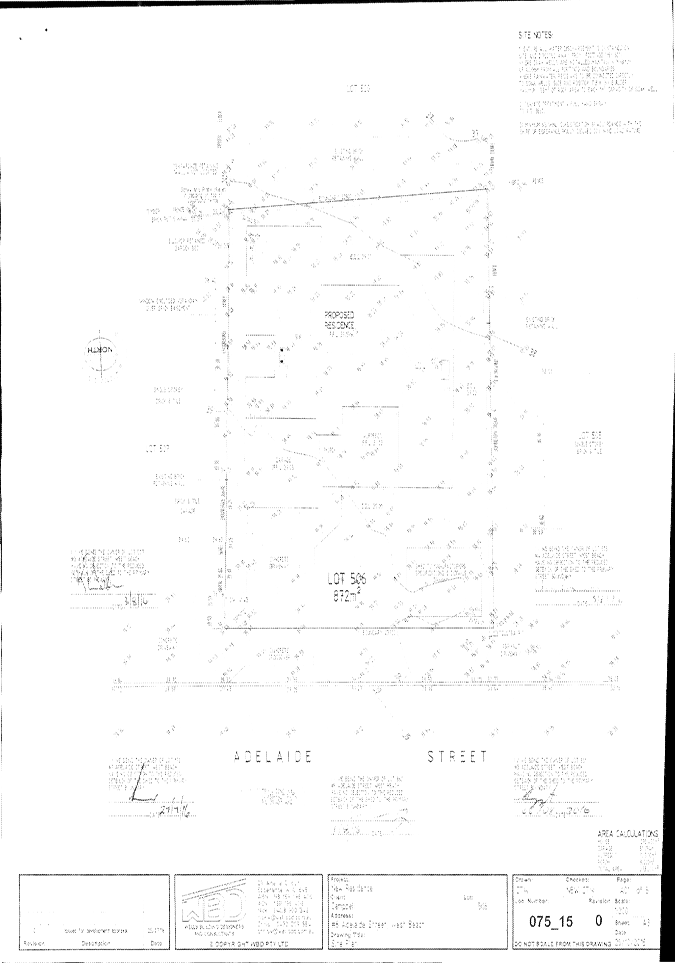
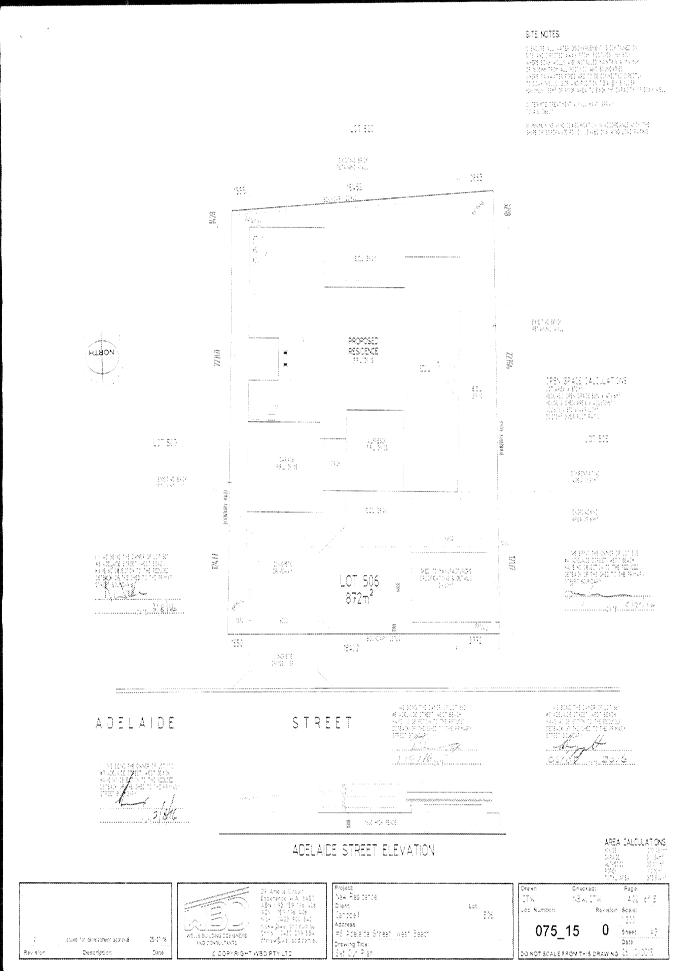
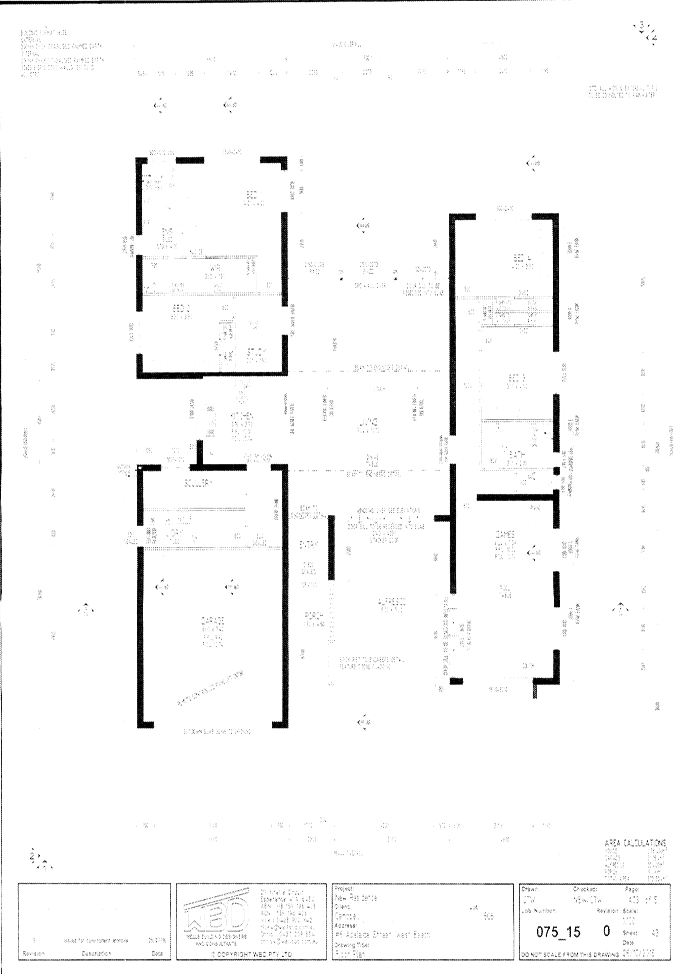
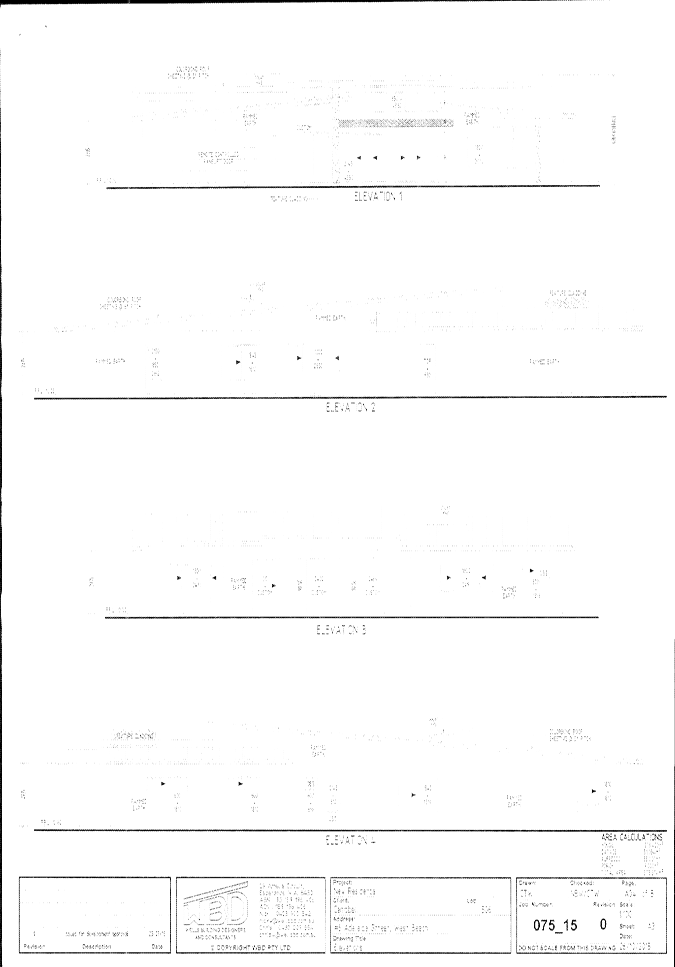
- Single Dwelling and Outbuilding (Shed) - Lot 506 (6) Adelaide Street, West
Beach
|
Author/s
|
Peter Wilks
|
Senior Planning Officer
|
|
Authorisor/s
|
Richard Hindley
|
Manager Planning & Land Projects
|
File Ref: D16/21766
Applicant
M & R Campbell
Location/Address
Lot 506 (6) Adelaide Street, West Beach
Executive Summary
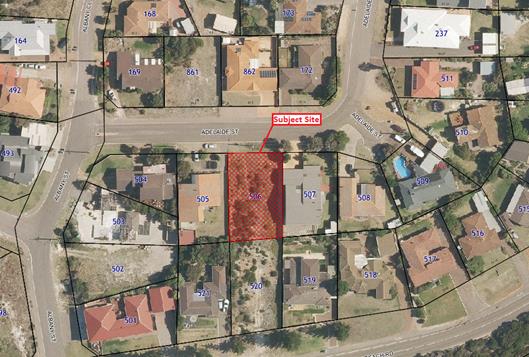
For Council to consider Development Application
2016.3275.1 for a Single Dwelling, Outbuilding (Shed) and Overheight Front
Fence at Lot 506 (6) Adelaide Street, West Beach.
Recommendation in Brief
That Council resolve to approve the Dwelling proposed
as part of Development Application 2016.3275.1 and resolve to refuse the
Outbuilding (Shed) at Lot 506 (6) Adelaide Street, West Beach due to
non-compliance with the Residential Design Codes and Local Planning Policy:
Outbuildings.
Background
An application was
received on 8 August 2016 for a Single Dwelling and Outbuilding (Shed) on lot
506 (6) Adelaide Street, West Beach.
The proposal has been
referred to Council due to the nature of the proposed variation to the Primary
Street Setback for the proposed Outbuilding (Shed). The proposed Dwelling and
over height Front Fence are acceptable to Planning Services.
The retaining walls and associated earthworks marked
on the plans were approved under delegated authority as part of Planning
Application 10.2016.3235.1.
Officer’s Comment
The subject land is zoned Residential R12.5. Under the
Residential Design Codes, all buildings in the Residential zone must
comply with one of the following three criteria for setback from the primary
street:
- A
standard setback of 7.5 metres;
- The
average setback of the dwellings on both sides;
- A
reduction of up to 50 per cent provided that the area of any building including
a carport or garage, intruding into the setback area is compensated for by at
least an equal area of open space between the setback line and drawn parallel
to it at twice the setback distance.
The proposal calls for a 1.001 metre setback
for the proposed Outbuilding (Shed). The proposed setback is not consistent
with the Residential Design Codes. The prevailing setback within this
zone is 7.5 metres and a 1.001 metre setback will have a significant impact on
the amenity of the street.
Approving the Outbuilding (Shed) is
also not consistent with the Local Planning Policy: Outbuildings which required
setbacks to be in accordance with the Residential Design Codes.
If the Outbuilding (Shed) is approved
with the proposed Dwelling there would be a potential precedent set by this
application that is contrary to the Residential Design Codes.
Consultation
Non-objections were provided by the applicant from all
adjoining landowners and the three landowners directly opposite the property on
Adelaide Street.
Financial Implications
Application fees totalling $1600.00 were received as part of
this application.
Asset Management Implications
Nil
Statutory Implications
Local Planning Scheme No. 23
Planning and Development Act 2005
Policy Implications
Nil
Strategic Implications
Strategic Community Plan 2012 - 2022
Economic
Facilitate and guide high
quality and efficient building and development across the Shire
A community with high
quality and efficient buildings and development
Environmental Considerations
Nil
Attachments
|
a.
|
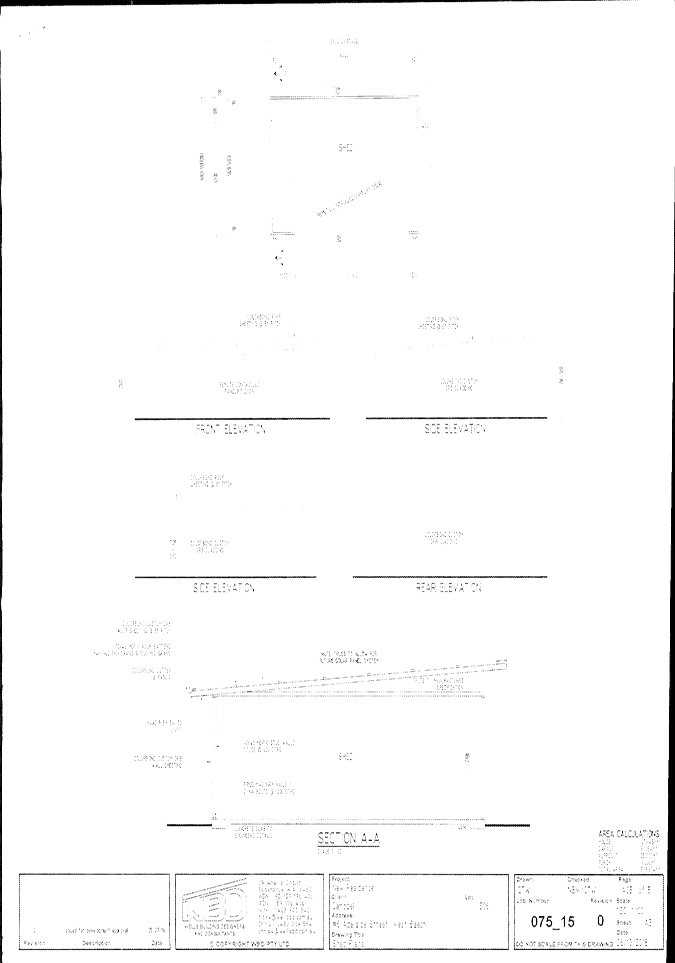
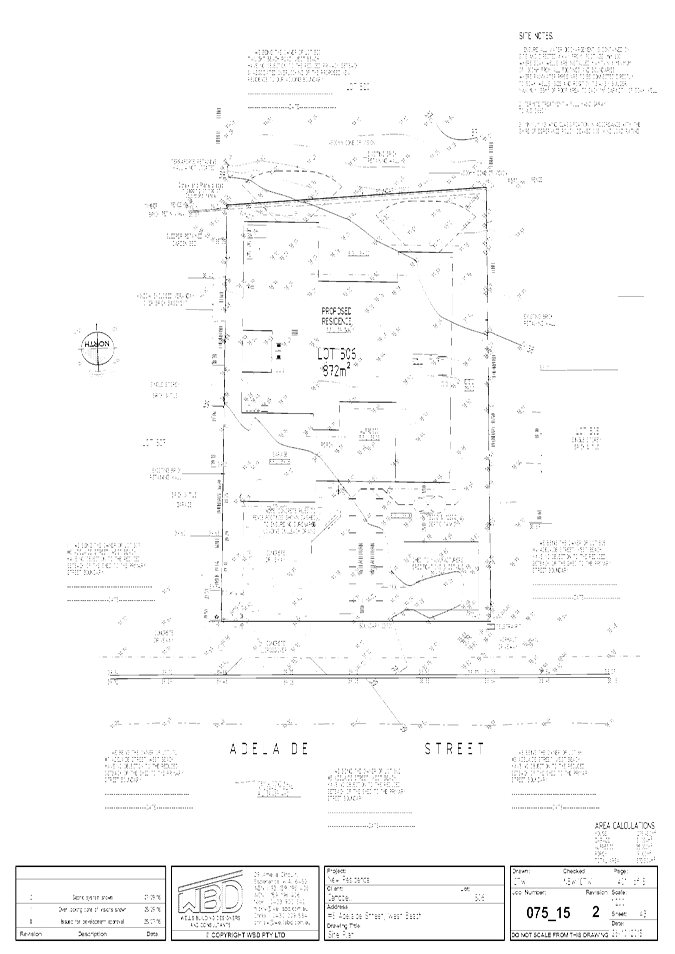
Plans of Dwelling
|
|
|
b.
|
Plans of Effluent Disposal System
|
|
|
Officer’s Recommendation
That Council
1. Approve Development Application
2016.3275.1 for a Single Dwelling and Overheight Front Fence at Lot 506 (6)
Adelaide Street, West Beach subject to the following conditions:
i. Development shall be carried out
and fully implemented in accordance with the details indicated on the stamped
approved plan(s) unless otherwise required or agreed in writing by the Shire
of Esperance (Planning Services).
ii. The
land and buildings the subject of this approval shall be used for the
purposes of Dwelling only and for no other purpose unless otherwise approved
in accordance with the provisions of Local Planning Scheme No. 23 (refer
below definition as extracted from the Residential Design Codes).
a. Dwelling
– A building or portion of a building being used, adapted, or designed
or intended to be used for the purpose of human habitation on a permanent
basis by a single person, a single family, or no more than six persons who do
not comprise a single family.
iii. During
construction stage, adjoining lots are not to be disturbed without the prior
written consent of the affected owner(s).
iv. All
retaining walls, earthworks and/or associated drainage shall be undertaken in
accordance plans and specifications certified by a qualified Engineer as
being consistent with standard engineering practices, as approved by the
Shire of Esperance (Building Services).
v. Earthworks
are to be in accordance with AS 3798 Guidelines on earthworks for commercial
and residential developments.
vi. The
vehicle crossover is to be constructed, drained and sealed to the
satisfaction and specifications of the Shire of Esperance (Asset Management
Division) – refer enclosed vehicle crossover application form.
vii. A
minimum of two (2) car parking bays are to be provided on-site in accordance
with the requirements of Australian Standard AS2890.1:2004 Parking Facilities
– Off-street Car Parking.
viii. Vehicle
parking, manoeuvring and circulation areas shall be suitably constructed,
sealed (asphalt, concrete or brickpavers), drained and thereafter maintained.
ix. All
stormwater and drainage run off from all roofed and impervious areas is to be
retained on-site to the satisfaction of the Shire of Esperance (Building
Services).
x. The
existing infrastructure located within the road reserve shall be retained and
protected during the construction process period with any damage to the
infrastructure being repaired to the satisfaction of the Shire of Esperance
(Asset Management Division) or the applicable Service Provider at the
developer’s expense.
xi. The
provision of all services, including augmentation of existing services,
necessary as a consequence of any proposed development shall be at the cost
of the developer and at no cost to the Shire of Esperance.
xii. The
approved development must be connected to a reticulated water supply provided
by a licensed water provider.
xiii. Prior to
the commencement of development, an application to construct or install an
apparatus for the treatment of sewage and the disposal of effluent and liquid
wastes must be submitted for the approval of the Shire of Esperance (Health
Services), in accordance with the Health (Treatment of Sewage and Disposal of
Effluent and Liquid Waste) Regulations 1974.
xiv. The
development hereby approved must not create community safety concerns, or
otherwise adversely affect the amenity of the subject locality by reason of
(or the appearance or emission of) smoke, fumes, noise, vibration, odour,
vapour, dust, waste water, waste products or other pollutants.
xv. External
clothes drying area(s) appurtenant to the dwelling(s) shall be provided in a
location such that they are screened from view from public view from the street.
Mechanical driers are available to be used as an alternative to external
clothes drying area(s).
xvi. All fencing
shall be in accordance with the Shire of Esperance Local Law Relating to
Fencing.
xvii. The works
involved in the implementation of the development must not cause sand drift
and/or dust nuisance. In the event that the Shire of Esperance is aware of,
or is made aware of, the existence of a dust problem, measures such as
installation of sprinklers, use of water tanks, mulching, or other land
management systems as appropriate may be required to be installed or
implemented to prevent or control dust nuisance, and such measures shall be
installed or implemented within the time and manner directed by the Shire of
Esperance (Environmental Health Services).
xviii. The proposed
operations, during and after construction, are required to comply with the
Environmental Protection (Noise) Regulations 1997.
And the following advice notes:
i. THIS
IS NOT A BUILDING PERMIT. An application for a building permit is required to
be submitted and approved by the Shire of Esperance (Building Services) prior
to any works commencing on-site.
ii. The
development is to comply with the Building Code of Australia, Building
Act 2011, Building Regulations 2012 and the Local Government
Act 1995.
iii. It
is the responsibility of the applicant to ensure that building setbacks
correspond with the legal description of the land. This may necessitate
re-surveying and re-pegging the site. The Shire of Esperance will take
no responsibility for incorrectly located buildings.
iv. It is the responsibility of the
developer to search the title of the property to ascertain the presence of
any easements and/or restrictive covenants that may apply.
v. Horizon Power has requested the
Shire to advise Applicants that Horizon Power has certain restrictions
regarding the installation of conductive materials near its network assets.
Applicants are advised to contact Horizon Power’s Esperance office to
ascertain whether any of Horizon Power’s restrictions affect their
proposed development.
vi. The
approved development is required to comply with the following legislation (as
amended from time to time):
a. Health Act 1911
b. Sewerage (Lighting, Ventilation
& Construction) Regulations 1971
c. Environmental Protection
(Noise) Regulations 1997
d. Health Act (Laundries and
Bathrooms) Regulations 1971
vii. The
two nine metre leach drains proposed will need to be concrete to meet the
requirements of a four bedroom dwelling. Plastic leach drains would require a
length of 10.5 metres and cannot be fitted and still meet setback
requirements.
And;
2. Resolve
to refuse Development Application 2016.3275.1 for an Outbuilding (Shed) at
Lot 506 (6) Adelaide Street, West Beach due to the proposal being
inconsistent with Local Planning Policy: Outbuildings and the Residential
Design Codes.
Voting Requirement Simple Majority
|
27 September 2016 Page
59
27 September 2016 Page
64
27 September 2016 Page
66
Item: 12.1.7
Proposed
changes to Cemetery fees and charges
|
Author/s
|
Katie Kelly
|
Administration Officer
|
|
Authorisor/s
|
Richard Hindley
|
Manager Strategic Planning & Land Projects
|
File Ref: D16/22328
Applicant
Shire of Esperance
Location/Address
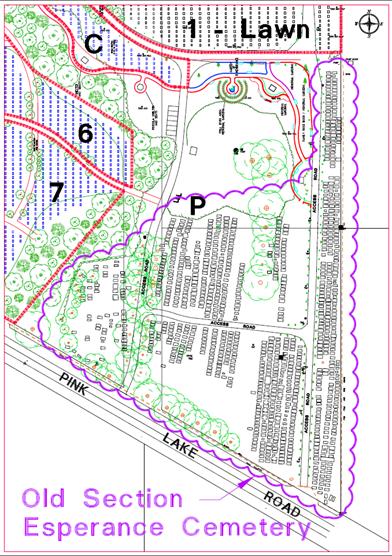
Old Section within the Esperance Cemetery including;
Pioneer, Anglican, Catholic, Lutheran, Methodist,
People’s Church and Uniting Church.
Executive Summary
For Council to consider providing a waiver of the plot
fee for persons wishing to install monumental works on graves in the “old
section of the Esperance Cemetery” where the right of burial has
expired.
Recommendation in Brief
That Council:
1. Waive the Plot Fee where a plot has expired
within the area known as Old Section (Pioneer, Lutheran, Anglian, Catholic,
Methodist, People’s Church and Uniting Church) of the Esperance Cemetery
for the purpose of monumental works only.
2. Advise
applicants that the fee for Approval to Erect a Monument is still
applicable.
Background
Under the Cemeteries Act 1986, a person must
have “Right of Burial” to undertake monumental works at the
Esperance Cemetery. Currently under the Shire’s fee and charges, a
“Right of Burial” or Plot Fee is $1,350.00. Any “Right
of Burial” is valid for 25 years (Section 25(1)). This is causing
frustration for family and/or friends of deceased persons buried in the
“old section” of the Esperance Cemetery, wishing to construct
monumental works (plaques, head stones etc) on graves, when the “Right of
Burial” has expired, and approval cannot be given, unless a new “Right
of Burial” is purchased ($1,350).
The purpose of this item is to provide an ability for
monumental works to occur in the old section of the Cemetery, without requiring
additional cost to family/friends of the person buried in this
section.
Officer’s Comment
As discussed in the background, monumental works cannot be
approved without a valid and unexpired “Right of Burial”.
“Rights of Burial” are only valid for 25 years, therefore legally
someone wishing to install a monument on an existing grave needs to either
provide the Shire with a valid “Right of Burial” or purchase a new
“Right of Burial’ (Plot fee), which adds additional cost to any
monumental works.
Though it may be realistic for graves within the new section
of the cemetery to still have valid “Rights of Burial” (i.e. under
25 years), it is reasonable to assume that in the old section of the cemetery,
most (if not all) “Rights of Burial” have expired. As per
both the Cemeteries Act 1986 and the Local Government 1995, the
Shire Administration does not have the legal authority to waive this
requirement, however it is understandable the additional stress this can cause
possibly still grieving family and friends of persons buried in the section,
who may have not (for various reasons) been able to construct a monument on the
grave during the valid period of the original “Right of
Burial”.
Recently this issue has arisen, when monumental works
approval have been applied for several graves within the old section, and for
obvious reasons, applicants have been disgruntled with the prospect of having
to pay additional costs, for no real added value. There is also the real
likelihood of relatives choosing not to go through the approval process,
however proceeding with the monumental works illegally, hoping to avoid paying
any fees, given the quantum of the “Right of Burial” or Plot fee,
compared to just the new monument fee ($160).
Council has two possible options in moving forward, being:
1) Maintain
the status quo, which means some monumental works in the old section will incur
an additional $1,350 in fees to obtain a valid “Right of Burial”,
or
2) Council
could waive the fee associated in obtaining a new “Right of Burial”
in this section, so approval process can occur, without the additional cost.
Given that for a person to have been buried in the old
section, a “Right of Burial” would have been required (and paid
for) in the past, it is believed that requiring an additional plot fee some
+25years later so a headstone or plaque can be placed on an existing grave does
not seem to be in the Council’s (and therefore the community’s)
best interest in comparison to the potential added income gained.
Consultation
Metropolitan Cemeteries Board
Financial Implications
The financial implications arising from this report are the
waving of the Plot Fee ($1350).
A permit approval of $160.00 (as per current fees and
charges) would still be required.
Asset Management Implications
Nil
Statutory Implications
Cemeteries Act 1986
Cemeteries Local Law 2010
Policy Implications
Nil
Strategic Implications
Strategic Community Plan 2012 - 2022
Economic
Deliver a diverse range
of affordable services and infrastructure across the Shire
A range of services,
facilities and programs that the broadest community can access
Environmental Considerations
Nil
Attachments
Nil
|
Officer’s Recommendation
That Council:
1. Waive
the
Plot Fee where a plot has expired within the area known as Old Section
(Pioneer, Lutheran, Anglian, Catholic, Methodist, People’s Church and
Uniting Church) of the Esperance Cemetery for the purpose of monumental
works only.
2. Advise
an applicant that the fee for
Approval to Erect a Monument is still applicable.
Voting Requirement Absolute
Majority
|
27 September 2016 Page
69
Item: 12.1.8
Management
Committee - Esperance Visitors Centre
|
Author/s
|
Terry Sargent
|
Director External Services
|
|
Authorisor/s
|
Matthew Scott
|
Chief Executive Officer
|
File Ref: D16/22266
Applicant
Internal Report
Location/Address
N/A
Executive Summary
For Council to consider the establishment of the
Esperance Visitor Centre Management Committee.
Recommendation in Brief
That Council:
1. Establish
the Esperance Visitor Centre Management Committee.
2. Nominate
Cr …… and Cr …… to be members of the committee and Cr
….. to act as deputy.
3. Invite
Tourism Esperance to nominate 2 representatives to serve on the committee.
4. Seek
expressions of interest from people involved in the Tourism Industry in
Esperance to serve as one of 3 community representatives.
Background
At the Ordinary Council Meeting on 24th
November 2015 Council resolved in part to:
1. Confirm
that the role of the Esperance Visitor Centre is to enhance visitor experience
and extend their stay by providing:
a. Shop
front for tourism information
b. On-line
presence for tourism information
c. A
booking services for visitors
2. Request
the Chief Executive Officer to determine if Tourism Esperance wishes to
participate in a Management Committee of Council responsible for overseeing the
delivery of these priority services and;
a. Prepare
Draft Terms of Reference for a Management Committee responsible for delivering
the priority services identified above via the Esperance Visitor Centre ,in the
event that Tourism Esperance confirm their agreement to be involved in the
proposed management committee;
Following this decision the internal
focus of the visitor centre has been shifted, with retail stock levels and
permanent staff numbers reduced to allow greater flexibility in concentrating
on the priority services in the future.
Implementation of this decision has
been delayed as priority was given, initially to bushfire recovery and
subsequently to the internal organisational restructure within the
shire’s external services.
Notwithstanding the delay Tourism
Esperance (TE) has considered draft terms of reference and while still keen to
be involved in management of the visitor centre has offered comment or sought
clarification as noted below.
Officer’s Comment
Tourism Esperance legitimately raised matters that
concern the group in relation to the proposed terms of reference for a
management committee. These do not represent insurmountable problems or
impediments to establishing the committee.
The major concerns were (for full Tourism Esperance
comment and Officer responses see Attachments B & C);
Membership
–
Tourism
Esperance seeks clarification on the definition of Community Representatives
and requires direct input into selecting, nominating or endorsing any Community
Representatives.
Council is
required to appoint any committee, so it can’t delegate this decision
making function to TE, however there will be the opportunity to view and
comment on any nominations prior to any appointments being made by Council.
Tourism Esperance would prefer to
also include the most senior visitor centre staff member, or nominee, for
reporting and feedback purposes
Staff attendance will be managed to reduce cost etc.
but where necessary any member of staff can attend
Meeting frequency –
Tourism
Esperance would prefer that the intention will be to hold meetings, where
practical, on a monthly basis. This can be reviewed once the Management
Plan is implemented.
Meeting
frequency will be at the discretion of the committee which can meet monthly if
it chooses.
Designated Powers and Duties –
Clause 1c. reads “Promotion of visitation to the
district; and Tourism Esperance” prefers:…“Interactive
Promotion of visitation to the district in partnership with
“Australia’s Golden Outback” and “Tourism WA”.
The terms of reference are deliberately broad enough
to allow the management committee to pursue those preferences.
Additional Powers and duties were proposed.
4. Tourism Esperance in addition would, once the
Management Plan is prepared, encourage the management committee’s ongoing
involvement in ensuring the Visitor Centre is meeting its targets - as outlined
in the Management Plan.
This is not
required as the term can be extended if “resolved otherwise” by
Council.
5.
Tourism Esperance would like to include: that the management committee can, if
required, provide feedback to or seek feedback from the Visitor Centre Staff.
This is not
required as such communication, properly conducted, is not prevented and is in
fact critical to the good management of the facility. There is a requirement
that there be separation between the staff and the committee.
6.
Tourism Esperance would like to include: that the management committee will continue to support the existing three way
marketing campaign funding arrangements between Australia’s Golden
Outback, Shire of Esperance and Tourism Esperance.
While consistent with Council’s position to
date, this is a decision of Council, not the Visitor Centre, therefore is not
appropriate for inclusion.
These comments generally reflect the
limited understanding of the process that would guide anyone not deeply
involved in Local Government. Responses have been provided to TE and
unless they have cause for reconsideration, it is appropriate that a committee
be established under the terms of reference as attached.
The terms of reference for the proposed
management committee call for 2 x Elected
Members & Deputy, 2 x Representatives from Tourism Esperance and 3 x
Community representatives.
It is recommended therefore, that
Council:
· Proceed to establish the Esperance
Visitor Centre Management Committee
· Nominate Cr …… and Cr
…… to be members of the committee and Cr ….. to act as
deputy.
· Invite Tourism Esperance to nominate
2 representatives to serve on the committee
· Seek expressions of interest from people involved in the
Tourism Industry in Esperance to serve as one of 3 community representatives
Consultation
Tourism Esperance
Financial Implications
The proposed establishment of a management committee does
not, of itself have any financial implications
Asset Management Implications
Nil
Statutory Implications
Nil
Policy Implications
Nil
Strategic Implications
Strategic Community Plan 2012 - 2022
Economic
Deliver a diverse range
of affordable services and infrastructure across the Shire
A range of services,
facilities and programs that the broadest community can access
Environmental Considerations
Nil
Attachments
|
a.
|
Proposed Terms of Reference -
Esperance Visitors Centre Management Committee
|
|
b.
|
Tourism Esperance Comments - Draft
Terms of Reference
|
|
c.
|
Response Provided to Concerns
Raised by Tourism Esperance
|
|
Officer’s Recommendation
That Council
1. Establish
the Esperance Visitor Centre Management Committee.
2. Nominate
Cr …… and Cr …… to be members of the committee and Cr
….. to act as deputy.
3. Invite
Tourism Esperance to nominate 2 representatives to serve on the committee.
4. Seek
expressions of interest from people involved in the Tourism Industry in
Esperance to serve as one of 3 community representatives
Voting Requirement Simple Majority
|
27 September 2016 Page
72

27 September 2016 Page
74


27 September 2016 Page
76

27 September 2016 Page
78
12.2 Asset Management
Nil
12.3 Corporate Resources
Item: 12.3.1
Esperance
Bay Turf Club - New Lease & Proposed Optus Tower
|
Author/s
|
Jennifer Parry
|
Manager Corporate Support
|
|
Authorisor/s
|
Shane Burge
|
Director Corporate Resources
|
File Ref: D16/19615
Applicant
Daly International & Esperance Bay Turf Club
Location/Address
Lot 202 Fisheries Road, Bandy Creek
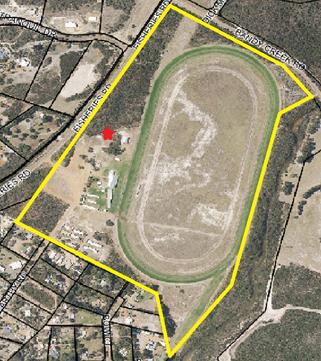

Current lease boundary of Esperance Bay Turf Club

Approximate area of proposed Optus
tower
Executive Summary
For Council to consider;
1. Accepting the surrender of
current lease from Esperance Bay Turf Club (due to expire 30/06/2023) and
entering into a new lease with Esperance Bay Turf Club for a period of 10 years
with a 10 year option, for the same area of land with the exception of an 80m2
portion to be excised for the installation of an Optus Mobile communications
tower; and
2. Allowing an Optus Mobile
communication tower to be erected on an 80m2 portion of land on a
portion of Lot 202 Fisheries Rd Bandy Creek.
Recommendation in Brief
That Council agrees to accept the surrender of current
lease from Esperance Bay Turf Club; enter into a new lease with Esperance Bay
Turf Club for a period of 10 years with a 10 year option for Lot 202 Fisheries
Rd Bandy Creek (excluding an 80m2 portion of the Lot proposed to be
leased to Optus Mobile Pty Ltd); and agrees to enter into a new lease with
Optus Mobile Pty Ltd for an 80m2 portion of Lot 202 Fisheries Rd
Bandy Creek. Both leases being subject to certain conditions.
Background
Lot 202 on Plan 39677 is owned by the
Shire of Esperance (SoE). The property was leased to Esperance Bay Turf Club
(EBTC) on 1 July 1980 for a period of 21 years for a peppercorn rent. A new 21
year lease commenced 1 July 2002, expiring 30 June 2023 for the rent of $1.00
per annum, payable on demand.
In May 2013 Council approved a previous request by
Daly International to sub-lease a 60m2 portion of land from EBTC to
construct a communications tower for the National Broadband Network (NBN). This
proposal came to a standstill and no further communications were received from
Daly International until July 2016 when the Shire was again approached with
this current proposal.
Officer’s Comment
A request for written
confirmation was sent to Daly International in order to determine that the NBN
proposal was not going to proceed any further; or if it was to proceed into the
future, that the NBN infrastructure would be able to be installed on this same
communications tower proposed by Optus Mobile. Daly International confirmed
that the NBN proposal would not be proceeding (confirmation email attached).
Further investigations
into the leasing process revealed that it would be preferable for the Lease to
be between the Shire and Optus Mobile rather than permitting the Turf Club to
sub-let in this instance. If we were to consider enabling the EBTC to sub-let,
a new lease would be required nevertheless, as the terms would need to be
aligned and the permitted use item in the schedule would have required amending
for the Turf Club.
The issue of the new proposed lease for the tower
being between Optus and the Shire and with the EBTC leased land area being
reduced by this amount was discussed with the President of the Turf Club and he
agreed to take the matter to a forthcoming Committee meeting (earlier this
month). The Club President discussed the proposal with the Committee at their
meeting and I have received verbal notification (written confirmation to come)
that they are happy to surrender the existing lease and enter into a new
agreement for 20 years.
Consultation
Esperance Bay Turf Club
Shire of Esperance Planning
McLeods Barristers & Solicitors
Financial Implications
There are no anticipated financial implications for the
Shire; Daly International will be responsible for legal costs involved in
creating the lease up to a maximum of $1,000 and rent generated from the lease
will go into the Shire Trust Account for Esperance Bay Turf Club.
Asset Management Implications
The lessee will be responsible to
install, erect, construct, dismantle, modify, repair, replace, renew and
maintain upon the premises, telecommunications equipment and removal of such
infrastructure within 6 months of the expiry date of the lease.
Statutory Implications
Local Government Act 1995 – Section 3.58 Disposing of
property
Local Government (Functions and General) Regulation 1996
– Section 30 Disposing of property excluded from Local Government Act
Section 3.58
Local Government Act 1995 – Section 9.49A Execution of
documents
Policy Implications
COR 004: Building and Property Leases
Strategic Implications
Strategic Community Plan 2012 - 2022
Civic Leadership
Be innovative in the management of Shire operations,
services, staff and resources to create a resilient and financially stable
Shire.
A Shire that is
progressive, sustainable, resilient and adaptive to changes
Corporate Business Plan 2013/2014 – 2016/2017
Action 4.5.12 Manage Shire leases and insurances
Environmental Considerations
It is not anticipated that there will be any environmental
issues to be considered; but if there are any submissions received after the
statutory 2 week advertising period, then a further report will be brought back
to Council for consideration.
Attachments
|
a.
|
Confirmation from Daly
International that NBN Tower would not be proceeding at Esperance Turf Club
|
|
Officer’s Recommendation
That Council
1. Accepts
the surrender of the current lease from Esperance Bay Turf Club on Lot 202
Fisheries Rd Bandy Creek, due to expire 30 June 2023;
2. Agrees
to enter into a new standard community & sporting group lease with
Esperance Bay Turf Club on Lot 202 Fisheries Rd Bandy Creek;
3. The
new lease term with Esperance Bay Turf Club to be 10 years with a 10 year
option;
a. The
area of land to be clearly identified on an annexure to the lease;
b. The
rent to be $100.00 (ex GST) per annum;
c. The
proposed use of the premises be for racecourse, sporting and associated
activities; and
4. Agrees
to enter into a new commercial lease with Optus Mobile Pty Ltd to erect and
maintain a telecommunication tower on an 80m2 portion of Lot 202
Fisheries Road Bandy Creek;
a. The
term of the lease to be 10 years with a 10 year option;
b. The
area of land to be clearly identified on an annexure to the lease;
c. The
proposed rent to be $8,500 (ex GST) per annum with a 3% fixed increase
annually;
d. The
rent to be paid to the Shire and held in Trust for the Esperance Bay Turf
Club;
e. The
proposed use of the premises be for the purpose of constructing, maintaining
and operating a telecommunications network and telecommunications service
including but not limited to installing, storing, operating, repairing,
maintaining, altering, and replacing Telecommunications Equipment consistent
with the evolving nature of telecommunications services;
5. All
applicable approvals are to be obtained by Optus Mobile Pty Ltd under Local
Planning Scheme No. 23 and the Building Act 2011;
6. The
proposed lease with Optus Mobile Pty Ltd to be advertised in accordance with
the Local Government Act 1995 s.3.58 Disposing of property; and
7. Authorises
the CEO to execute the documents.
Voting Requirement Simple Majority
|
27 September 2016 Page
81

27 September 2016 Page
82
Item: 12.3.2
Self
Supporting Loan Request - Esperance Bay Yacht Club
|
Author/s
|
Beth O'Callaghan
|
Manager Financial Services
|
|
Authorisor/s
|
Shane Burge
|
Director Corporate Resources
|
File Ref: D16/20919
Applicant
Esperance Bay Yacht Club
Location/Address
The Esplanade, Esperance
Executive Summary
This report recommends approval of a new self
supporting loan of $40,000 for the purpose of assisting with the acquisition of
a replacement start boat for the Esperance Bay Yacht Club.
Recommendation in Brief
That Council agrees to provide a self supporting loan
of $40,000 to the Esperance Bay Yacht Club for a maximum term of 5 years for
the purpose of assisting with the acquisition of a replacement start boat.
Background
The Club has made an
application to the Shire for a $40,000 self supporting loan to assist with the
acquisition of a replacement start boat. The current start boat is timber
planked and estimated to be 50 years old, requiring increasing maintenance
costs each year. (See letter attached).
An aluminium replacement
boat is estimated to cost approximately $64,000. The club will be seeking
grants to assist in the shortfall between the cost and self supporting loan but
also have funds of their own to put towards the replacement boat if the grant
applications are unsuccessful.
The replacement start boat will be utilized for club
competitive events, co-ordinate on-water rescue fleets and course
setters. It will also ensure the organisers of future regattas (such as
the National Flying 15 title and State 125 title) a safer and more comfortable
option.
Officer’s Comment
In making a determination
with regards to this self supporting loan application, repayment ability and
security need to be addressed.
Repayment Ability: Financial statements for
the last 3 financial years have been provided in support of the
application. A review of the statements indicates the club has
consistently generated operating surpluses for the past 3 years and is in a
position to service the loan.
The loan repayments will
be approximately $9,000 each year. The club has an existing self
supporting loan with the Shire since August 2013 for $400,000 and has not
defaulted on any payments to date.
The table below represents
the surplus for the past 3 years indicating the ability to service the new loan
as well as the existing loan. Please note that the Club’s financial year
runs from 1 May to 30 April.
|
Year
|
2014
|
2015
|
2016
|
|
Operating Surplus*
|
$84,658*
|
$38,406
|
46,582
|
|
Existing Loan Principal Repayment
|
$5,928
|
$12,305
|
$12,929
|
|
Funds available to service new loan
|
$78,730
|
$26,101
|
$33,653
|
*Operating surplus in 2014 was higher than other years
due to a number of reasons:
- Amortisation
of Building improvements commenced in 2015 for approximately $13,500
- Only
half a year’s self supporting loan interest was paid in 2014 as the loan
commenced in August 2013
- Depreciation
expenses increased from 2015 by approximately $20,000 for plant and equipment
Security: Standard
practice for a self supporting loan is that personal guarantees are sought from
within the membership group who will benefit from the loan provision.
Esperance Bay Yacht Club has provided a list of five guarantors.
Advertising for this loan will not be required as it was
included in the 2016/17 Statutory Budget recently adopted in July 2016.
Consultation
Nil
Financial Implications
All self supporting loans are included as a total liability
of the shire regardless of any loan agreements and guarantors that it has with
the community group or club. This means that any increases in self
supporting loans will decrease the borrowing capacity of the Shire.
Asset Management Implications
Nil
Statutory Implications
Section 6.20 (1) of the Local Government Act (1995)
provides the power to borrow. Section 6.20 (2), requires that where the
establishment of a loan occurs outside the budget adoption process, that one
month’s public notice of the proposal be given and must be resolved by an
absolute majority.
Policy Implications
The policy implications arising from this report are CORP 002: Financial
Management (Loan Funding) – Council will consider loan funding that is
prudent and within guidelines and ratios as identified by the Department of
Local Government. Loan funding will be guided by those loans that are
proposed in the Long Term Financial Plant. An exception to this is self
supporting loans.
Strategic Implications
Strategic Community Plan 2012 - 2022
Civic Leadership
Be innovative in the
management of Shire operations, services, staff and resources to create a
resilient and financially stable Shire
A Shire that is
progressive, sustainable, resilient and adaptive to changes
Environmental Considerations
Nil
Attachments
|
a.
|
Letter from Esperance Bay Yacht
Club
|
|
|
Officer’s Recommendation
That Council agree to provide self
supporting loan of $40,000 to the Esperance Bay Yacht Club for a maximum term
of 5 years for the purpose of assisting with the acquisition of a replacement
start boat and that a loan agreement with guarantors is executed.
Voting Requirement Absolute
Majority
|
27 September 2016 Page
84

27 September 2016 Page
85
Item: 12.3.3
Rate
Exemption Application for Esperance Masonic Lodge
|
Author/s
|
Shane Burge
|
Director Corporate Resources
|
|
Authorisor/s
|
Matthew Scott
|
Chief Executive Officer
|
File Ref: D16/21417
Applicant
Esperance Masonic Lodge
Location/Address
74 Windich Street, Esperance
Executive Summary
For Council to consider granting a rates exemption to 74
Windich Street, Esperance under Section 6.26(2)(g) (Charitable purpose
exemption) of the Local Government Act 1995.
Recommendation in Brief
That Council grant a rate exemption under Section 6.26(2)(g)
of the Local Government Act 1995 to Esperance Masonic Lodge for 74
Windich Street, Esperance (Assessment 505).
Background
Esperance Masonic Lodge
recently wrote to the Shire seeking a rates exemption due to charitable purpose
for its Lodge under Section 6.26(2)(g) of the Local Government Act 1995.
As per their application letter (attached) the Esperance
Lodge exists as a non-profit charitable organisation endeavoring to contribute to the Esperance community in the following
areas over the past 12 months-
· Schools Tournament of the Minds
· Esperance Senior High School Quiet Lion
Tour to Thailand for Anzac Commemorations
· Movember
· Esperance Aged Care Facility
· 2015 Bush Fires Appeal
· Maintenance and management of Retirement
Village
The property at 74
Windich Street is used as the groups meeting place to plan, organise and manage
their community based activities.
Officer’s Comment
Section 6.26(2)(g) of the Act provides that
“land used exclusively for charitable purposes” is not rateable by
a local government. There is no clear definition in the Act as to how this
clause should be interpreted and as such there is inconsistencies in the
interpretation and application of the charitable land use provisions by local
governments. Although there is no clear definition there has been case law and
‘general practice’ as well as guidance from local government
inquiries that can be used as a guide to help local government determine rate
exemptions provided under this section of the Act.
An independent inquiry in 2001 was
conducted by the Commonwealth into definitional issues relating to charitable,
religious and community not-for-profit organizations. This inquiry along with
the WA Charitable Collections Act 1946 assists in defining the term
“charitable purpose”. Each definition appears to have its origin
from the Charitable Uses Act 1601 and the House of Lords case of 1891
which define charitable purpose to include: relief of the aged, impotent and
poor, the advancement of education and religion and other purposes of benefit
to the community.
Mere ownership of land by a
charitable organization does not in itself bring that land within the scope of
Section 6.26(g). It is only where the use of the land is used
exclusively for a charitable purpose that the sub-section applies. Accordingly,
land in private, as opposed to charitable ownership, could be exclusively used
for a charitable purpose. This view was supported it the case of William
Trustees v Inland Revenue Commissioners (1947) and also more recently where
retirement villages are privately owned have been determined to meet the
charitable purpose definition.
Legal opinion indicates that payment
for services rendered or a profit motive by an institution does not deny that
institution of charitable status for rating purposes, provided the profits do
not accrue to an individual or non-charitable objects. However, if the charges
function to exclude the element of public benefit, then this may be found to be
inconsistent with the charity definition. In the instance of the Esperance
Masonic Lodge and from the information that has been provided, it would appear
that there is little to no profit motive with all funds that are received by
the group being distributed back to the community.
Esperance Masonic Lodge fit within
the charitable
purpose definition to include: relief of the aged, impotent and poor, the
advancement of education and religion and other purposes of benefit to the
community. It is common throughout WA local governments that charitable
organisations that provide community services are exempt under Section
6.26(2)(g). This is also in line with the current practice by the Shire of
Esperance by not charging rates to other similar organisations that provide
similar services to the community.
It should be noted that any rates
exemption only applies to the rates portion of the rates notice. Charges such
as rubbish collection and ESL are still due and payable.
It is therefore recommended that the
Shire of Esperance grant a rate exemption to Esperance Masonic Lodge under
Section 6.26(2)(g) of the Local Government Act 1995 for the property
located at 74 Windich Street, Esperance.
Consultation
Information from the applicants has been received to
determine the recommendation based upon Case Law and general local government
interpretation of the Local Government Act 1995.
Financial Implications
There calculated rates on the property for the 2016/17
financial year amount to $2,833.41 and $80 for the Waste Rate.
Rubbish Collection charges and ESL will remain due and
payable.
Statutory Implications
Section 6.26(2)(g) of the Local Government Act 1995
Strategic Implications
Strategic Community Plan 2012-2022
Civic Leadership
Strategy 4.5 Be innovative in the management of Shire
operations, services, staff and resources to create a resilient and financially
stable Shire.
Corporate Business Plan 2013/2014 – 2016/2017
Action 4.5.19 Manage Shire Rates
Attachments
|
a.
|
Esperance Masonic Lodge Rates
Exemption Application
|
|
|
Officer’s Recommendation
That Council grant a rates
exemption under Section 6.26(2)(g) of the Local Government Act 1995 to
Esperance Masonic Lodge for 74 Windich Street, Esperance (Assessment 505)
whilst the property continues to be used exclusively for charitable purpose.
Voting Requirement Simple Majority
|
27 September 2016 Page
88

27 September 2016 Page
89
Item: 12.3.4
Financial
Services Report - August 2016
|
Author/s
|
Beth O'Callaghan
|
Manager Financial Services
|
|
Authorisor/s
|
Shane Burge
|
Director Corporate Resources
|
File Ref: D16/22464
Attachments
|
a.
|
Monthly Financial Report - August
2016
|
|
|
Officer’s Recommendation
That the report entitled Monthly
Financial Management Report (incorporating the Statement of Financial
Activity) for the month of August 2016 as attached be received.
Voting Requirement Simple Majority
|
27 September 2016 Page
91

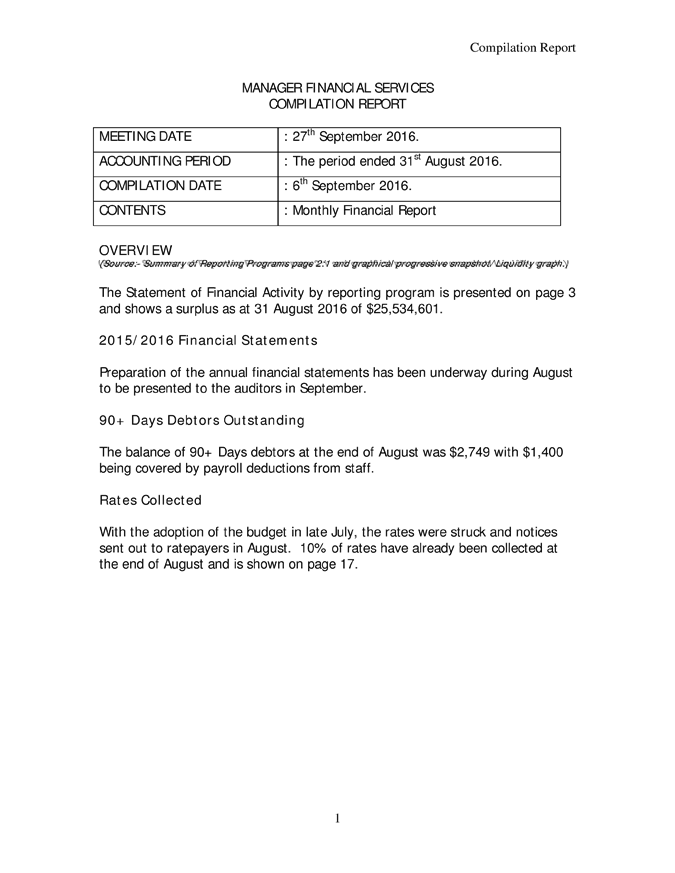
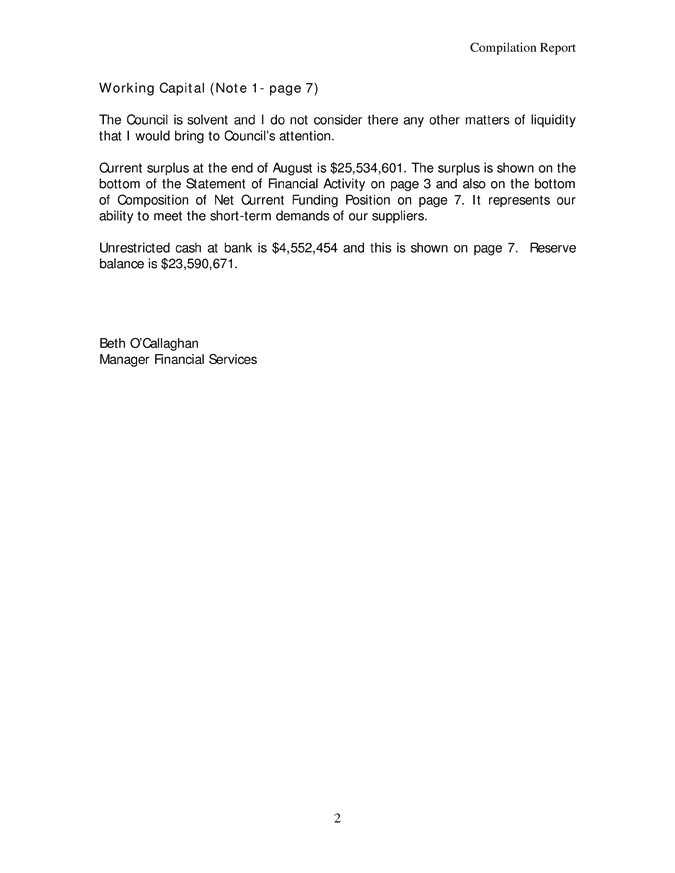
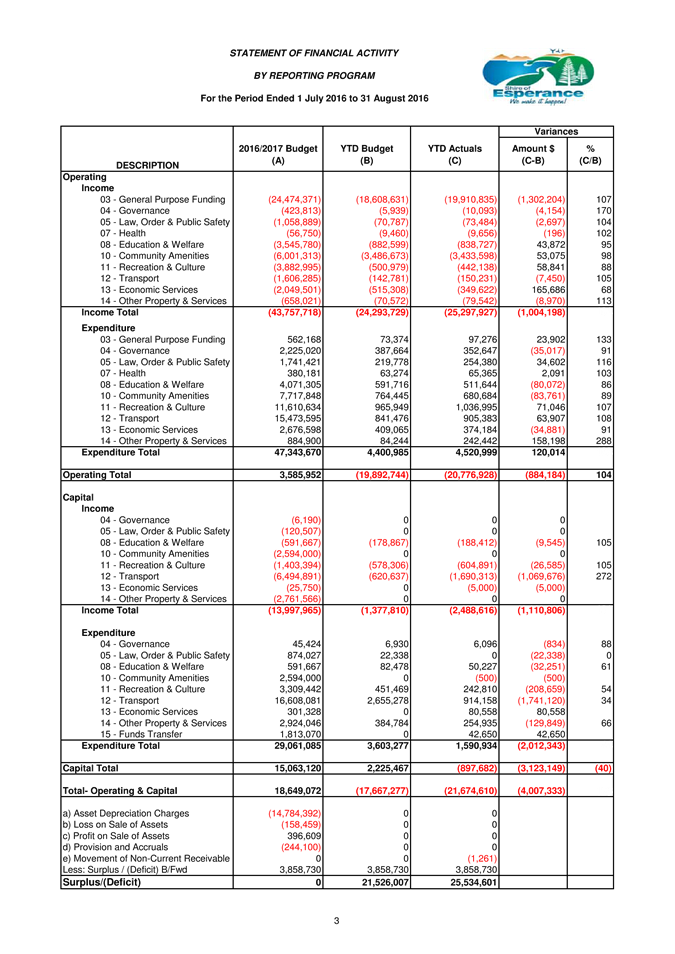
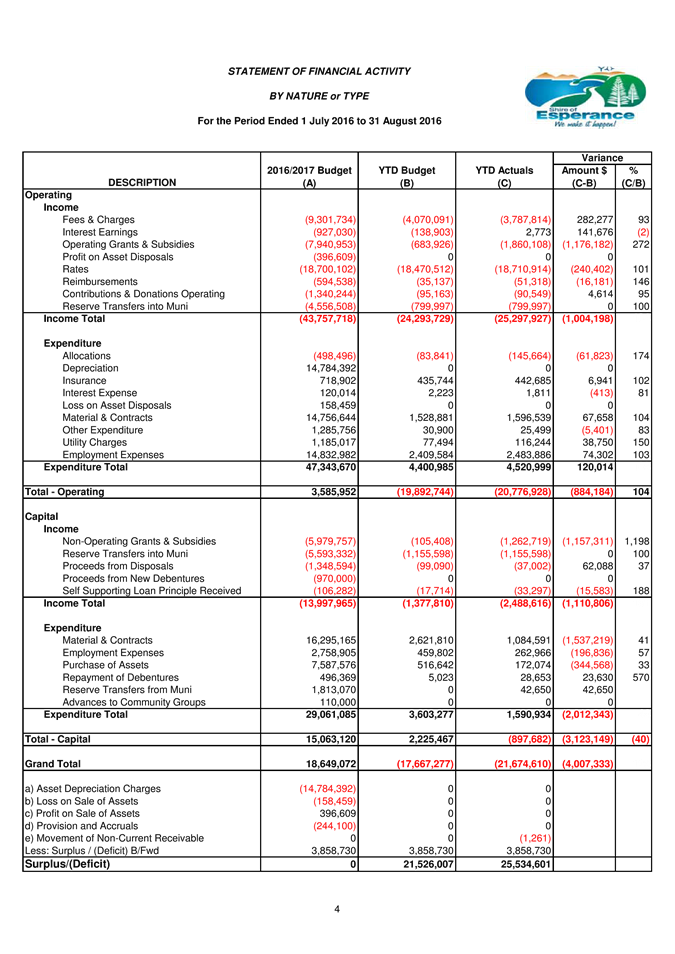
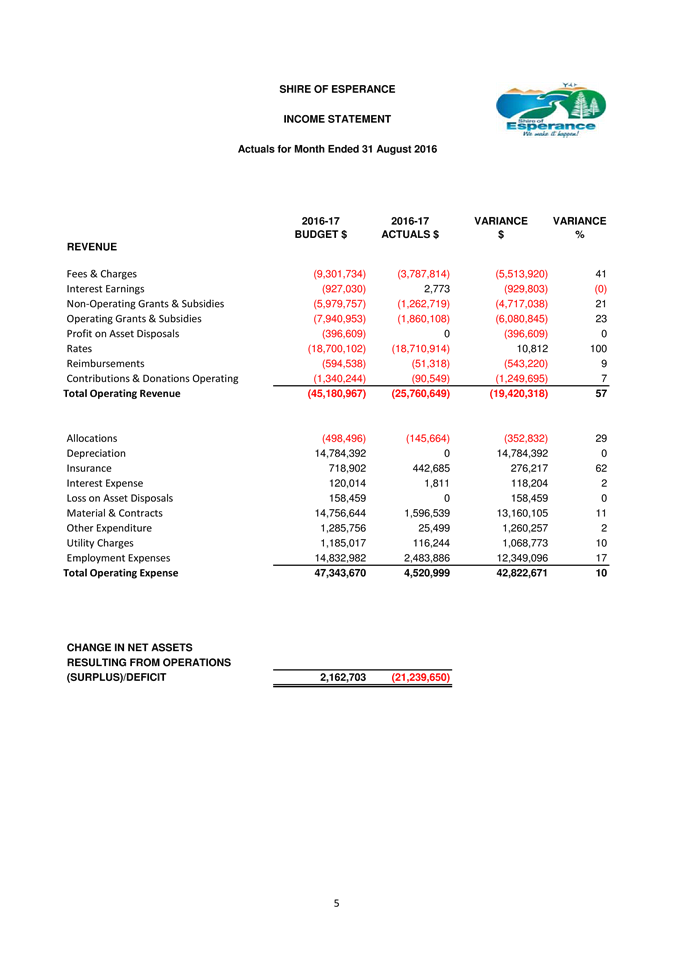
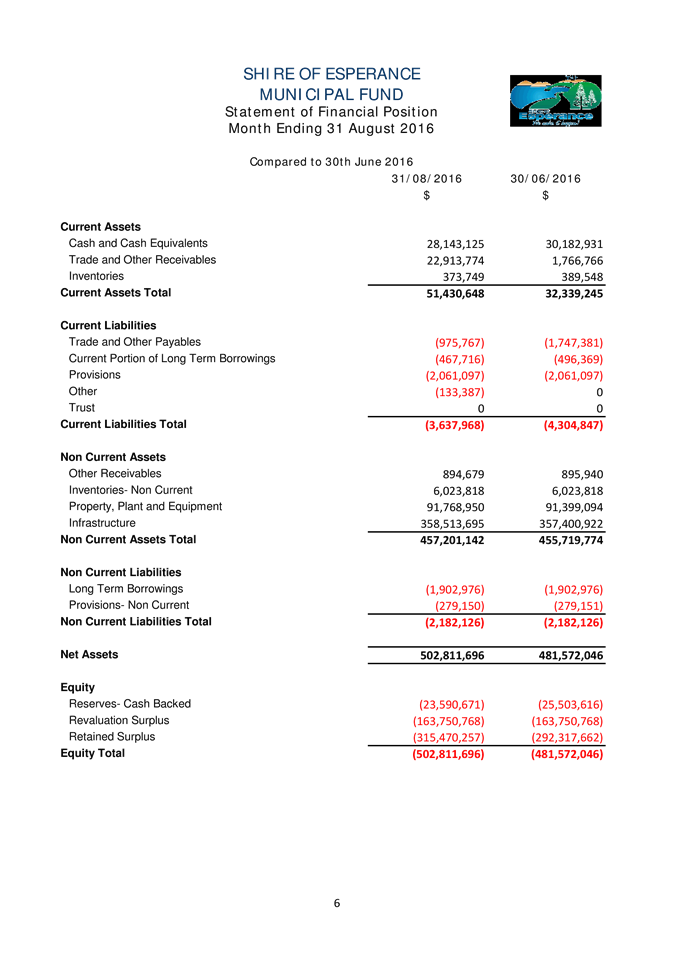
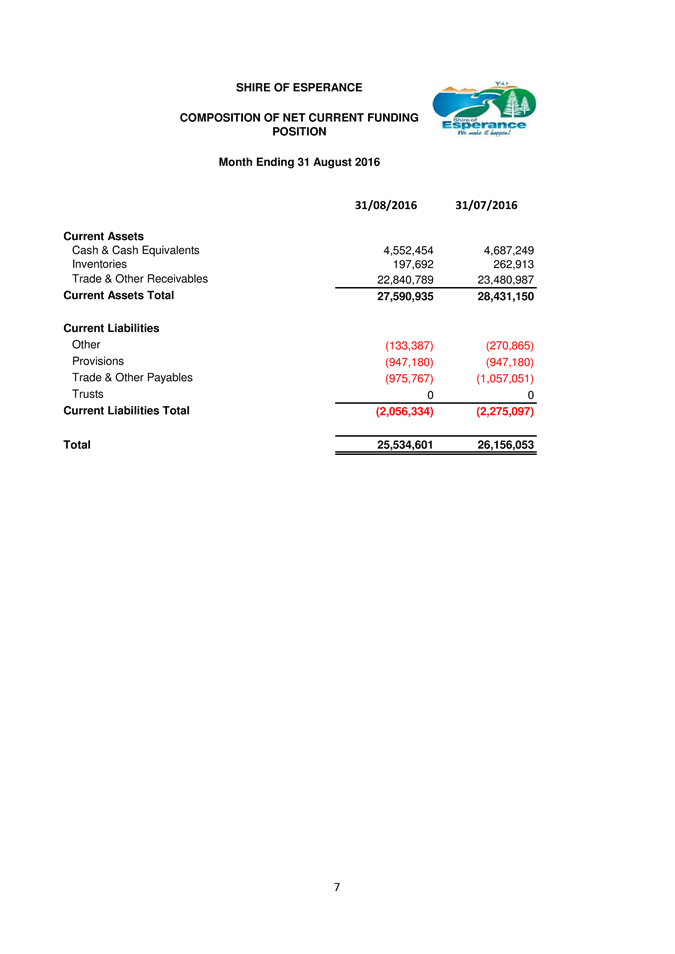
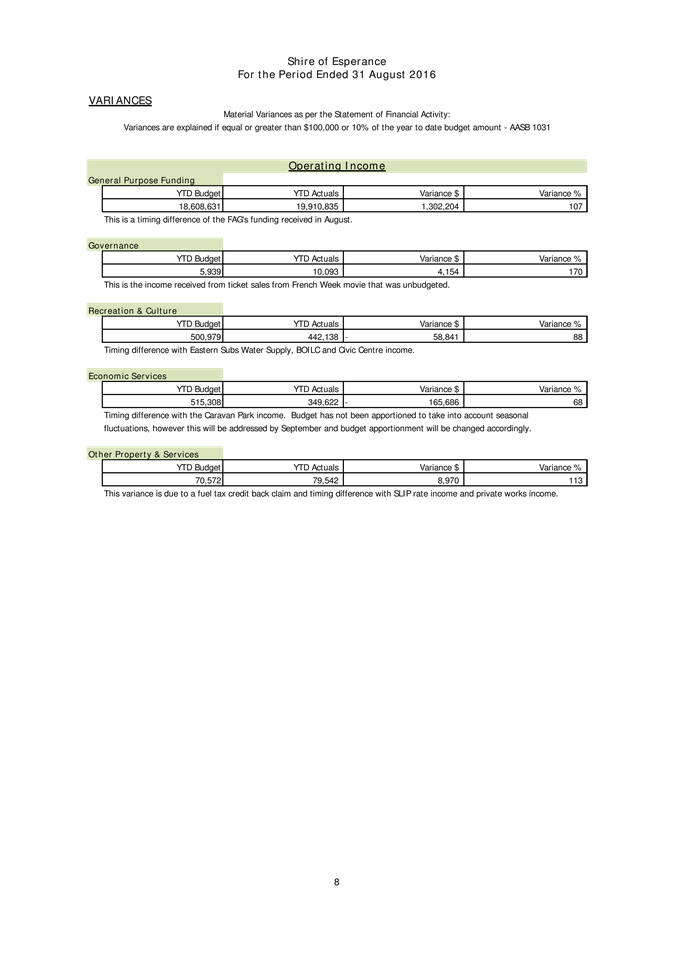
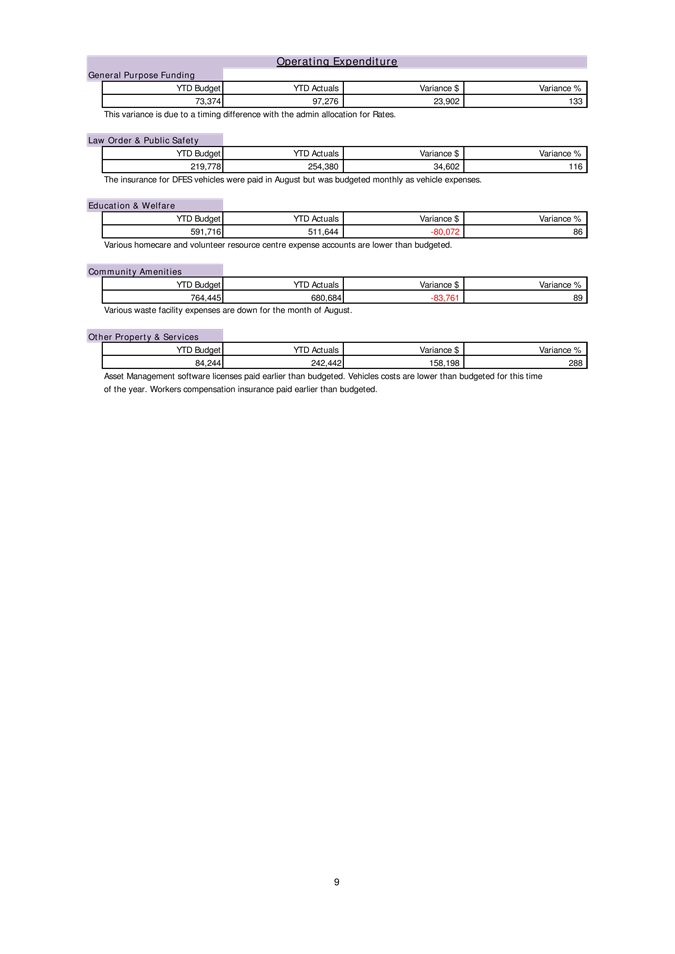

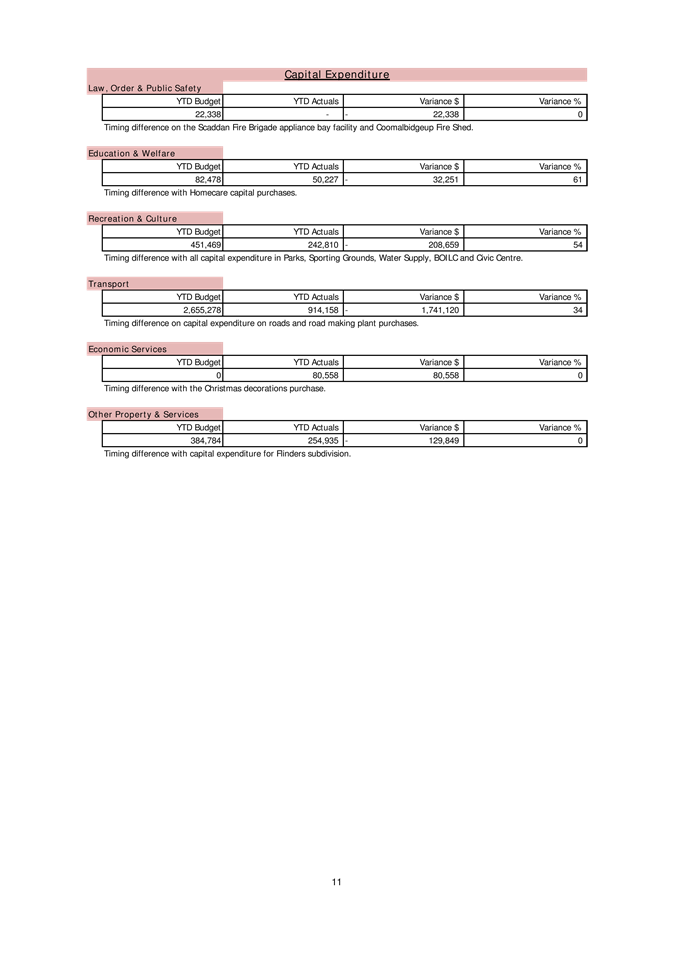

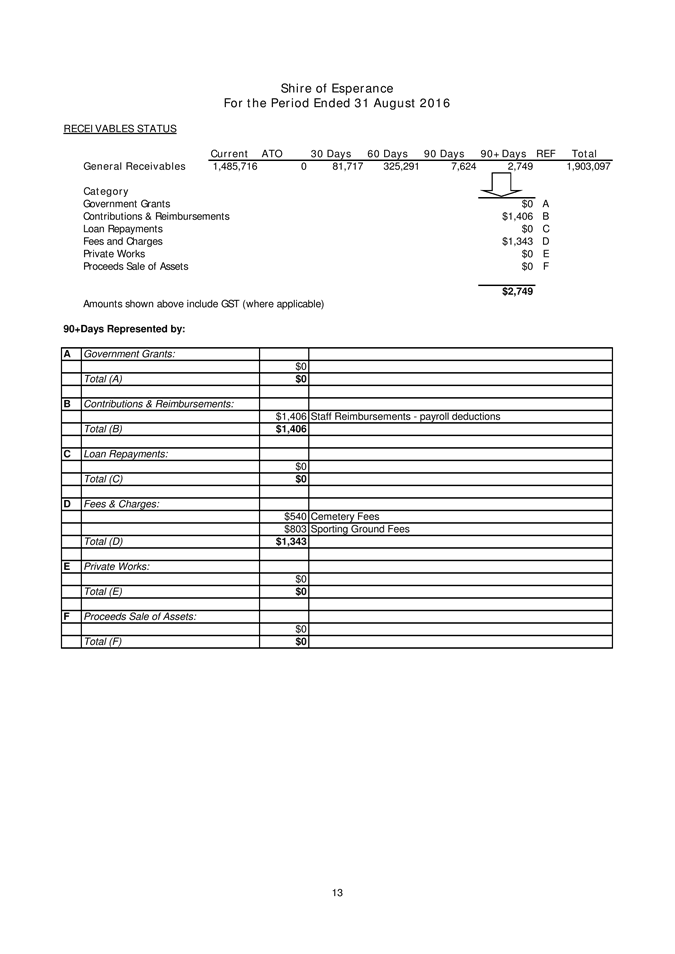
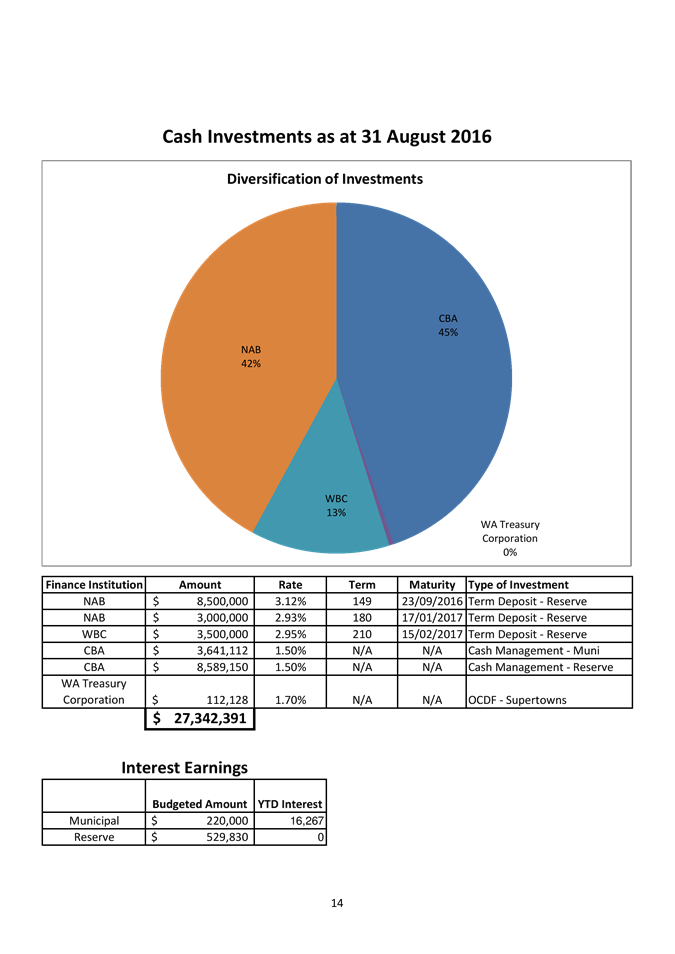
27 September 2016 Page
109
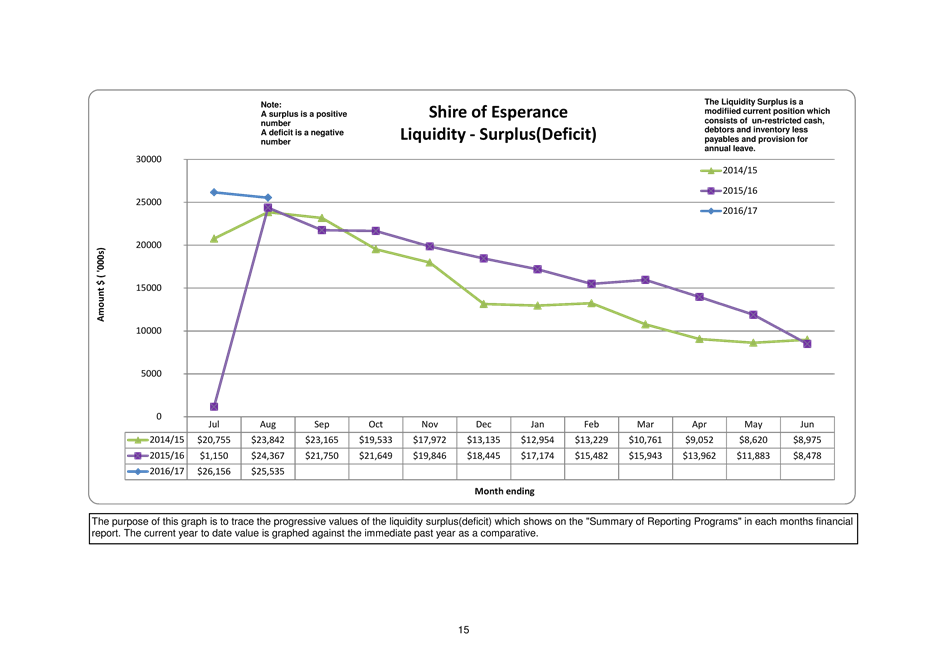
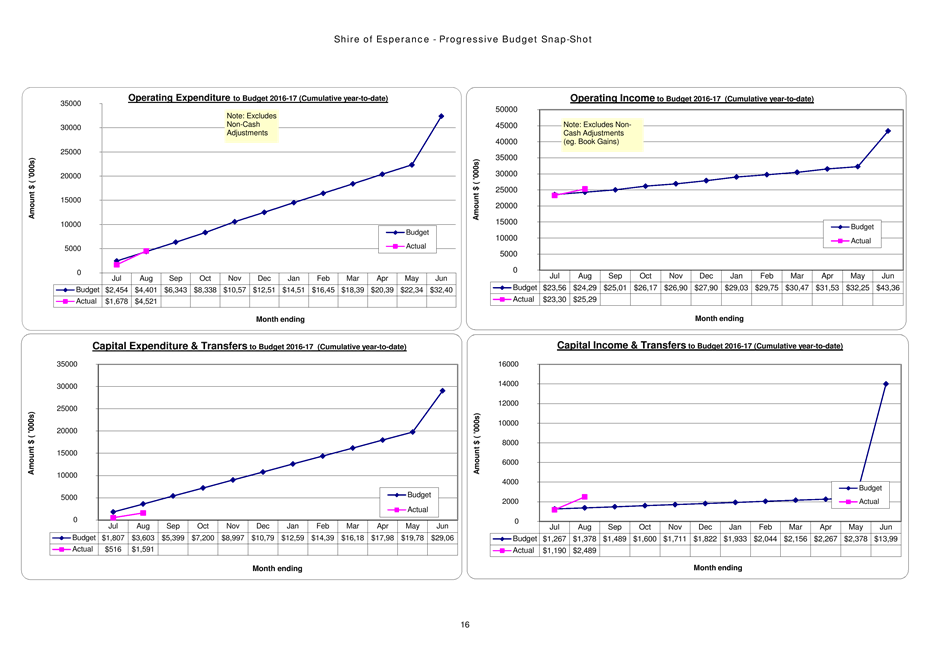
27 September 2016 Page
112

27 September 2016 Page
114
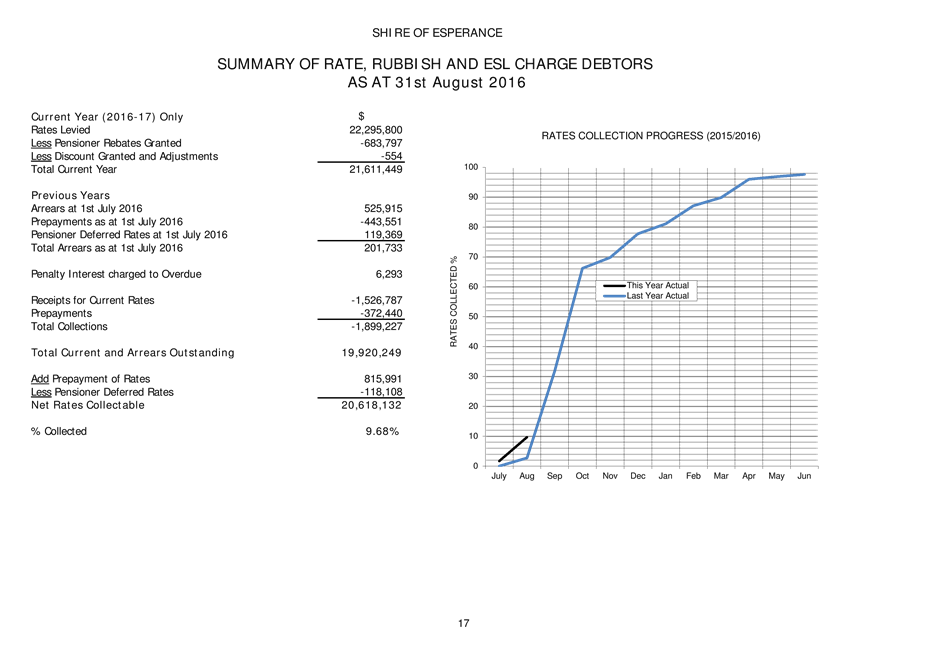
27 September 2016 Page
116
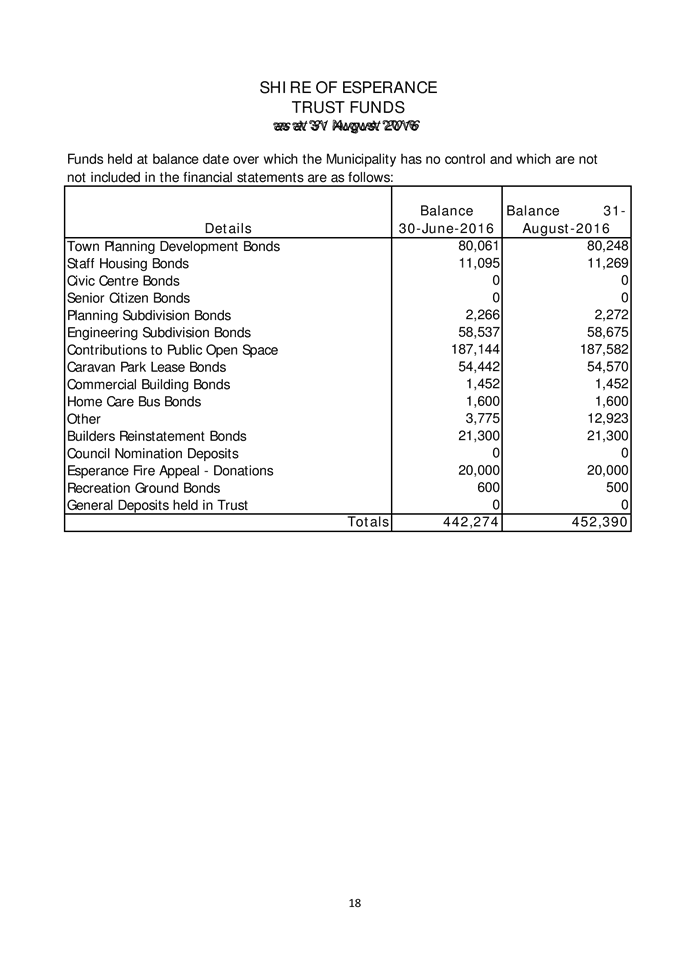

27 September 2016 Page
119
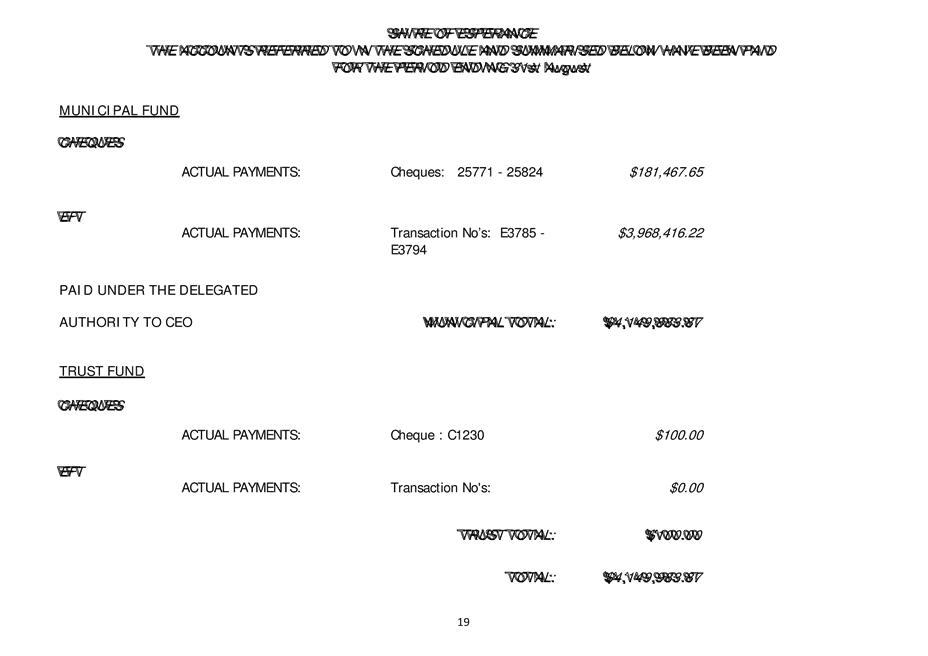
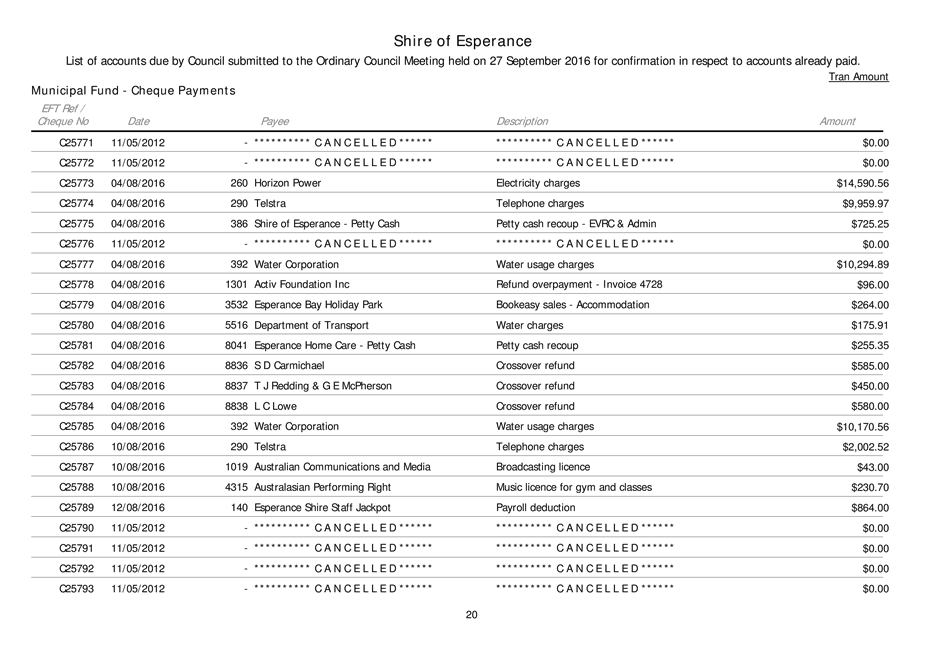
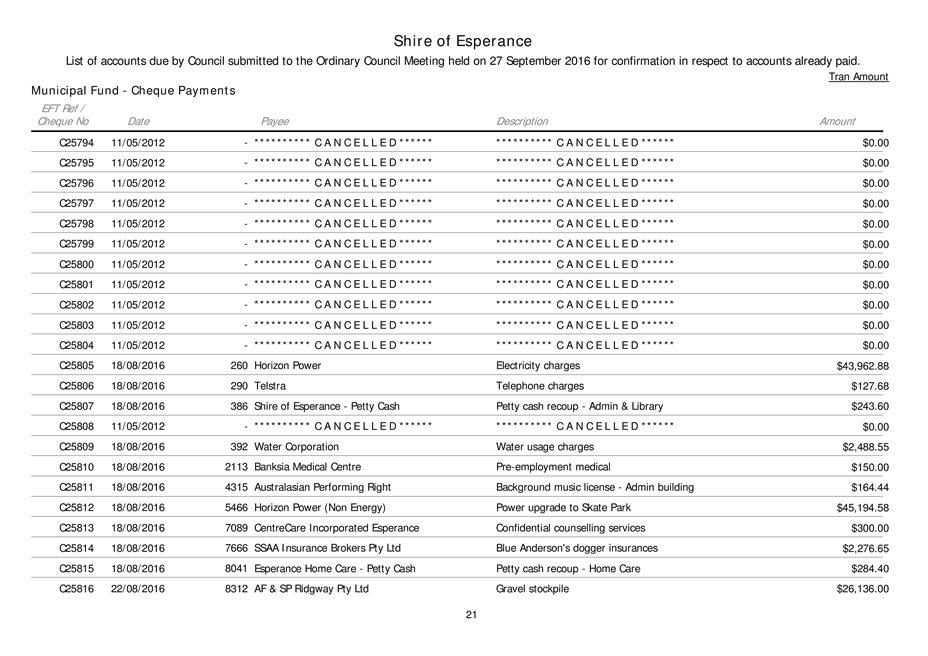
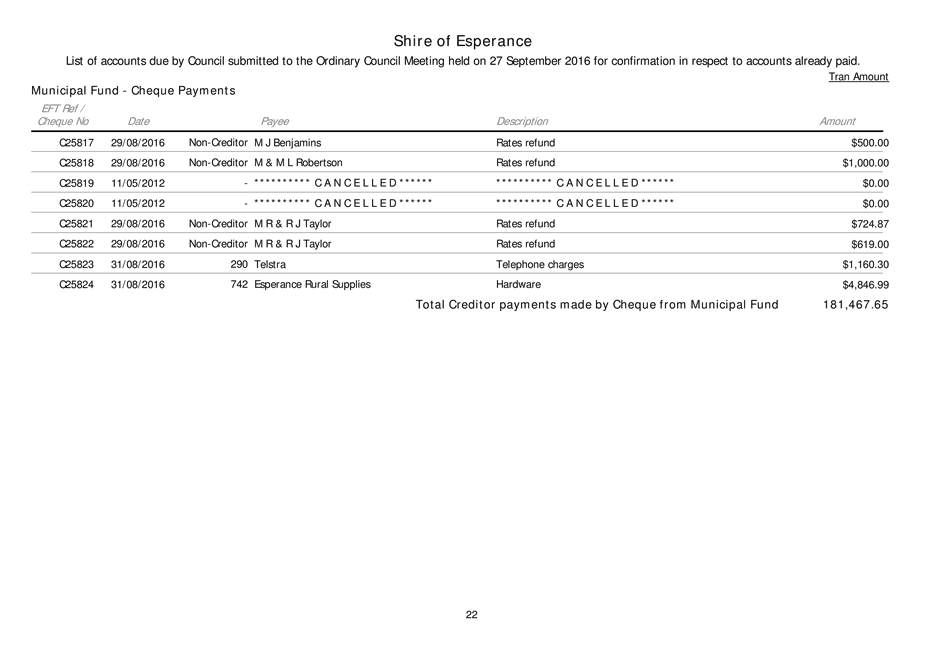
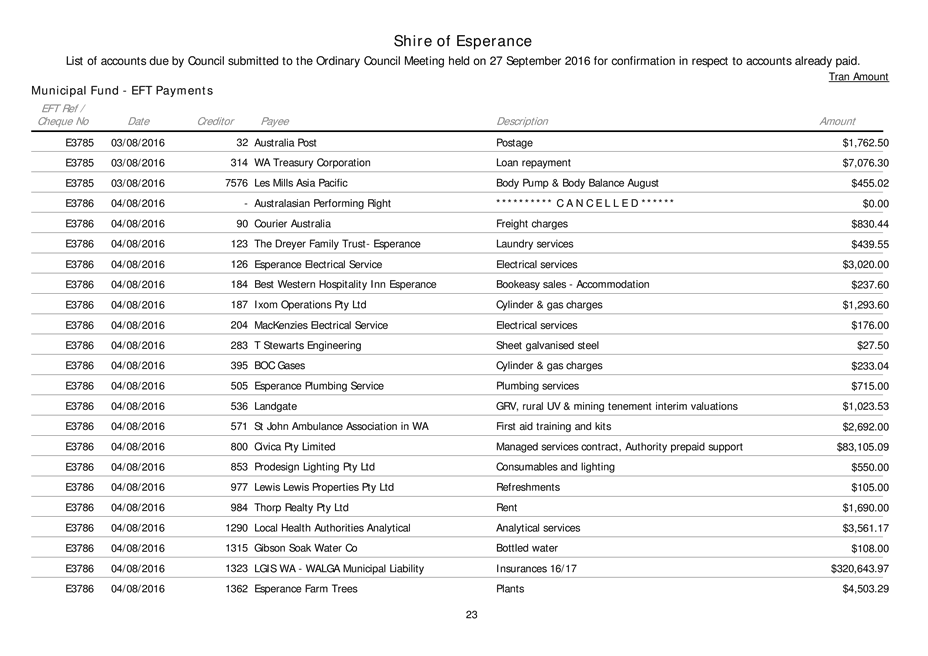
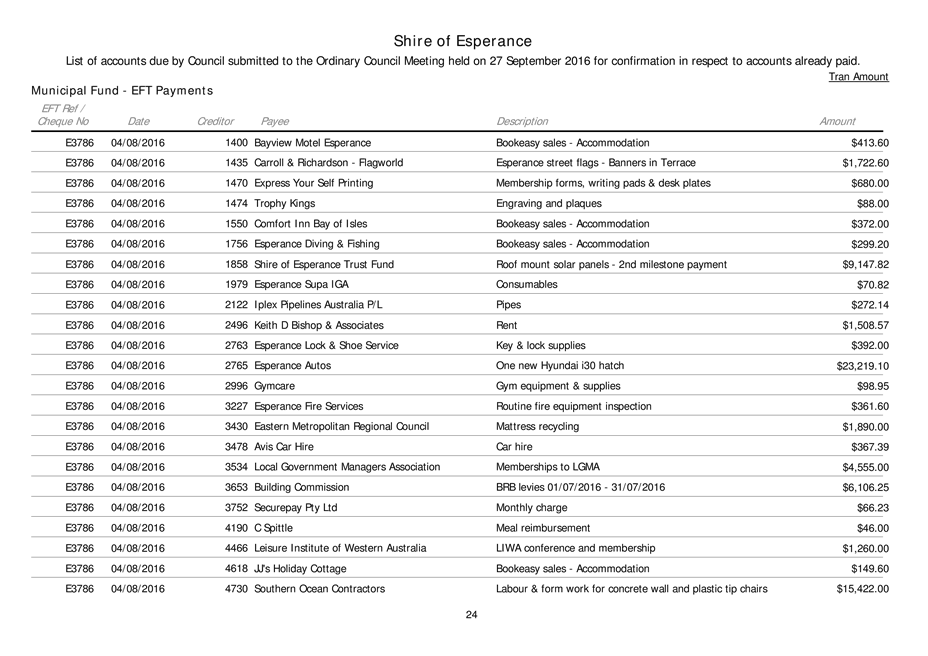
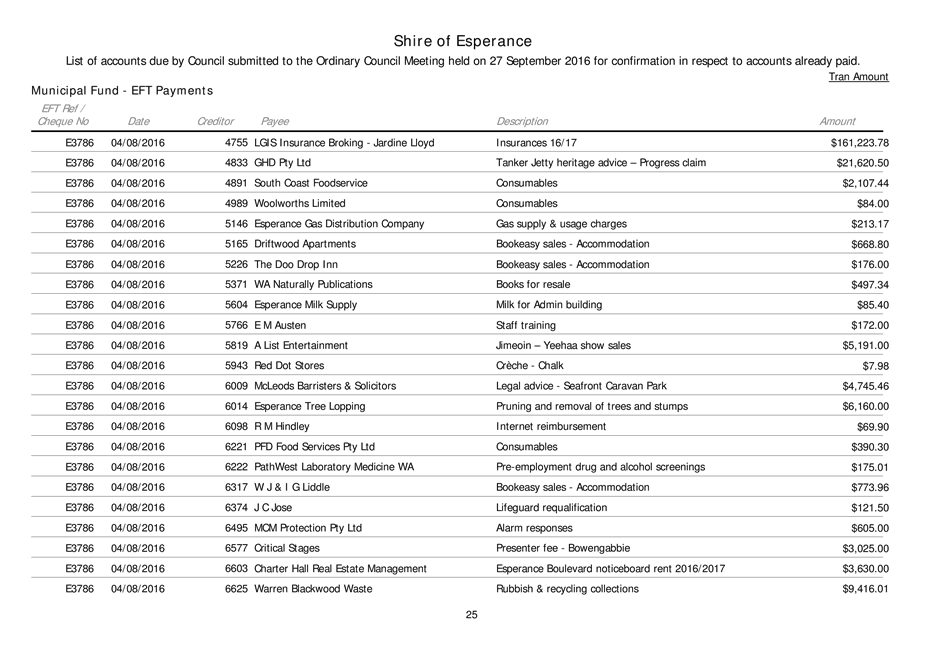
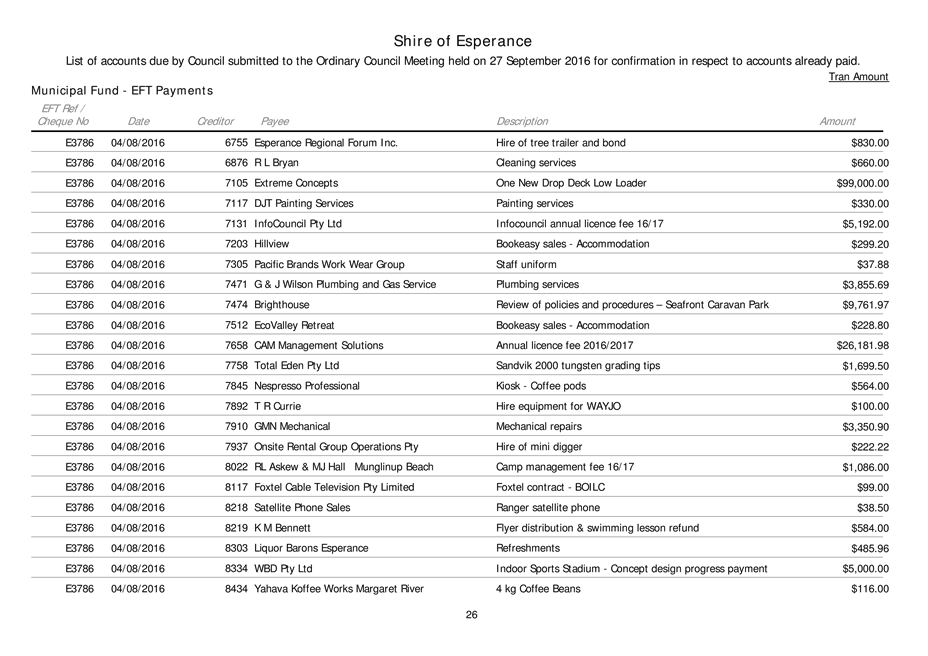
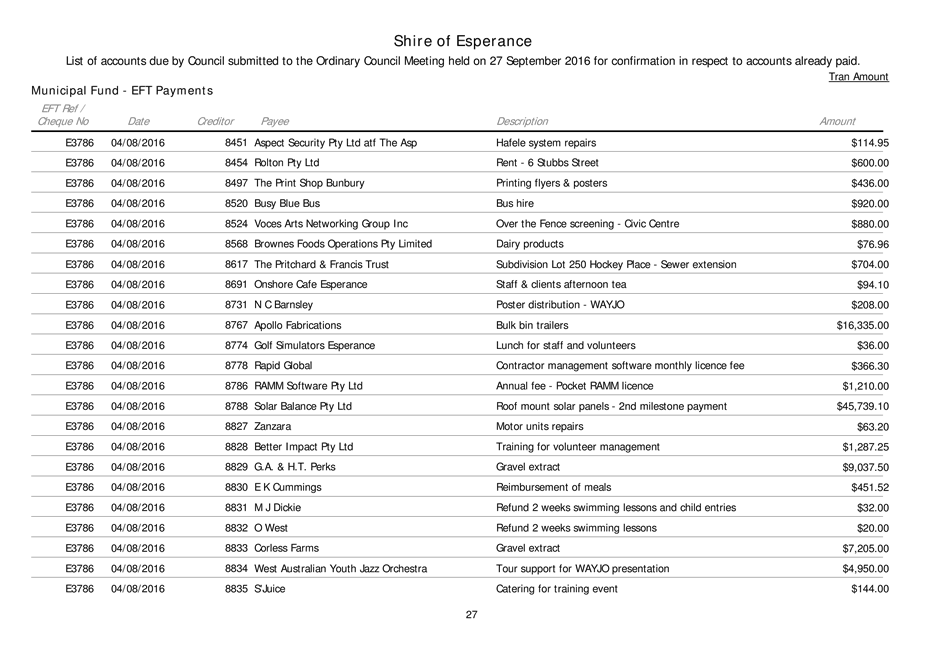
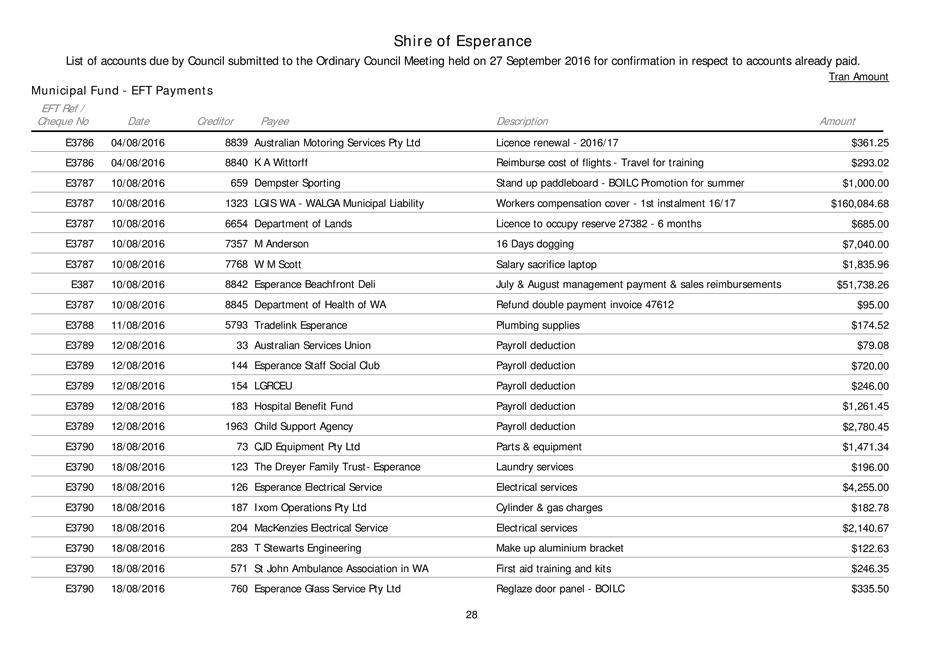
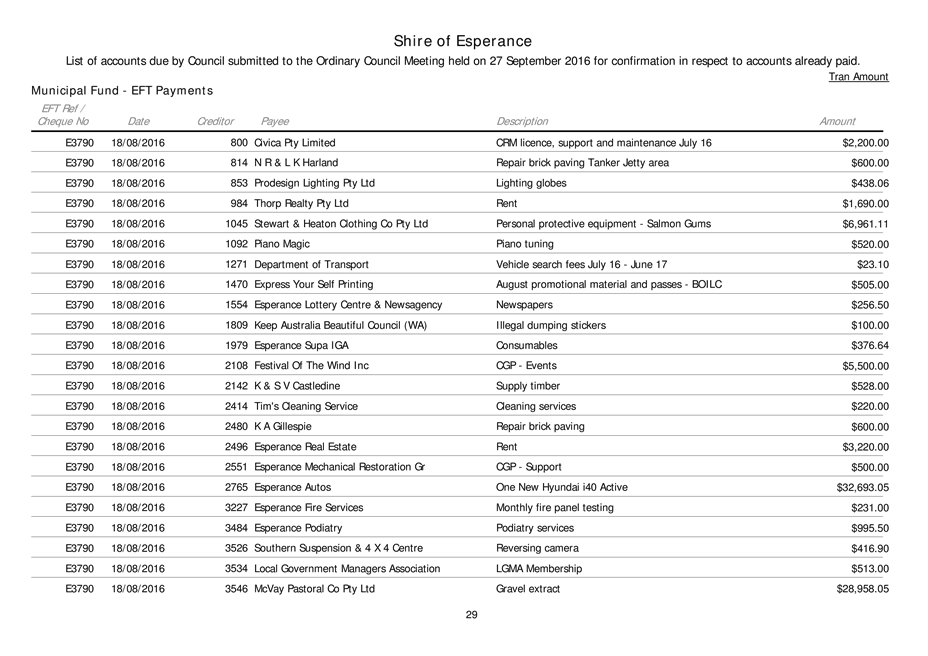
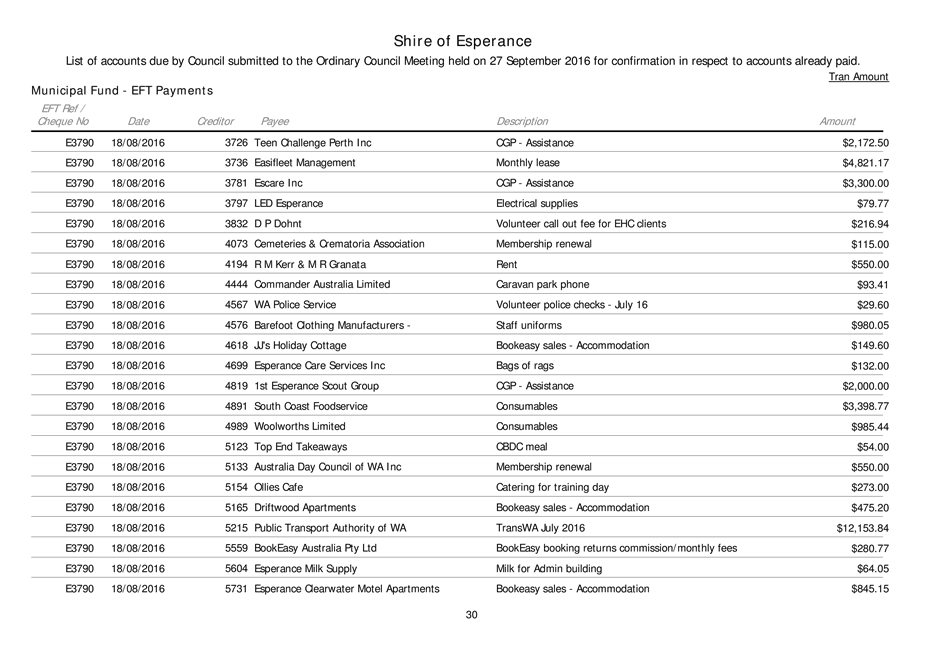
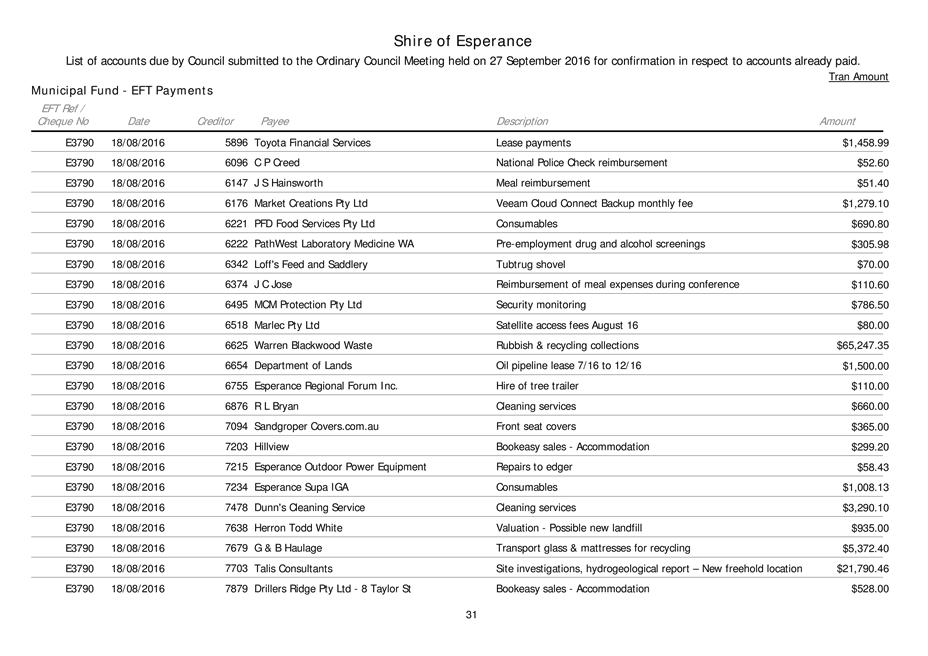
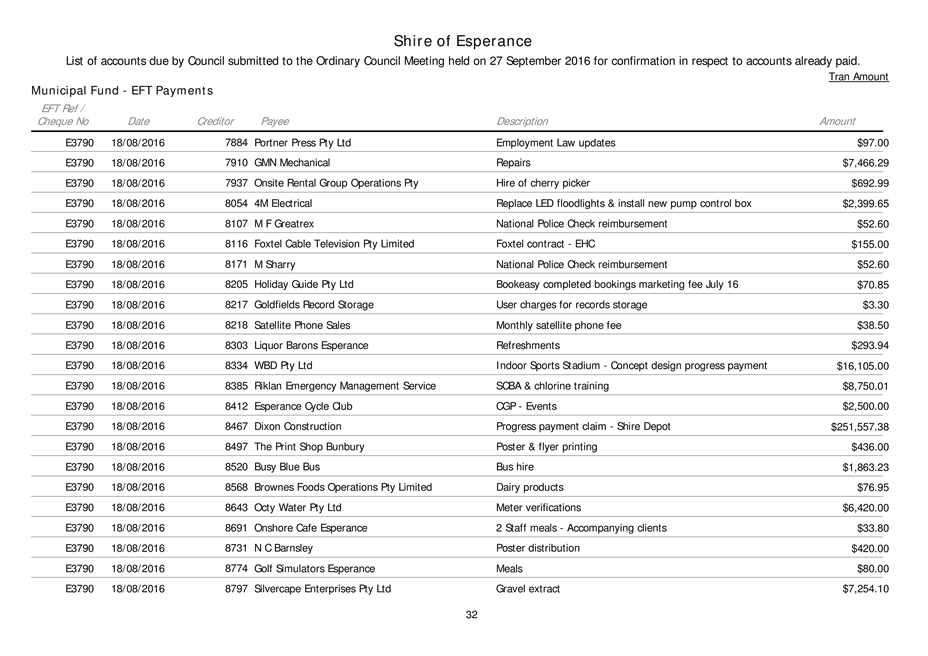
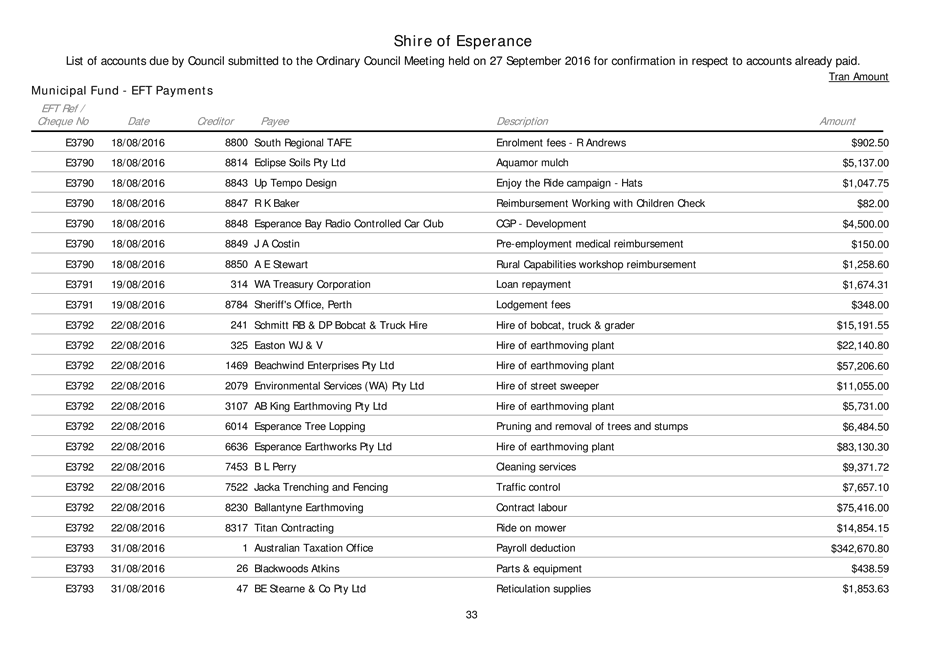
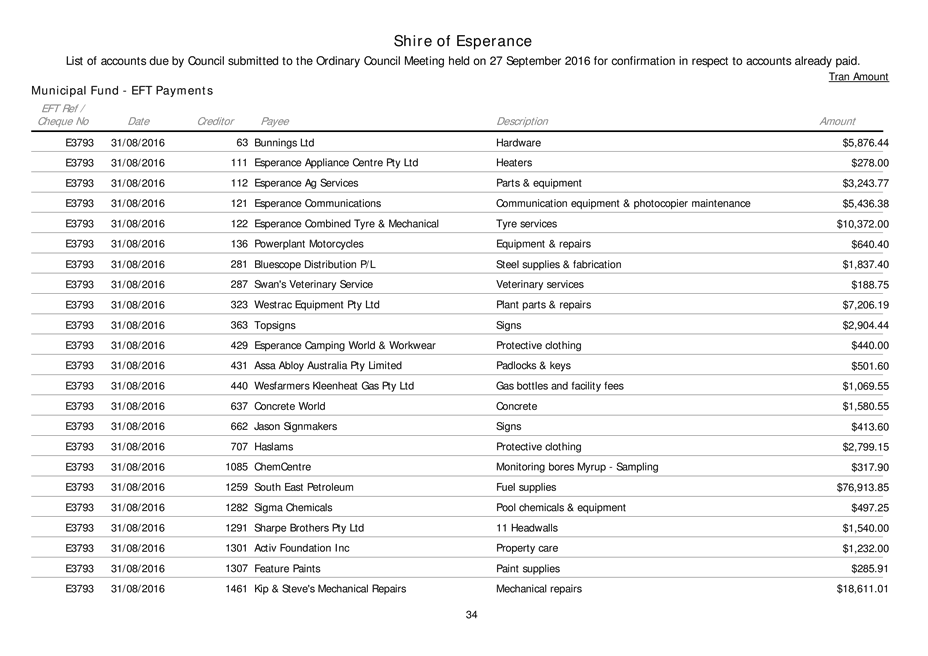
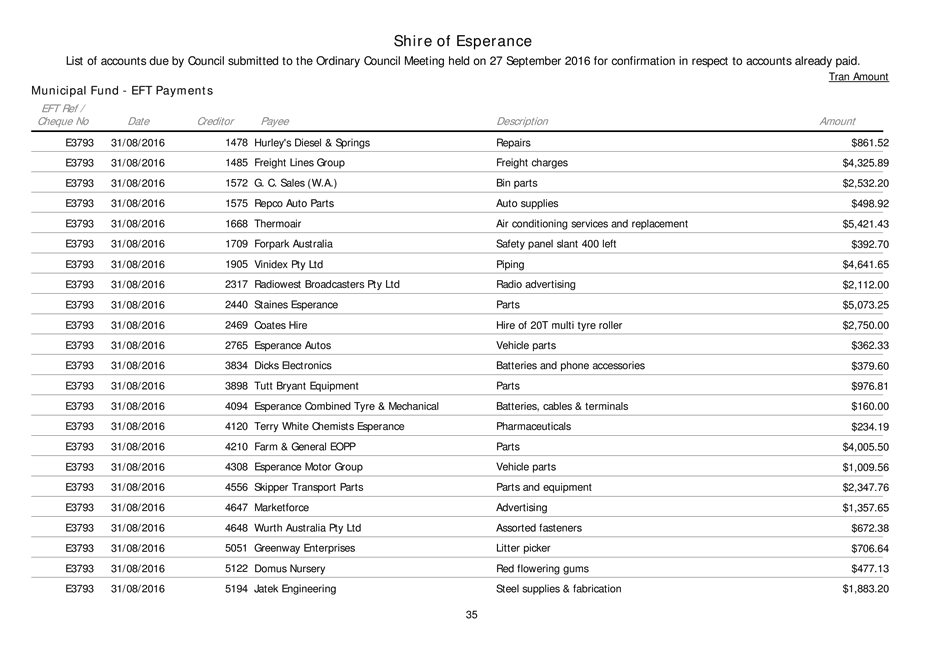
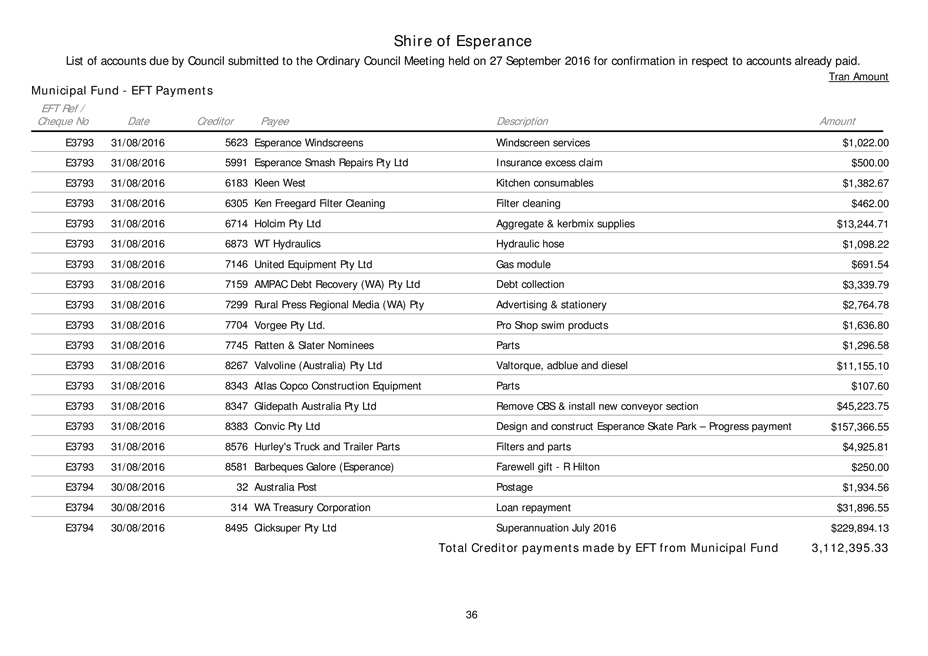
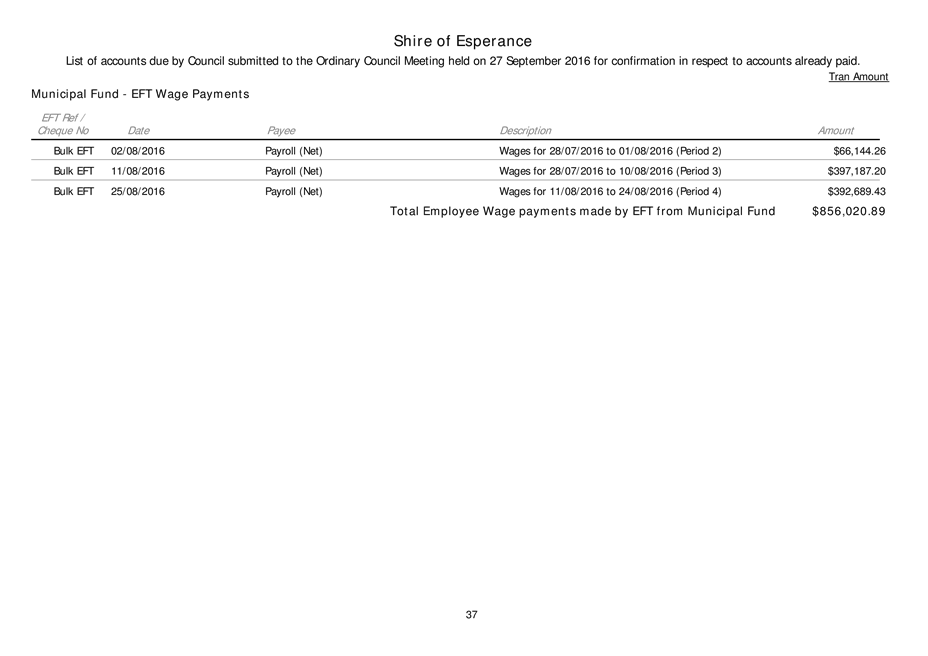
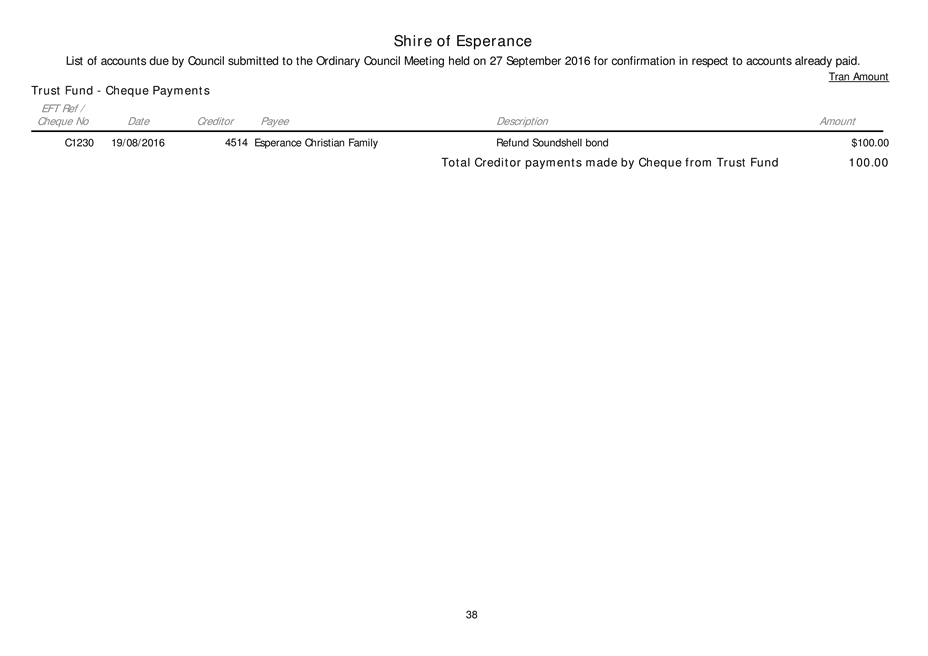
27 September 2016 Page
140
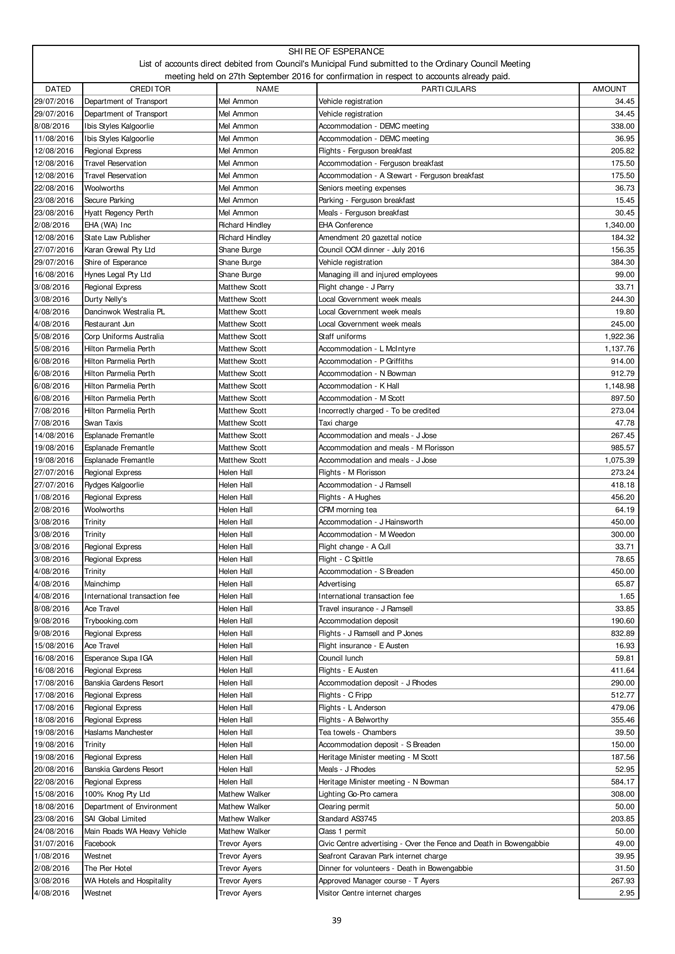

27 September 2016 Page
142
12.4 Executive Services
Item: 12.4.1
Amendment
to the Delegated Authority Register 2015/16
|
Author/s
|
Karen Naylor
|
Project Reporting Officer
|
|
|
Richard Hindley
|
Manager Strategic Planning & Land Projects
|
|
Authorisor/s
|
Matthew Scott
|
Chief Executive Officer
|
File Ref: D16/18948
Applicant
Internal
Location/Address
Shire of Esperance
Executive Summary
For Council to consider amending the Delegated
Authority Register 2016-2017 with reference to 5.3 -Bush Fire Control Officers are
authorised to perform s.33 and s.59A of the Bush Fires Act 1954. The
proposed amendment is to remove staff who have left the organization, to include the newly
appointed Community Emergency Management Coordinator and to acknowledge the
change of title for the Manager Development and Statutory Services with
reference to 6.2 – Prohibition orders (s.65(1), s.66 & s.67(4) and
6.3 – Registration of food business (s.110(1)(5) & s.112) of the Food
Act 2008.
Recommendation in Brief
That Council delegates s.33 and s.59A of the Bush Fires Act 1954 to Shaun Breaden and Karen Naylor and s.65(1), s.66, s.67(4)
s.110(1)(5) & s.112 of the Food Act 2008 to the Manager
Development and Statutory Services; and Council amends delegation 4.2(b) by adding at the end a
dot point stating “Where a planning application is received that is not
consistent with an adopted Local Planning Policy.”
Background
The Delegated Authority Register 2016-17 was endorsed by
Council at the July 2016 OCM, since this date several staff have left the
organisation, the Community Emergency Management Coordinator’s was filled and the
Manager of Development Compliance title was changed to Manager Development and
Statutory Services.
Officer’s Comment
Whilst section 5.46(2) of the Local Government Act
requires delegations to be formally reviewed annually, this does not preclude
local governments from amending or enabling new delegations on an ad-hoc basis
as required throughout the year.
As a decision maker (either Council or a delegated officer)
a Local Planning Policy is considered a relevant consideration in determining a
development application. This will allow a delegated officer to refuse a
development application when it is not compliant with a Local Planning Policy.
It is proposed to include non-compliance with an
adopted Local Planning Policy as a delegated reason for the refusal of a
planning application. It should be noted however that the Outbuildings Local
Planning Policy requires referral to Council in its provision and as such would
not be affected by this amended delegation.
Consultation
Director External Services
Manager Development Compliance
Statutory Implications
Local Government Act 1995
Food Act 2008
Strategic Implications
Strategic Community Plan 2012-2022
Civic Leadership
Maintain a clear,
transparent and ethical decision making process
Openness and transparency
in Council decisions
Corporate Business Plan 2014/2015 – 2017/2018
4.5.1.16 Review and update Delegations Register
Attachments
|
a.
|
Delegated Authority Register -
Change to register - OCM 02/09/2016
|
|
|
Officer’s Recommendation
That Council delegate Sections s.33 and s.59A of
the Bush Fires Act 1954 to Shaun Breaden and Karen Naylor.
Voting Requirement Absolute
Majority
|
27 September 2016 Page
144
PLANNING AND DEVELOPMENT
ACT 2005
|
|
4.2
General administration powers
|
|
Function Delegated:
This text is provided as a reference only.
Delegates shall only act in full understanding of the delegated statutory
power, inclusive of conditions [see below].
|
Unless the specific
power may only be exercised by the Council itself (or is not permitted to be
delegated under the provisions of the Local Government Act), the
Council hereby delegates authority under Clause 82 of Schedule 2 of the
Planning and Development (Local Planning Schemes) Regulations 2015 to the Chief Executive Officer[1] to administer the
Scheme and exercise discretionary powers to conditionally or unconditionally
approve (or recommend approval for) the following subject to the delegate/s
actions being in accordance with the Act, the Scheme, the Acceptable Development requirements
of the Residential Design Codes and variations that satisfy the Objectives
and Performance Criteria of the Codes, relevant Local Laws and adopted
Planning Strategies or Policies:
a) Except
for new buildings in the Central Area unless under a value of $1,000,000
and/or a place of Heritage Value under Part 7 of the Scheme, development[2] and land use
applications:
· where advertising is not necessary;
· for which advertising is necessary and there are no
objections;
· for which advertising is necessary and any comments
can be resolved through negotiation with the applicant or appropriately
conditioned on the planning consent;
· for which advertising is necessary and objections
are received which are determined to be frivolous or vexatious by the Chief
Executive Officer;
· for which comments have been sought from any
Government instrumentalities and those recommendations have been
satisfactorily addressed or appropriately conditioned on the planning consent.
b) Unless
the specific power may only be exercised by the Council itself (or is not
permitted to be delegated under the provisions of the Local Government Act),
the Council hereby delegates authority under Clause 82 of Schedule 2 of the Planning
and Development (Local Planning Schemes) Regulations 2015 to the Chief Executive
Officer[3]
to administer the Scheme and exercise discretionary powers to refuse (or
recommend refusal for) the following subject to the delegate/s actions being
in accordance with the Act, the Scheme, the Acceptable Development
requirements of the Residential Design Codes and variations that satisfy the
Objectives and Performance Criteria of the Codes, relevant Local Laws and
adopted Planning Strategies or Policies:
· Where a planning application is received that is
classified as “X’ or non-permitted under the provisions of Local
Planning Scheme No. 23.
· Where a request for further information has not been
responded to in accordance with Policy DEV-PS 003.
· Where a planning application is received that is not
mentioned in the Zoning and Land Use Table and is not consistent with the
objectives of the particular zone.
· Where a planning application is received that is not
consistent with an adopted Local Planning Policy.
c) Commence
advertising of any proposal where so required by the Scheme or other related
legislation and inform or consult with any affected person or statutory
authority prior to the application being determined by or on behalf of
Council.
d) Development
on reserved land that is consistent with the gazetted purpose of the reserve,
the Scheme and leasing arrangements subject to prior consultation with the
reserve manager or the Crown if not under Council control.
e) Concurrently
advertise and subsequently approve or renew planning applications for:
· extractive industries under the Scheme and
Extractive Industries Local Law 2001.[4]
· kennels under the Scheme and Dogs Local Law 2002[5].
f) Make recommendations to the
Western Australian Planning Commission (WAPC) for:
· approval of subdivisions, amalgamations, strata and
survey-strata plans, and variations to such applications that comply with the
Scheme, any adopted ODP and the adopted Local Planning Strategy;
· refusal of subdivisions, amalgamations, strata and
survey strata plans, and variations to such applications that do not comply
with the Scheme, any adopted ODP and the adopted Local Planning Strategy; and
· clearance of subdivision conditions that comply with
the WAPC preliminary approval and Council’s applicable development
standards including authorization of receipt or refund of bonds, cash
(includes cleared cheque) or bank guarantees for associated works.
g) Administer
the “Planning for Bushfire Protection” document prepared by
Department of Planning and Department Fire
& Emergency Services (DFES), including approval of fire management plans.
h) Determine
that a revised plan is considered to contain modifications that are minor and
do not amount to a significantly different proposal, do not breach any of the
conditions of the approval and do not materially affect the decision given
by, or on behalf of, Council or the WAPC.
i) Determine
whether there is compelling evidence to warrant reconsideration of a Council
decision whether the decision was made by, or on behalf of Council.
j) Amend
or revoke planning consent upon the request of the owner prior to
commencement of the use or development.
k) Respond,
defend and otherwise deal with legal proceedings arising from planning
decisions made by, or on behalf of, Council.[6].
l) Exercise
discretion on behalf of Council to reach determination, where appropriate, of
Appeals processed by mediation under the State Administrative Tribunal.
m) Exercise
discretion on behalf of Council in relation to the Arbitration provisions of
the Scheme.
n) Make
modifications to Scheme Amendments in accordance with directions from the
Minister for Planning and Infrastructure providing that any such
modification:
· does not substantially alter the intent of the
Council in adopting the amendment; or
· is required because the proposed
text is not lawful.
o) Agree
to accept management orders for reserves provided they have been created
under Section 152 of the Act.
p) Extend
time for a planning consent when there has been no proposed change to the
Scheme or supporting planning strategies and policies that would affect the
previous approval and any change to the proposed plans is relatively minor.
q) Comment
on mineral exploration licenses.
r) Issue
Liquor Licensing Act Section 40 Certificates regarding compliance with
relevant planning laws.
s) Enter
land or buildings for the purposes of administering the Scheme.
t) Allow
appropriate selection of road names by developers from the Council/Geographic
Names Committee approved reserved name list subject to developers being given
the opportunity to submit alternative selections to Council
u) Determine
that a use is consistent or not consistent with the objectives of a zone and
determine an application under section 4.4.2 of the Scheme.
v) Determine
a cash-in-lieu payment for parking spaces in accordance with section 5.11.2
of the scheme.
|
|
Statutory Power being Delegated:
|
Local Government Act 1995
Planning and Development Act 2005
Planning and Development (Local
Planning Schemes) Regulations 2015
Shire of Esperance Local Planning
Scheme No 23
Shire of Esperance Extractive
Industries Local Law 2001
Shire of Esperance Dogs Local Law
2002
|
|
Power is originally assigned to:
|
Local Government
|
|
Statutory Power of Delegation
|
Local
Government Act 1995
s.5.42 –
Delegation of some powers or duties to the CEO
Planning and Development
(Local Planning Scheme) Regulations 2015
Sc.2, Part
10, cl.82
|
|
Power Delegated to:
|
Chief Executive Officer
|
|
Council’s Conditions on Delegation:
|
Nil
|
|
Statutory Power to Sub-Delegate:
|
Local
Government Act 1995
s.5.44
– CEO may delegate some powers and duties to other employees
|
|
Record Keeping Statement
[s5.46(3)]
|
A person to whom a power
or duty is delegated under this Act, is to keep records in accordance with
the Local Government (Administration) Regulations 1996 r.19 Delegates to keep
certain records (Act s.5.46(3)). You are required to maintain a written
record of;
(a) how you exercised the
power or discharged the duty; and
(b) when you exercised
the power or discharged the duty; and
(c) the persons or
classes of persons, other than Council or committee members or employees of
the local government, directly affected by the exercise of the power or the
discharge of the duty.
|
|
Compliance Links
|
Section 11 & 11.1
Shire of Esperance Local Planning Scheme No.23
|
|
Delegation Administration:
|
|
|
Decision Reference
|
|
Decision Reference
|
|
1.
|
Adopted – February 2004, Resolution
# O0204-0769
|
5.
|
Reviewed – May 2015, Resolution # O0515-026
|
|
2.
|
Amended– February 2011, Res # O0211-1575 &
O0211-1573
|
6.
|
Amended – November 2015, Resolution # O1115-030
|
|
3.
|
Reviewed - May 2012, Resolution # AP0412-005
|
7.
|
Reviewed – July 2016, Resolution # O0716-032
|
|
4.
|
Reviewed - June 2013,
Resolution # O0613-012
|
8.
|
Review – Sept 2016, Resolution # O
|
|
|
|
|
|
|
BUSH FIRES ACT 1954
|
5.3
Bush Fire Control Officers are authorised to perform s.33 and s.59A of the
Bush Fires Act 1954
|
|
Function Delegated:
This text is provided as a reference only.
Delegates shall only act in full understanding of the delegated statutory
power, inclusive of conditions [see below].
|
Bush Fire Control
Officers are authorised to perform the following functions-
s.33 – Local Government may
require occupier of land to plough or clear fire-break
s.59A –
Alternative procedure – infringement notices
|
|
Statutory Power being Delegated:
|
Bush
Fires Act 1954
s.33 – Local Government may
require occupier of land to plough or clear fire-break
s.59A
– Alternative procedure – infringement notices
|
|
Power is originally assigned to:
|
Local Government
|
|
Statutory Power of Delegation
|
Bush
Fires Act 1954
s.38(1)
– a local government may from time to time appoint such persons as it
thinks necessary to be its bush fire control officers under and for the
purposes of this Act.
|
|
Power Delegated to:
|
Mel Ammon
Shaun Breaden
Karen Naylor
Jan Verbaant
Tundra Foo
Kole Wittorff
|
|
Conditions on Delegation:
|
Nil
|
|
Statutory Power to Sub-Delegate:
|
Local Government Act 1995
s.5.44 CEO may delegate powers and duties to other
employees
|
|
Record Keeping Statement
[s5.46(3)]
|
A person to whom a power or duty is delegated under
this Act, is to keep records in accordance with the Local Government (Administration) Regulations
1996 r.19 Delegates to keep certain records (Act s.5.46(3)). You are
required to maintain a written record of;
·
(a) how you exercised the
power or discharged the duty; and
·
(b) when
you exercised the power or discharged the duty; and
·
(c) the persons or classes of persons, other than Council or committee
members or employees of the local government, directly affected by the
exercise of the power or the discharge of the duty.
|
|
Compliance Links
|
Local
Government Act 1995 and Bush Fires Act 1954
|
|
Delegation Administration:
|
|
|
Decision Reference
|
|
Decision Reference
|
|
1.
|
Adopted - Sept 2015, Resolution # O0915-024
|
5.
|
|
|
2.
|
Reviewed – July 2016, Resolution # O0716-032
|
6.
|
|
|
3.
|
Reviewed – Sept 2016, Resolution #
|
7.
|
|
|
4.
|
|
8.
|
|
|
|
|
|
|
|
FOOD ACT 2008
|
|
6.2
Prohibition orders (s.65(1), s.66 & s.67(4)
|
|
Function Delegated:
This text is provided as a reference only.
Delegates shall only act in full understanding of the delegated statutory
power, inclusive of conditions [see below].
|
1) Serve a Prohibition order
on the proprietor of a food business in accordance with s65 of the Food
Act 2008 (the Act)
2) Give a Certificate of
clearance, where inspection demonstrates compliance with a Prohibition order
and any Improvement Notices [s66 of the Act].
3) Give written notice to
proprietor of a food business on whom a Prohibition Order has been served of
the decision not to give a certificate of clearance after an inspection
[s67(4) of the Act].
|
|
Statutory Power being Delegated:
|
Food Act
2008
s.65(1)
– Prohibition order
s.66
– Certificate of clearance to be given in certain circumstances
s.67(4) – Request for
re-inspection
|
|
Power is originally assigned to:
|
Enforcement Agency (Local Government)
|
|
Statutory Power of Delegation
|
Food Act
2008
s.118(2)(b)
– Local government (enforcement agency) may delegate a function conferred
on it
s.118(3)
– Delegation subject to conditions [s119] and guidelines adopted [s120]
s.118(4) – Sub-delegation
only permissible if expressly provided in regulations
|
|
Power Delegated to:
|
Chief Executive Officer
Director External Services
Manager Development and Statutory Services
Coordinator Environmental Health
Environmental Health Officer
|
|
Council’s Conditions on
Delegation:
|
Nil
|
|
Statutory Power to Sub-Delegate:
|
Nil
|
|
Record Keeping Statement
[s5.46(3)]
|
A
person to whom a power or duty is
delegated under this Act, is to keep records in accordance with the Local Government (Administration) Regulations
1996 r.19 Delegates to keep certain records (Act s.5.46(3)). You are
required to maintain a written record of;
·
(a) how you exercised the power
or discharged the duty; and
·
(b) when
you exercised the power or discharged the duty; and
·
(c) the persons or classes of persons, other than Council or committee
members or employees of the local government, directly affected by the
exercise of the power or the discharge of the duty.
|
|
Compliance Links
|
Food
Act 2008
Food Regulations 2009
Department of Health:
Food Act 2008 Regulatory Guideline No.1:
Introduction of
Regulatory Food Safety Auditing in WA
Department of Health:
Food Unit Fact Sheet 8: Guide to Regulatory
Guideline No.1
Department of Health: WA
Priority Classification System
Department of Health:
Food Act 2008 Verification of Food Safety
Program
Guideline
|
|
Delegation Administration:
|
|
|
Decision Reference
|
|
Decision Reference
|
|
1.
|
Adopted - June 2013,
Resolution # O0613-012
|
5.
|
Reviewed – Sept 2017, Resolution #
|
|
2.
|
Reviewed – May 2015, Resolution # O0515-026
|
6.
|
|
|
3.
|
Amended – March 2016, Resolution # O0316-023
|
7.
|
|
|
4.
|
Reviewed – July 2016, Resolution # O0716-032
|
8.
|
|
|
|
|
|
|
|
|
6.3
Registration of food business (s.110(1)(5) & S.112)
|
|
Function Delegated:
This text is provided as a reference only.
Delegates shall only act in full understanding of the delegated statutory
power, inclusive of conditions [see below].
|
1) Register
a food business in respect of any premises for the purposes of Part 9 of the Food
Act 2008 and issue a certificate of registration [s110(1) of the Food
Act 2008 (the Act)].
2) After considering an application, determine
to grant (with or without conditions) or refuse the application [s110(5) of
the Act].
3) Vary the
conditions or cancel the registration of a food business in respect of any
premises under Part 9 of the Food Act 2008 [s112(1) of the Act].
|
|
Statutory Power being Delegated:
|
Food Act
2008
s.110 (1) and (5) –
Registration of food business
s.112
– Variation of conditions or cancellation of registration of food
businesses
|
|
Power is originally assigned to:
|
Enforcement Agency (Local Government)
|
|
Statutory Power of Delegation
|
Food Act
2008
s.118(2)(b) – Local government (enforcement agency)
may delegate a
function
conferred on it
s.118(3) – Delegation subject
to conditions [s119] and guidelines adopted [s120]
s.118(4)
– Sub-delegation only permissible if expressly provided in regulations
|
|
Power Delegated to:
|
Chief Executive Officer
Director External Services
Manager Development and Statutory Services
Coordinator Environmental Health
Environmental Health Officer
|
|
Council’s Conditions on
Delegation:
|
Nil
|
|
Statutory Power to Sub-Delegate:
|
Nil
|
|
Record Keeping Statement
[s5.46(3)]
|
A person to whom a power or duty is delegated under
this Act, is to keep records in accordance with the Local Government (Administration) Regulations
1996 r.19 Delegates to keep certain records (Act s.5.46(3)). You are
required to maintain a written record of;
·
(a) how you exercised the
power or discharged the duty; and
·
(b) when
you exercised the power or discharged the duty; and
·
(c) the persons or classes of persons, other than Council or committee members
or employees of the local government, directly affected by the exercise of
the power or the discharge of the duty.
|
|
Compliance Links
|
Food Act 2008
Food Regulations 2009
Department of Health: Food Act 2008 Regulatory
Guideline No.1:
Introduction of Regulatory Food Safety Auditing in
WA
Department of Health: Food Unit Fact Sheet 8: Guide
to Regulatory
Guideline No.1
Department of Health: WA Priority Classification
System
Department of Health: Food Act 2008 Verification of
Food Safety
Program Guideline
|
|
Delegation Administration:
|
|
|
Decision Reference
|
|
Decision Reference
|
|
1.
|
Adopted - June 2013,
Resolution # O0613-012
|
5.
|
|
|
2.
|
Reviewed – May 2015, Resolution # O0515-026
|
6.
|
|
|
3.
|
Amended – March 2016 Resolution # O0316-023
|
7.
|
|
|
4.
|
Reviewed – July 2016, Resolution # O0716-032
|
8.
|
|
|
|
|
|
|
|
27 September 2016 Page
152
Item: 12.4.2
Completed
review of three (3) Shire of Esperance Local Laws
|
Author/s
|
Karen Naylor
|
Project Reporting Officer
|
|
Authorisor/s
|
Matthew Scott
|
Chief Executive Officer
|
File Ref: D16/21039
Applicant
Internal
Location/Address
Shire of Esperance
Executive Summary
For Council to acknowledge
the review undertaken as per s3.16 of the Local Government Act 1995 in
relation to the Shire of Esperance’s Activities on Thoroughfares and Trading in Thoroughfares and
Public Places Local Law 2001, Local Government Property Local Law 2001 and Private Property
Local Law 2003 has completed.
During the submission
period one (1) submission was received that requires consideration in accordance with Section
3.16(3) of the Local Government Act 1995.
Council should consider repealing the Shire of
Esperance Activities on
Thoroughfares and Trading in Thoroughfares and Public Places Local Law 2001 in accordance with
Section 3.16(4) of the Local Government Act 1995.
Recommendation in Brief
That Council, as a result of the full review of Local
Laws:
1. Council
notes that one (1) submission was received that requires consideration in
accordance with Section 3.16(3) of the Local Government Act 1995.
2. Council
considers repealing the Shire of Esperance Activities on Thoroughfares and Trading in Thoroughfares and
Public Places Local Law 2001 under s3.16(4) of the Local Government Act 1995.
Background
s.3.16. Periodic review of local laws
(1) Within a period of 8 years from the day when a
local law commenced or a report of a review of the local law was accepted under
this section, as the case requires, a local government is to carry out a review
of the local law to determine whether or not it considers that it should be
repealed or amended.
(2) The local government is to give Statewide public
notice stating that —
(a) the local government
proposes to review the local law; and
(b) a copy of the local law
may be inspected or obtained at any place specified in the notice; and
(c)
submissions about the local law may be made to the local government before a
day to be specified in the notice, being a day that is not less than 6 weeks
after the notice is given.
(2a) A notice under subsection (2) is also to be
published and exhibited as if it were a local public notice.
(3) After the last day for submissions, the local
government is to consider any submissions made and cause a report of the review
to be prepared and submitted to its council.
(4) When its council has considered the report, the
local government may determine* whether or not it considers that the local law
should be repealed or amended.
At the June 2016 OCM Council requested the
Chief Executive Officer under s.3.16 of the Local Government Act 1995, gives
local and state-wide public notice of the Shire’s intent to review:
· Activities on Thoroughfares and Trading in
Thoroughfares and Public Places Local Law 2001;
· Local Government Property Local Law 2001; and
· Private Property Local Law 2003.
The review period is now closed. During the review
process it was evident that the Activities on Thoroughfares and Trading in Thoroughfares and
Public Places Local Law 2001 requires changes to accommodate submission suggestions and
suitability with current community needs.
Shire Officers are still reviewing the Shire of
Esperance’s Local Government Property Local Law 2001 and Private Property
Local Law 2003, and recommendations on potential changes to these local laws
are still being assessed and will either be repealed or amended at a later
date.
Officer’s Comment:
A full review means we can ensure the
validity and timeliness of these Local Laws, ensuring they are kept relevant
and provides a robust framework that supports our local community.
These Local Laws directly impact on
several topical issues, including signage, al fresco and permitted activities
on Local Government Property.
Table
1 summarises the submission received. Comments contained in the submission are
included with reference to the applicable local law and the officer’s
comments. The officer’s comments includes references to the current local
law and the potential influence on the proposed local law.
Table 1: Submissions for Activities on Thoroughfares and
Trading in Thoroughfares and Public Places Local Law (Local Law)
|
Submission comment
|
Local Law reference
|
Officer comment
|
|
With
a permit, businesses should be allowed to display reasonable and appropriate
signage within an appropriate perimeter of their business.
Consultation
should occur with business owners to determine the conditions around the type
of signage. It should be noted that business owners want flexibility with
their signage, and while there can be guidelines regarding the size and
nature of signs, there shouldn’t be rigid restrictions.
|
Clauses:
3.2 (3)
3.4
|
The
current local law allows signage with a permit, however clause 3.2 (3) is
prescriptive in nature and leads to restrictions in what can be approved by
the Shire. Additionally, clause 3.4 has further prescriptive restrictions
imposed as conditions of any approval.
The future local law needs
to allow for the Shire to exercise discretion in approvals, and therefore
maintain flexibility for the community. Any proposed sign should be assessed
on its individual merit, rather than rigid restrictions.
|
|
Within
an appropriate perimeter directly in front of their premises, businesses
should be able to display signage, goods for sale and utilise alfresco dining
options.
This
allows businesses to use the space in front of their premises on an ad-hoc
basis; displaying temporary signage (for example, promoting special
activities or events), products they’re wishing to showcase and
maximising good weather to offer alfresco dining.
As
such, the wording surrounding stallholders and required permits currently in
section 6 should be changed to reflect that business owners can utilise this
space in front of their business without being required to obtain a permit
for each occasion.
|
Clauses:
Part 6
division 1
Part 6
division 3
|
Providing
an exemption does in theory provide greater flexibility for business owners,
however there may be unforeseen consequences
with this approach:
· An increase in the prescriptive nature of the local
law would be required, which could result in a lack of flexibility;
· Local Law may be suitable short term, but be
problematic in the future. The local law must be robust enough to accommodate
changes in community expectations;
· Drafting a precedent in local law wording may cause
lengthy delays in progressing the local law through, and addressing the
current identified issues;
· Broad exemptions create difficulty in administering
local law, and enforcement could be difficult in some instances at the
detriment to the community
Any proposed local law must
enable a single approval to be granted to streamline the process. A
conditional approval (issued annually or longer) could address the comments
raised in the submission
|
|
Allowances
in place for businesses to display directional signage that informs people of
services available on days such as public holidays. We envisage that
businesses would apply for a permit that would allow them to display
temporary, portable signage on specific days’ in designated locations.
|
Clauses:
3.2
3.4
|
Directional
signage is limited by clause 3.2(2), and is ambiguous as to when and how
often the exemption is used.
Further
to this, portable signage cannot be approved under clause 3.4 other than
immediately adjacent to the business to which the sign relates.
The restrictions remove the
ability to assess a sign on its individual merit, and an approval mechanism
should be considered in the new local law.
|
|
The ECCI supports the
current framework around portable directional signage in principle, however
encourages the Shire of Esperance to engage with regular uses of this signage
(for example real estate agents and Tourism Esperance) to ensure that their
needs are being taken in to consideration, especially regarding the
positioning of signage. We believe that discussion needs to be held regarding
item 3.2.3 (c), which heavily restricts the positioning of portable directional
signs for events such as home opens.
|
Clause:
3.2 (3)(c)
|
The
current clause prevents signage from being placed “on or within 3m of a
carriageway”, and provides no variation provisions.
Any
relaxation of this should be considered in the context of what could be
compliant under traffic safety requirements. Additionally, the permit
approval process should allow sufficient flexibility to assess any sign on
its individual merit.
|
|
We also believe that the
changes being made to the local law should allow more flexibility regarding
the size of portable directional signage.
|
Clause:
3.4
|
Portable signage provisions
under clause 3.4 are prescriptive and lack flexibility. Any proposed local
law should address this concern.
|
|
The cost of permits should
be kept to a realistic amount, which doesn’t place a significant burden
on business owners.
|
N/A
|
Permit fee is not a
statutory fee prescribed by the local law, and can be modified by council.
|
In summary the majority of
the changes proposed by the ECCI agree with community consultation and Shire
officer recommendations. These suggested proposals can predominately be
accommodated in a new Activity on
Thoroughfares and Trading in Thoroughfares and Public Places Local Law.
Consultation:
Manager Development and Statutory Services
Community submissions
Financial Implications
The financial implications arising from this report will be
restricted to advertising costs and resource time during the review process.
Asset Management Implications
Nil
Statutory Implications
The statutory implications associated with this item are:
· Local Government Act 1995 s3.16
Policy Implications
Nil
Strategic Implications
Strategic Community Plan 2012-2022
Civic Leadership
Strategy 4.2 Maintain a clear, transparent and ethical
decision making process
Strategy 4.3 Ensure open and consistent communication between
the Shire and the community
Corporate Business Plan 2015/2016 – 2018/2019
Action 4.2.1.2 Review Shires suite of Local Laws
Action 4.3.1.2 Manage Corporate Reporting
Environmental Considerations
Nil
Attachments
|
a.
|
Submission - Chamber of Commerce -
Review of Local Laws s3.16
|
|
|
Officer’s Recommendation
That Council, as a result of the full review of Local
Laws:
1. Notes that one (1) submission was received that
requires consideration in accordance with Section 3.16(3) of the Local
Government Act 1995.
2. Repeals the
Shire of Esperance Activities on
Thoroughfares and Trading in Thoroughfares and Public Places Local Law 2001 under s3.16(4) of the Local
Government Act 1995.
Voting Requirement Absolute
Majority
|
27 September 2016 Page
156



27 September 2016 Page
159
Item: 12.4.3
Commence
procedure for making a new Thoroughfares Local Law
|
Author/s
|
Karen Naylor
|
Project Reporting Officer
|
|
Authorisor/s
|
Matthew Scott
|
Chief Executive Officer
|
File Ref: D16/21667
Applicant
Internal
Location/Address
The Shire of Esperance
Executive Summary
For Council to undertake the next step in
the review of the Shire’s
Activities on Thoroughfares and Trading in Thoroughfares and Public Places
Local Law 2001, Local Government Property Local Law 2001 and Private
Property Local Law 2003.
Recommendation in Brief
That Council requests the Chief Executive Officer:
· Under s3.12(2) of the Local
Government Act 1995, the Shire of Esperance proposes to make the Activities on Thoroughfares and
Trading in Thoroughfares and Public Places Local Law 2016; and
· Undertake the required statutory advertising as
per s3.12(3) of the Local
Government Act 1995.
Background
At the June 2016 OCM Council requested the
Chief Executive Officer under s.3.16 of the Local Government Act 1995, gives
local and state-wide public notice of the Shire’s intent to review:
· Activities on Thoroughfares and Trading in
Thoroughfares and Public Places Local Law 2001;
· Local Government Property Local Law 2001; and
· Private Property Local Law 2003.
Council, as a result of the review of the Local Laws
mentioned above:
1. Council
notes that one (1) submission was received that requires consideration in
accordance with Section 3.16(3) of the Local Government Act 1995.
2. Council
considers repealing the Shire of Esperance Activities on Thoroughfares and Trading in Thoroughfares and
Public Places Local Law 2001 under s3.16(4) of the Local Government Act 1995.
3.12. Procedure for making local laws
(1) In making a local law a local government is to
follow the procedure described in this section, in the sequence in which it is
described.
(2) At a council meeting the person presiding is to
give notice to the meeting of the purpose and effect of the proposed local law
in the prescribed manner.
(3) The local government is to —
(a) give Statewide public notice stating that —
(i) the
local government proposes to make a local law the purpose and effect of which
is summarized in the notice; and
(ii) a
copy of the proposed local law may be inspected or obtained at any place
specified in
the notice; and
(iii)
submissions about the proposed local law may be made to the local government
before a day to be specified in the notice, being a day that is not less than 6
weeks after the notice is given; and
(b) as soon as the notice is given, give a copy of the
proposed local law and a copy of the notice to the
Minister and, if another Minister administers the Act
under which the local law is proposed to be made, to that other Minister; and
(c) provide a copy of the proposed local law, in
accordance with the notice, to any person requesting it.
(3a) A notice under subsection (3) is also to be
published and exhibited as if it were a local public notice.
(4) After the last day for submissions, the local
government is to consider any submissions made and may make the local law* as
proposed or make a local law* that is not significantly different from what was
proposed.
* Absolute majority required.
These Local Laws directly impact on several topical issues,
including signage, al fresco and permitted activities on Local Government
Property.
The Western Australian Local Government Association (WALGA)
provides assistance to local governments in the implementation of local laws by
creating “model” local laws. These local laws provide a starting
point in which to develop local laws suitable to the locality of the local
government whilst ensuring the local laws across the state are generally
similar when dealing with a particular subject matter.
The proposed local law is based on the WALGA
“Activities in Thoroughfares and Public Places and Trading” model
local law and the “City of Busselton Activities in Thoroughfares and
Public Places and Trading Local Law 2015”. The City of Busselton local
law was based on the WALGA model local law, and has similar requirements to
Esperance.
Officer’s Comment:
Pursuant to Section 3.12 of
the Local Government Act 1995, the Shire of Esperance proposes to make
the following Local Law:
Activities on
Thoroughfares and Trading in Thoroughfares and Public Places Local Law 2016
The
purpose of the Activities on
Thoroughfares and Trading in Thoroughfares and Public Places Local Law 2016 is to replace the Activities
on Thoroughfares and Trading in Thoroughfares and Public Places Local Law 2001, to capture
current community needs, adherence to legislation requirements, and to consolidate and make one law relating to Activities
on Thoroughfares and Trading in Thoroughfares and Public Places.
The
effect of this Local Law is to acknowledge some activities are prohibited and some activities are
permitted only under permit on thoroughfares and public places.
The proposed local law is
broadly based on the WALGA model Activities in Thoroughfares and Public Places
and Trading Local Law, and has incorporated a number of modifications made in
2015 by the City of Busselton. These Busselton modifications were published in
the Government Gazette on 20 February 2015, and additionally, further
publications indicate the Joint Standing Committee has allowed the Local Law.
In preparing the new local law, it was considered appropriate to rely on
previously published documents to ensure that the local law is contemporary and
consistent with the rest of the state.
Through previous formal and
informal consultation it was identified that several relevant issues exist that
require review. Of particular importance was the provisions relating to signage
and trading, and how in some instances the requirements were too restrictive.
The intent in creating the new Local Law was to provide flexibility in the
approval process, whilst still maintaining enough prescriptive detail for the
Shire to adequately govern within the district.
Part 3 – Advertising
Signs:
Signage has become a
significant area for concern under the current local law, as the previsions are
restrictive and offer little ability for the Shire to exercise discretion in
the approval process. The WALGA model remains consistent with the current local
law and therefore a deviation is proposed. The modifications from the WALGA
model contain similar prescriptive requirements, but allow flexibility in the
decision making process to ensure the local law is fit for purpose currently
and into the future.
Since the Signs Local Law was
repealed in early 2016, all signage applications are assessed under either
Local Planning Scheme No 23 (and signage local planning policy), or the
Thoroughfares Local Law, depending on the location. It is imperative that the
processes remain consistent between both legislative controls, and the proposed
local laws enable approvals based on the individual merit of an application in
a similar manner to a local planning scheme.
Small portable direction
signs which are placed on thoroughfares for the duration of a home open or a
garage sale do not require a permit. Other signs on thoroughfares require a
permit and are subject to specific conditions depending on their nature, as
determined by the City.
Part 6 – Trading:
Unlike
signage, the existing local law provides flexibility in the approval process
for trading in the thoroughfare. The WALGA model has undergone minor refinement
compared to that of the current local law, and does not contain significant
deviations from existing practices. This is considered fit for purpose
currently and into the future.
Please note, the Local Government Property Local Law
2001 and Private Property Local Law 2003 are still being reviewed by Officers
and these will be presented to Council at the October 2016 OCM.
Consultation
Managers Development and Statutory Services
With Council and Executive Management during briefing
sessions.
Financial Implications
The financial implications arising from this report will be
restricted to advertising costs and resource time during the review process.
Asset Management Implications
Nil
Statutory Implications
The statutory implications associated with this item are:
· Local Government Act 1995 (s3.12 and s3.16)
Section 3.5 of the Local
Government Act 1995 provides the heads of power for the Council to make the
proposed local law:
“A local government may
make Local Laws under this Act prescribing all matters that are required or
permitted to be prescribed by
a local law, or are necessary or convenient to be so prescribed, for it to
perform any of its functions
under this Act”.
The procedure for making
local laws is set out in section 3.12 of the Act and regulation 3 of the Local
Government (Functions and General) Regulations 1996. The person presiding at a
council meeting is to give notice of the purpose and effect of a proposed local
law by ensuring that —
(a) the purpose and effect of
the proposed local law is included in the agenda for that meeting; and
(b) the minutes of the
meeting of the council include the purpose and effect of the proposed local
law.
The purpose and effect of the
proposed local law is as follows:
The
purpose of the Activities on
Thoroughfares and Trading in Thoroughfares and Public Places Local Law 2016 is to replace the Activities
on Thoroughfares and Trading in Thoroughfares and Public Places Local Law 2001, to capture
current community needs, adherence to legislation requirements, and to consolidate and make one law relating to Activities
on Thoroughfares and Trading in Thoroughfares and Public Places.
The effect of this
Local Law is to acknowledge some
activities are prohibited and some activities are permitted only under permit
on thoroughfares and public places.
Joint Standing Committee
Section 42 of the
Interpretation Act 1984 allows the WA State Parliament to disallow a local law,
which is a mechanism to guard against the making of subsidiary legislation that
is not authorised or contemplated by the empowering enactment, has an adverse
effect on existing rights or ousts or modifies the rules of fairness.
Parliament has appointed the Joint Standing Committee on Delegated Legislation
(JSC), to undertake an overseeing role on its behalf, which includes the power
to scrutinise and recommend the disallowance of local laws to the Parliament.
The JSC may potentially have concerns with the proposed local law but, as a
result of its terms of reference, cannot consider local laws prior to their
publication in the Government Gazette.
National Competition
Policy
Since
the early 1990’s State, Territory and Commonwealth Heads of Government
through the Council of Australian Governments (COAG) initiated a commitment to
achieving a nationally consistent approach to competition policy in Australia.
This resulted in the adoption of the National Competition Policy (NCP) which
requires, among other things, that local governments ensure that all new local
laws which restrict competition are consistent with the following requirements:
· The benefits of the restriction to the community as a
whole outweigh the costs; and
· The objectives of the local laws can only be achieved
by restricting competition.
However
in accordance with the National Competition Local Law Review Guidelines local
governments are not required to do an assessment against the NCP of a local law
based on a WALGA model local law and adopted by Council without substantial
change. As the proposed local law is based on the WALGA model Activities in
Thoroughfares and Public Places and Trading Local Law an assessment against
the NCP is therefore not required.
Policy Implications
Nil
Strategic Implications
Strategic Community Plan 2012-2022
Civic Leadership
Strategy 4.2 Maintain a clear, transparent and ethical
decision making process
Strategy 4.3 Ensure open and consistent communication between
the Shire and the community
Corporate Business Plan 2015/2016 – 2018/2019
Action 4.2.1.2 Review Shires suite of Local Laws
Action 4.3.1.2 Manage Corporate Reporting
Environmental Considerations
Nil
Attachments
|
a.
|
Activities in Thoroughfares and
Public Places and Tradining Local Law 2016 - Draft Sept 2016
|
|
Officer’s Recommendation
That Council
1. Requests the Chief Executive Officer commences the
law-making process for the Shire of Esperance Activities on Thoroughfares and Trading in
Thoroughfares and Public Places Local Law 2016, the purpose and effect of the
local law being as follows:
Purpose: To replace the Activities on Thoroughfares and Trading in Thoroughfares and Public
Places Local Law 2001 to ensure
currency and adherence to legislation requirements and to consolidate and make one law relating to
Activities on Thoroughfares and Trading in Thoroughfares and Public Places.
Effect: To acknowledge some activities are prohibited and some activities are permitted only
under permit on thoroughfares and public places.
2. Authorises the Chief Executive
Officer under per s3.12(3) of the Local Government Act 1995:
i. to undertake all
statutory advertising; and
ii. provide a copy of the proposed
local law and public notice to the Minister for Local Government.
3. Instructs the Chief Executive
Officer, after the close of the public consultation period, to submit a
report to the Council addressing submissions received on the proposed local law
to enable Council to consider the submissions made and to determine whether the
local law in accordance with s3.12(4) of the Local Government Act
1995.
Voting Requirement Absolute
Majority
|
27 September 2016 Page
164

Shire of
Esperance
ACTIVITIES
IN THOROUGHFARES AND PUBLIC PLACES AND TRADING LOCAL LAW 2016
LOCAL GOVERNMENT ACT
1995
LOCAL
GOVERNMENT ACT 1995
Shire of Esperance
ACTIVITIES IN THOROUGHFARES AND
PUBLIC PLACES AND TRADING LOCAL LAW
TABLE OF CONTENTS
PART 1 -
PRELIMINARY
1.1 Citation
1.2 Definitions
1.3 Application
1.4 Repeal
PART 2 –
activities IN THOROUGHFARES AND PUBLIC PLACES
Division 1 -
General
2.1 General
prohibitions
2.2 Activities
allowed with a permit - general
2.3 No
possession and consumption of liquor on thoroughfare
Division 2 -
Vehicle crossing
Subdivision 1 -
Temporary crossings
2.4 Permit
required
Subdivision 2 -
Redundant vehicle crossings
2.5 Removal
of redundant crossing.
Division 3 -
Verge treatments
Subdivision 1 -
Preliminary
2.6 Interpretation
2.7 Application
Subdivision 2 -
Permissible verge treatments
2.8 Permissible
verge treatments
2.9 Only
permissible verge treatments to be installed
2.10 Obligations
of owner or occupier
2.11 Notice
to owner or occupier
Subdivision 3 -
Existing verge treatments
2.12 Transitional
provision
Subdivision 4 -
Public works
2.13 Power
to carry out public works on verge
Division 4 -
Property numbers
Subdivision 1 -
Preliminary
2.14 Interpretation
Subdivision 2 -
Assignment and marking of numbers
2.15 Assignment
of numbers
Division 5 -
Fencing
2.16 Public
place – Item 4(1) of Division 1, Schedule 3.1 of Act
Division 6 -
Signs erected by the local government
2.17 Signs
2.18 Transitional
Division 7 -
Driving on a closed thoroughfare
2.19 No
driving on closed thoroughfare
PART 3 –
ADVERTISING SIGNS ON THOROUGHFARES
Division 1 -
Preliminary
3.1 Interpretation
Division 2 - Permit
3.2 Advertising
signs and portable direction signs
3.3 Matters
to be considered in determining application for permit
Division 3
– Conditions on permit
3.4 Conditions
on portable sign
3.5 Conditions
on election sign
PART 4 –
OBSTRUCTING ANIMALS, VEHICLES OR SHOPPING TROLLEYS
Division 1 -
Animals and vehicles
4.1 Leaving
animal or vehicle in public place or on local government property
4.2 Prohibitions
relating to animals
Division 2 - Shopping
trolleys
4.3 Interpretation
4.4 Shopping
trolley to be marked
4.5 Person
not to leave trolley in public place
4.6 Retailer
to remove abandoned trolley
4.7 Retailer
taken to own trolley
PART 5
- ROADSIDE CONSERVATION
Division 1 -
Preliminary
5.1 Interpretation
5.2 Application
Division 2 -
Flora roads
5.3 Declaration
of flora road
5.4 Construction
works on flora roads
5.5 Signposting
of flora roads
5.6 Driving
only on carriageway of flora roads
Division 3 -
Special environmental areas
5.7 Designation
of special environmental areas
5.8 Marking
of special environmental areas
Division 4
– Planting in thoroughfares
5.9 Permit
to plant
5.10 Relevant
considerations in determining application
Division 5 -
Clearance of vegetation
5.11 Permit
to clear
5.12 Application
for permit
Division 6 - Fire
management
5.13 Permit
to burn thoroughfare
5.14 Application
for permit
5.15 When
application for permit can be approved
5.16 Prohibitions
on burning
Division 7 -
Firebreaks
5.17 Permit
for firebreaks on thoroughfares
5.18 application
for permit cannot be approved
Division 8 - Commercial
wildflower harvesting on thoroughfares
5.19 General
prohibition on commercial wildflower harvesting
5.20 Permit
for revegetation projects
PART 6
- TRADING IN THOROUGHFARES AND PUBLIC PLACES
Division 1 -
Stallholders and traders
Subdivision 1 -
Preliminary
6.1 Interpretation
Subdivision 2 -
Permits
6.2 Stallholder's
permit
6.3 Trader's
permit
6.4 No
permit required to sell newspaper
6.5 Relevant
considerations in determining application for permit
6.6 Conditions
of permit
6.7 Exemptions
from requirement to pay fee or to obtain a permit
Subdivision 3 -
Conduct of stallholders and traders
6.8 Conduct
of stallholders and traders
Division 2 -
Street entertainers
Subdivision 1 -
Preliminary
6.9 Interpretation
Subdivision 2 -
Permits
6.10 Permit
required to perform
6.11 Variation
of permitted area and permitted time
6.12 Duration
of permit
6.13 Cancellation
of permit
6.14 Obligations
of permit holder
Division 3 -
Outdoor eating facilities on public places
6.15 Interpretation
6.16 Permit
required to conduct Facility
6.17 Matters
to be considered in determining application
6.18 Obligations
of permit holder
6.19 Removal
of Facility unlawfully conducted
6.20 Use
of Facility by public
6.21 Temporary
removal of Facility may be requested
PART 7
- PERMITS
Division 1
– Applying for a permit
7.1 Application
for permit
7.2 Decision
on application for permit
Division 2 -
Conditions
7.3 Conditions
which may be imposed on a permit
7.4 Imposing
conditions under a policy
7.5 Compliance
with and variation of conditions
Division 3 -
General
7.6 Duration
of permit
7.6 Renewal
of permit
7.8 Transfer
of permit
7.9 Production
of permit
7.10 Cancellation
of permit
PART 8
- OBJECTIONS AND APPEALS
8.1 Application
of Part 9 Division 1 of Act
PART 9
- MISCELLANEOUS NOTICES
9.1 Notice
to redirect or repair sprinkler
9.2 Hazardous
plants
9.3 Notice
to repair damage to thoroughfare
9.4 Notice
to remove thing unlawfully placed on thoroughfare
PART 10
- ENFORCEMENT
Division 1 -
Notices given under this local law
10.1 Offence
to fail to comply with notice
10.2 Local
government may undertake requirements of notice
Division 2 -
Offences and penalties
Subdivision 1 -
General
10.3 Offences
Subdivision 2 -
Infringement notices and modified penalties
10.4 Prescribed
offences
10.5 Forms
SCHEDULE 1
PRESCRIBED
OFFENCES
27 September 2016 Page
169
LOCAL GOVERNMENT ACT 1995
SHIRE OF ESPERANCE
ACTIVITIES IN THOROUGHFARES AND PUBLIC
PLACES AND TRADING LOCAL LAW 2016
In pursuance of the powers conferred upon it by the Local
Government Act 1995 and under all other powers enabling it, the Council of
the Shire of Esperance resolved on the XX XXXXXXX 2016, to make the following
Local Law.
PART 1 - PRELIMINARY
1.1 Citation
This
local law may be cited as the Shire of Esperance Activities in Thoroughfares
and Public Places and Trading Local Law 2016.
1.2 Definitions
In this local law unless the
context otherwise requires -
"Act" means the Local
Government Act 1995;
"applicant" means a person who applies
for a permit;
"authorized
person"
means a person authorized by the local government under section 9.10 of the Act
to perform any of the functions of an authorized person under this local law;
"built-up area" has the meaning given to it
in the Road Traffic Code 2000;
"bulk
rubbish container"
means a bin or container designed or used for holding a substantial quantity of
rubbish and which is unlikely to be lifted without mechanical assistance, but
does not include a bin or container used in connection with the local
government's regular domestic rubbish collection service;
"carriageway" has the meaning given to it
in the Road Traffic Code 2000;
"CEO" means the chief executive
officer of the local government;
"commencement day" means the day on which this
local law comes into operation;
"Council" means the council of the
local government;
"crossing" means a crossing giving
access from a public thoroughfare to -
(a) private
land; or
(b) a
private thoroughfare serving private land;
"district" means the district of the
local government;
"garden" means any part of a
thoroughfare planted, developed or treated, otherwise than as a lawn, with one
or more plants;
"intersection" has the meaning given to it
in the Road Traffic Code 2000;
"kerb" includes the edge of a
carriageway;
"lawn" means any part of a
thoroughfare which is planted only with grass, or with a similar plant, but
will include any other plant provided that it has been planted by the local
government;
"liquor" has the meaning given to it
in section 3 of the Liquor Control Act 1988;
"local government" means the [insert name of
local government];
"local government
property"
means anything except a thoroughfare –
(a) which
belongs to the local government;
(b) of
which the local government is the management body under the Land
Administration Act 1997; or
(c) which
is an 'otherwise unvested facility' within section 3.53 of the Act;
"local
planning scheme"
means a town planning scheme of the local government made under the Planning
and Development Act 2005;
"lot" has the meaning given to it
in the Planning and Development Act 2005;
"owner" or
"occupier"
in relation to land does not include the local government;
"path" has the meaning given to it
in the Road Traffic Code 2000;
"permissible
verge treatment"
means any one of the 4 treatments described in clause 2.8(2), and includes any
reticulation pipes and sprinklers;
"permit" means a permit issued under
this local law;
"permit holder" means a person who holds a
valid permit;
"person" does not include the local
government;
"premises" for the purpose of the
definition of "public place" in both this clause and clause 6.1,
means a building or similar structure, but does not include a carpark or a
similar place;
"public
place"
includes any thoroughfare or place which the public are allowed to use, whether
or not the thoroughfare or place is on private property, but does not include
–
(a) premises
on private property from which trading is lawfully conducted under a written
law; and
(b) local
government property;
"Regulations" means the Local
Government (Functions and General) Regulations 1996;
"sign" includes a notice, flag, mark,
structure or device on which may be shown words, numbers, expressions or
symbols;
“thoroughfare”
has the meaning given to it in the Act, but does not include a private
thoroughfare which is not under the management control of the local government;
"townsite" means the townsite of
Esperance, Cascade, Condingup, Gibson, Grass Patch, Scadden and Salmon Gums
which are –
(a) constituted
under section 26(2) of the Land Administration Act 1997; or
(b) referred
to in clause 37 of Schedule 9.3 of the Act;
"vehicle" includes –
(a) every
conveyance and every object capable of being propelled or drawn on wheels,
tracks or otherwise; and
(b) an
animal being ridden or driven,
but
excludes –
(a) a
wheel-chair or any device designed for use by a physically impaired person on a
path; and
(b) a
pram, a stroller or a similar device; and
“verge”
means that
part of a thoroughfare between the carriageway and the land which abuts
the
thoroughfare, but does not include any path.
“written
law” has
the same meaning given to it by section 5 of the Interpretation Act 1984 and
includes
this local law.
1.3 Application
This local law applies
throughout the district.
1.4 Repeal
(1) The
following local laws are repealed –
(a) The
Shire of Esperance Activities on Thoroughfares and Trading in Thoroughfares and
Public Places Local Law 2001 published in the Government Gazette on 9 November
2001 ; and
(b) The
Shire of Esperance Activities on Thoroughfares and Trading in Thoroughfares and
Public Places Amendment Local Law 2009 published in the Government Gazette on 2
October 2009
(2) Where
a policy was made or adopted by the local government under or in relation to a
local law repealed by this local law, then the policy is to be taken to no
longer have any effect on and from the commencement day.
(3) The
Council may resolve that notwithstanding subclause (2) specified policies
continue, or are to be taken to have continued, to have effect on and from the
commencement day.
PART 2
– ACTIVITIES IN THOROUGHFARES AND PUBLIC PLACES
Division
1 - General
2.1 General
prohibitions
A person shall not -
(a) plant
any plant which exceeds or which may exceed 0.75m in height on a thoroughfare
so that the plant is within 6m of an intersection;
(b) damage
a lawn or a garden or remove any plant or part of a plant from a lawn or a
garden unless –
(i) the
person is the owner or the occupier of the lot abutting that portion of the
thoroughfare and the lawn or the garden or the particular plant has not been
installed or planted by the local government; or
(ii) the person is acting
under the authority of a written law;
(c) plant
any plant (except grass or a similar plant) on a thoroughfare so that it is
within 2m of a carriageway;
(d) place
on any path any fruit, fruit skins or other substance or fluid (whether
vegetable or otherwise, but not water) which may create a hazard for any person
using the path;
(e) unless
at the direction of the local government, damage, remove or interfere with any
signpost, direction plate, guidepost, notice, shelter, shed, fence or any
structure erected on a thoroughfare by the local government or a person acting
under the authority of a written law;
(f) play
or participate in any game or sport so as to cause danger to any person or
thing or impede the movement of vehicles or persons on a thoroughfare; or
(g) within
a mall, arcade or verandah of a shopping centre, ride any bicycle, skateboard,
rollerblades or similar device.
2.2 Activities
allowed with a permit – general
(1) A person shall not, without a
permit –
(a) dig
or otherwise create a trench through or under a kerb or path;
(b) subject
to Division 3 of this Part, throw, place or deposit anything on a verge except
for removal by the local government under a bulk rubbish collection, and then
only in accordance with the terms and conditions and during the period of time
advertised in connection with that collection by the local government;
(c) cause
any obstruction to a vehicle or a person using a thoroughfare as a
thoroughfare;
(d) cause
any obstruction to a water channel or a water course in a thoroughfare;
(e) throw,
place or drain offensive, noxious or dangerous fluid onto a thoroughfare;
(f) damage
a thoroughfare;
(g) deposit
or discharge any material including dust, sand, wastewater, waste, mud,
concrete, paint, oil or chemicals (but excluding water) in or on a thoroughfare
whether by hand, vehicle or otherwise;
(h) light
any fire or burn anything on a thoroughfare other than in a stove or fireplace
provided for that purpose or under a permit issued under clause 5.13;
(i) fell
any tree onto a thoroughfare;
(j) unless
installing, or in order to maintain, a permissible verge treatment -
(i) lay
pipes under or provide taps on any verge; or
(ii) place
or install anything on any part of a thoroughfare, and without limiting the
generality of the foregoing, any gravel, stone, flagstone, cement, concrete
slabs, blocks, bricks, pebbles, plastic sheeting, kerbing, wood chips, bark or
sawdust;
(k) provide,
erect, install or use in or on any building, structure or land abutting on a
thoroughfare any hoist or other thing for use over the thoroughfare;
(l) on
a public place use anything or do anything so as to create a nuisance;
(m) place
or cause to be placed on a thoroughfare a bulk rubbish container; or
(n) interfere
with the soil of, or anything in a thoroughfare or take anything from a
thoroughfare.
(2) Clause
2.2(1) does not apply to an activity being undertaken by a person who –
(a) is
an employee or contractor of the local government and is authorised or engaged
to undertake that activity; or
(b) is otherwise lawfully authorised to
undertake that activity.
(3) The local government may exempt a person
from compliance with subclause (1) on the application of that person.
2.3 No
possession and consumption of liquor on thoroughfare
(1) A
person shall not consume any liquor or have in her or his possession or under
her or his control any liquor on a thoroughfare unless –
(a) that
is permitted under the Liquor Control Act 1988 or under another written
law; or
(b) the person is doing so in
accordance with a permit.
(2) Subclause
(1) does not apply where the liquor is in a sealed container.
Division
2 - Vehicle crossing
Subdivision
1 - Temporary crossings
2.4 Permit
required
(1) Where
it is likely that works on a lot will involve vehicles leaving a thoroughfare
and entering the lot, the person responsible for the works shall obtain a
permit for the construction of a temporary crossing to protect the existing
carriageway, kerb, drains and path, where –
(a) a
crossing does not exist; or
(b) a
crossing does exist, but the nature of the vehicles and their loads is such
that they are likely to cause damage to the crossing.
(2) The
“person responsible for the works” in subclause (1) is to be taken
to be –
(a) the
person named on the building permit issued under the Building Act 2011,
if one has been issued in relation to the works; or
(b) the
registered proprietor of the lot, if no building permit has been issued under
the Building Act 2011 in relation to the works.
(3) If
the local government approves an application for a permit for the purpose of
subclause (1), the permit is taken to be issued on the condition that until
such time as the temporary crossing is removed, the permit holder shall keep
the temporary crossing in good repair and in such a condition so as not to
create any danger or obstruction to persons using the thoroughfare.
Subdivision
2 - Redundant vehicle crossings
2.5 Removal
of redundant crossing
(1) Where
works on a lot will result in a crossing no longer giving access to a lot, the
crossing is to be removed and the kerb, drain, path, verge and any other part
of the thoroughfare affected by the removal are to be reinstated to the
satisfaction of the local government.
(2) The
local government may give written notice to the owner or occupier of a lot
requiring her or him to –
(a) remove
any part of or all of a crossing which does not give access to the lot; and
(b) reinstate
the kerb, drain, path, verge and any other part of the thoroughfare, which may
be affected by the removal,
within the period of time stated in the
notice, and the owner or occupier of the lot shall comply with that notice.
Division
3 - Verge treatments
Subdivision
1 - Preliminary
2.6 Interpretation
In this Division, unless the
context otherwise requires -
"acceptable material" means any material which
will create a hard surface, and which appears on a list of acceptable materials
maintained by the local government.
2.7 Application
This
Division only applies to the town-site.
Subdivision
2 - Permissible verge treatments
2.8 Permissible
verge treatments
(1) An
owner or occupier of land which abuts on a verge may on that part of the verge
directly in front of her or his land install a permissible verge treatment.
(2) The
permissible verge treatments are –
(a) the
planting and maintenance of a lawn;
(b) the
planting and maintenance of a garden provided that -
(i) clear
sight visibility is maintained at all times for a person using the abutting
thoroughfare in the vicinity of an intersection or bend in the thoroughfare or
using a driveway on land adjacent to the thoroughfare for access to or from the
thoroughfare;
(ii) where
there is no path, a pedestrian has safe and clear access of a minimum width of
2m along that part of the verge immediately adjacent to the kerb;
(iii) it does not
include a wall or built structure;
(iv) it is not
thorny, poisonous or hazardous nature; and
(v) no plant
(except grasses or a similar plant) is within 6m of an intersection or within
2m of a carriageway
(c) the
installation of an acceptable material; or
(d) the
installation over no more than one third of the area of the verge (excluding
any vehicle crossing) of an acceptable material in accordance with
paragraph (c), and the planting and maintenance of either a lawn or a
garden on the balance of the verge in accordance with paragraph (a) or (b).
2.9 Only
permissible verge treatments to be installed
(1) A
person shall not install or maintain a verge treatment which is not a permissible
verge treatment.
(2) The
owner and occupier of the lot abutting a verge treatment referred to in
subclause (1) are each to be taken to have installed and maintained that
verge treatment for the purposes of this clause and clause 2.10.
2.10 Obligations of
owner or occupier
An
owner or occupier who installs or maintains a permissible verge treatment, or
who installs or maintains verge treatment under the authority of a permit,
shall -
(a) keep
the permissible verge treatment in a good and tidy condition and ensure, where
the verge treatment is a garden or lawn, that a path on the verge and a
carriageway adjoining the verge is not obstructed by the verge treatment;
(b) ensure
that the verge treatment does not cause a sight distance obstruction to any person
using a path on the verge or a carriageway or crossing adjoining the verge or
in proximity to it;
(c) not
place any obstruction on or around the verge treatment; and
(d) not
disturb a path on the verge.
ensure that
the verge treatment does not damage or obstruct a drain, manhole, gully, pit,
pipe, channel, kerb, public utility service or tree planted by the local
government;
(e) ensure
that any sprinklers or pipes installed to irrigate a verge treatment—
(i)
do not protrude above the level of the lawn when
not in use;
(ii)
are not used at such times so as to cause unreasonable
inconvenience to pedestrians or other persons; and
(iii)
do not otherwise present a hazard to pedestrians or other
persons.
2.11 Notice
to owner or occupier
The local government may give a notice in writing to the
owner or the occupier of a lot abutting on a verge to make good, within the
time specified in the notice, any breach of a provision of this Division.
Subdivision
3 - Existing verge treatments
2.12 Transitional
provision
(1) In
this clause –
"former
provisions"
means the local law of the local government which permitted certain types of
verge treatments, whether with or without the consent of the local government,
and which was repealed by this local law.
(2) A
verge treatment which –
(a) was
installed prior to the commencement day; and
(b) on
the commencement day is a type of verge treatment which was permitted under and
complied with the former provisions,
is to be taken to be a permissible verge
treatment for so long as the verge treatment remains of the same type and
continues to comply with the former provisions.
Subdivision
4 - Public works
2.13 Power
to carry out public works on verge
Where
the local government or an authority empowered to do so under a written law
disturbs a verge, the local government or the authority -
(a) is
not liable to compensate any person for that disturbance;
(b) may
backfill with sand, if necessary, any garden or lawn; and
(c) is
not liable to replace or restore any –
(i) verge treatment and, in
particular, any plant or any acceptable material or other hard surface; or
(ii)
sprinklers,
pipes or other reticulation equipment.
Division
4 - Property numbers
Subdivision
1 - Preliminary
2.14 Interpretation
In this Division, unless the
context requires otherwise -
"Number" means a number of a lot with
or without an alphabetical suffix indicating the address of the lot by
reference to a thoroughfare.
Subdivision
2 - Assignment and marking of numbers
2.15 Assignment
of numbers
The local government may assign a Number
to a lot in the district and may assign another Number to the lot instead of
that previously assigned.
Division
5 - Fencing
2.16 Public
place – Item 4(1) of Division 1, Schedule 3.1 of Act
The following places are specified as a public place for
the purpose of item 4(1) of Division 1 of Schedule 3.1 of the Act –
(a) a
public place, as that term is defined in clause 1.2; and
(b) local
government property.
Division
6 - Signs erected by the local government
2.17 Signs
(1) The
local government may erect a sign on a public place specifying any conditions
of use which apply to that place.
(2) A
person shall comply with a sign erected under subclause (1).
(3) A
condition of use specified on a sign erected under subclause (1) is to be for
the purpose of giving notice of the effect of a provision of this local law.
2.18 Transitional
Where a sign erected on a public place
has been erected under a local law of the local government repealed by this local
law, then on and from the commencement day, it is to be taken to be a sign
erected under clause 2.17 if –
(a) the
sign specifies a condition of use relating to the public place which gives
notice of the effect of a provision of this local law; and
(b) the
condition of use specified is not inconsistent with any provision of this local
law.
Division
7 - Driving on a closed thoroughfare
2.19 No
driving on closed thoroughfare
(1) A
person shall not drive or take a vehicle on a closed thoroughfare unless
–
(a) that
is in accordance with any limits or exceptions specified in the order made
under section 3.50 of the Act; or
(b) the
person has first obtained a permit.
(2) In
this clause –
"closed thoroughfare" means a thoroughfare wholly
or partially closed under section 3.50 or 3.50A of the Act.
PART 3 – ADVERTISING SIGNS ON
THOROUGHFARES
Division
1 - Preliminary
3.1 Interpretation
In this Part, unless the
context otherwise requires -
"advertising
sign"
means a sign used for the purpose of advertisement or to draw attention to a
product, business, person or event and includes a home open sign and a garage
sale sign
“home open sign” means a portable free
standing sign used to direct persons to a home for sale that is open for
inspection by the public;
“garage sale sign” means a portable free standing sign used
to direct persons to a garage sale at a residential premises;
Division
2 - Permit
3.2 Advertising
signs and portable direction signs
(1) A person shall not, without a permit, erect, place or maintain an advertising
sign –
(a) on
or above a thoroughfare;
(b) on
a path;
(c) over
any path where the resulting vertical clearance between the sign and the path
is less than 2.75m;
(d) on
or within 1.5m of a carriageway;
(e) in
any other location where the sign is likely to obstruct lines of sight along a
thoroughfare or cause danger to any person using the thoroughfare; or
(f) on
any natural feature, including a rock or tree, on a thoroughfare, or on any
bridge or the structural approaches to a bridge.
(2) Notwithstanding
subclause (1), a permit is
not required in respect of a home open sign or a garage sale sign, provided
that -
(a) the
signs neither exceeds 500mm in height nor 0.5m2 in area;
(b) the
sign is placed or erected on a thoroughfare no more than half an hour prior to
the garage sale or home open and is removed within half an hour of the close of
the garage sale or home open; and
(c) there
is no more than one home open sign or garage sale sign at any road intersection
and no more than six separate signs which delineate no more than 2 alternative
routes to the home open or garage sale.
3.3 Matters
to be considered in determining application for permit
In
determining an application for a permit for the purpose of clause 3.2(1), the
local government is to have regard to -
(a) any
other written law regulating the erection or placement of signs within the
district;
(b) the
dimensions of the sign;
(c) other
advertising signs already approved or erected in the vicinity of the proposed
location of the sign;
(d) whether
or not the sign will create a hazard to persons using a thoroughfare;
(e) the
amount of the public liability insurance cover, if any, to be obtained by the
applicant; and
(f) Any
other matter it considers relevant
3.4 Exemption
(1) The local government may exempt the holder
of a valid stallholder’s permit, trader’s permit, facility permit,
or other event authorisation issued by the local government, from all or part
of the prohibitions in clause 3.2 in relation to an advertisement that directly
relates to the goods or services which are the subject of the permit or
authorisation.
(2) Signs
erected by the local government or an authority empowered to do so under a
written law are exempted from the requirement to obtain a permit.
3.5 Impounding
of advertising signs
Any sign which contravenes clause 3.2
may be removed, impounded or disposed of in accordance with Subdivision 4 of
Division 3 of Part 3 of the Act and regulation 29 of the Regulations.
PART
4 – OBSTRUCTING ANIMALS, VEHICLES OR SHOPPING TROLLEYS
Division
1 - Animals and vehicles
4.1 Leaving
animal or vehicle in public place or on local government property
(1) A
person shall not leave an
animal or a vehicle, or any part of a vehicle, in a public place or on local
government property so that it obstructs the use of any part of that public
place or local government property, unless that person has first obtained a
permit or is authorized to do so under a written law.
(2) A
person will not contravene subclause (1) where the animal is secured or
tethered for a period not exceeding 1 hour.
(3) A
person will not contravene subclause (1) where the vehicle is left for a period
not exceeding 24 hours.
4.2 Prohibitions
relating to animals
(1) In
subclause (2), "owner" in relation to an animal includes –
(a) an
owner of it;
(b) a
person in possession of it;
(c) a
person who has control of it; and
(d) a
person who ordinarily occupies the premises where the animal is permitted to
stay.
(2) An
owner of an animal shall not –
(a) allow
the animal to enter or remain for any time on any thoroughfare except for
the use of the thoroughfare as a thoroughfare and unless it is led,
ridden or driven;
(b) allow
an animal which has a contagious or infectious disease to be led, ridden or
driven in a public place; or
(c) train
or race the animal on a thoroughfare.
(3) An
owner of a horse shall not lead, ride or drive a horse on a thoroughfare in a
built-up area, unless that person does so under a permit or under the authority
of a written law.
4.3 Impounding
of vehicle or animal
Any animal or vehicle left in
contravention of clause 4.1 may be removed, impounded or disposed of in
accordance with Subdivision 4 of Division 3 of Part 3 of the Act and regulation
29 of the Regulations.
Division
2 - Shopping trolleys
4.4 Interpretation
In
this Division –
"retailer" means a proprietor of a shop
in respect of which shopping trolleys are provided for the use of customers of
the shop; and
"shopping
trolley"
means a wheeled container or receptacle supplied by a retailer to enable a
person to transport goods.
4.5 Shopping
trolley to be marked
A retailer shall clearly mark its name
or its trading name on any shopping trolley made available for the use of
customers.
4.6 Person
not to leave trolley in public place
A
person shall not leave a shopping trolley in a public place other than in an
area set aside for the storage of shopping trolleys.
4.7 Retailer
to remove abandoned trolley
(1) If a
shopping trolley is found in a public place, other than in an area set aside
for the storage of shopping trolleys, the local government may advise (verbally
or in writing) a retailer whose name is marked on the trolley of the location
of the shopping trolley.
(2) A
retailer shall remove a shopping trolley within 24 hours of being so advised
under subclause (1), unless the retailer -
(a) requests
the local government to collect and deliver the shopping trolley to the
retailer; and
(b) pays
any fee for that collection and delivery (imposed and determined under and in
accordance with sections 6.16 to 6.19 of the Act) within the period specified
by the local government.
4.8 Retailer
taken to own trolley
In the absence of any proof to the
contrary, a shopping trolley is to be taken to belong to a retailer whose name
is marked on the trolley.
4.9
Impounding of abandoned
trolley
Any
shopping trolley that is—
(a)
left on a thoroughfare or public place that is not
marked in accordance with clause 4.5; or
(b)
not removed by a retailer after having been so advised
under clause 4.7(1),
may be
removed, impounded or disposed of in accordance with Subdivision 4 of Division
3 of Part 3 of the Act and regulation 29 of the Regulations.
PART
5 - ROADSIDE CONSERVATION
Division
1 - Preliminary
5.1 Interpretation
In this Part -
"MRWA" means Main Roads Western
Australia;
"protected flora" has the meaning given to it
in section 6(1) of the Wildlife Conservation Act 1950;
"rare flora" has the meaning given to it
in section 23F of the Wildlife Conservation Act 1950;
"Roadside
Conservation Committee" means the Roadside Conservation Committee established
under the Land Resource Policy Council within the Office of Premier and
Cabinet; and
"special environmental
area"
means an area designated as such under clause 5.7.
5.2 Application
This Part does not apply to
the town-site.
Division
2 - Flora roads
5.3 Declaration
of flora road
The
local government may declare a thoroughfare which has, in the opinion of the
local government, high quality roadside vegetation to be a flora road.
5.4 Construction
works on flora roads
Construction
and maintenance work carried out by the local government on a flora road is to
be in accordance with the 'Code of Practice for Roadside Conservation and Road
Maintenance' prepared by the Roadside Conservation Committee.
5.5 Signposting
of flora roads
The local government may
signpost flora roads with the standard MRWA 'flora road' sign.
5.6 Driving
only on carriageway of flora roads
(1) A
person driving or riding a vehicle on a flora road shall only drive or ride the
vehicle on the carriageway.
(2) Subclause
(1) does not apply where -
(a) conditions
on the thoroughfare do not reasonably permit a vehicle to remain on the
carriageway;
(b) there
is no carriageway; or
(c) an
exemption from the application of subclause (1) has been obtained from the
local government.
Division
3 - Special environmental areas
5.7 Designation
of special environmental areas
The
local government may designate a thoroughfare, or any part of a thoroughfare,
as a special environmental area which -
(a) has
protected flora or rare flora; or
(b) in
the opinion of the local government, has environmental, aesthetic or cultural
significance.
5.8 Marking
of special environmental areas
The local
government is to mark and keep a register of each thoroughfare, or part of a
thoroughfare, designated as a special environmental area.
Division
4 – Planting in thoroughfares
5.9 Permit
to plant
A person shall not plant any plant or
sow any seeds in a thoroughfare without first obtaining a permit.
5.10 Relevant
considerations in determining application
In determining an application for a
permit for the purpose of clause 5.9, the local government is to have regard to
-
(a) existing
vegetation within that part of the thoroughfare in which the planting is to
take place; and
(b) the
diversity of species and the prevalence of the species which are to be planted
or sown.
Division
5 - Clearance of vegetation
5.11 Permit
to clear
A person shall not clear and maintain in a cleared state,
the surface of a thoroughfare within 1m of that person's land without first
obtaining a permit and any other approvals which may be required under any
written law.
5.12 Application
for permit
In addition to the requirements of clause 7.1(2), a person
making an application for a permit for the purpose of clause 5.11 shall submit
a sketch plan clearly showing the boundary of the person's land and the
portions of the thoroughfare joining that person's land which are to be
cleared.
Division
6 - Fire management
5.13 Permit
to burn thoroughfare
A person shall
not burn part of a thoroughfare without first obtaining a permit or unless
acting under the authority of any other written law.
5.14 Application
for permit
In
addition to the requirements of clause 7.1(2), an application for a permit for
the purposes of clause 5.13 shall –
(a) include
a sketch plan showing the portions of a thoroughfare which are proposed to be
burned; and
(b) advise
of the estimated fire intensity and the measures to be taken to protect upper
storey vegetation from the burn.
5.15 When
application for permit can be approved
The local government may approve an application for a
permit for the purpose of clause 5.13 only if the burning of the particular
part of the thoroughfare will -
(a) reduce
a fire hazard and alternative means of reducing that hazard, such as slashing
or the use of herbicides, are considered by the local government to be not
feasible or more detrimental to native flora and fauna than burning; or
(b) in
the opinion of the local government, be beneficial for the preservation and
conservation of native flora and fauna.
5.16 Prohibitions
on burning
Notwithstanding
anything to the contrary in this local law, an application for a permit for the
purpose of clause 5.13 is not to be approved by the local government -
(a) for
burning between 31 August and 1 May of the following year where the intensity
of the burn could damage native flora and fauna; or
(b) in
any year to any person for any part of a thoroughfare which is on the opposite
side of the carriageway to that portion of the thoroughfare for which a permit
to burn has been approved in the same year.
Division
7 - Firebreaks
5.17 Permit
for firebreaks on thoroughfares
A person shall not construct a firebreak
on a thoroughfare without first obtaining a permit.
5.18 When
application for permit cannot be approved
(1) The
local government is not to approve an application for a permit for the purpose
of clause 5.17 where the thoroughfare is less than 20m wide.
(2) Subclause
(1) does not apply where the firebreak is, in the opinion of the local
government, desirable for the protection of roadside vegetation.
Division
8 - Commercial wildflower harvesting on thoroughfares
5.19 General
prohibition on commercial wildflower harvesting
Subject to
clause 5.20, a person shall not commercially harvest native flora on a
thoroughfare.
5.20 Permit
for revegetation projects
(1) A
person shall not collect seed from native flora on a thoroughfare without first
obtaining a permit.
(2) The
local government may approve an application for a permit under subclause (1)
only where-
(a) the
seed is required for a revegetation project in any part of the district; and
(b) the
thoroughfare, or the relevant part of it, is not a special environmental area.
(3) Unless
the local government specifically provides to the contrary on a permit, if the
local government approves an application for a permit for the purpose of
subclause (1) it is to be taken to be approved subject to the following
conditions –
(a) the
collection of the seed is to be carried out so as not to endanger the long time
survival of the native flora on the thoroughfare; and
(b) any
license or approval which may be required under any other written law is to be
obtained by the applicant.
PART
6 - TRADING IN THOROUGHFARES AND PUBLIC PLACES
Division
1 - Stallholders and traders
Subdivision 1 - Preliminary
6.1 Interpretation
In this Division, unless the context
otherwise requires -
"Competition
Principles Agreement"
means the Competition Principles Agreement executed by each State and Territory
of the Commonwealth and the Commonwealth of Australia on 11 April 1995;
"public place" includes -
(a) any
thoroughfare or place which the public are allowed to use whether or not the
thoroughfare or place is on private property; and
(b) local
government property,
but does not
include premises on private property from which trading is lawfully conducted
under a written law.
"stall" means a movable or temporarily fixed
structure, stand or table in, on or from which goods or services are sold,
hired or offered for sale or hire;
"stallholder" means a person in charge of a stall;
"stallholder’s permit" means a permit issued to a stallholder;
"trader" means a person who carries on trading;
"trader’s permit" means a permit issued to a trader; and
"trading" includes –
(a) the
selling or hiring of, the offering for sale or hire of or the soliciting of
orders for goods or services in a public place;
(b) displaying
goods in any public place for the purpose of –
(i) offering
them for sale or hire;
(ii) inviting
offers for their sale or hire;
(iii) soliciting
orders for them; or
(iv) carrying
out any other transaction in relation to them; and
(c) the
going from place to place, whether or not public places, and –
(i) offering
goods or services for sale or hire; or
(ii) inviting
offers or soliciting orders for the sale or the hire of goods or services
Subdivision
2 - Permits
6.2 Stallholder's
permit
(1) A
person shall not conduct a stall on a public place unless that person is
–
(a) the
holder of a valid stallholder’s permit; or
(b) an
assistant specified in a valid stallholder’s permit.
(2) Every
application for a stallholder’s permit shall –
(a) state
the full name and address of the applicant;
(b) specify
the proposed number of assistants to be engaged by the applicant in conducting
the stall, as well as their names and addresses if already engaged;
(c) specify
the proposed location of the stall;
(d) specify
the period of time for which the permit is sought, together with the proposed
days and hours of operation;
(e) specify
the proposed goods or services to be sold or hired or offered for sale or hire
from the stall; and
(f) be
accompanied by an accurate plan and description of the proposed stall.
6.3 Trader's
permit
(1) A
person shall not carry on trading unless that person is –
(a) the
holder of a valid trader’s permit; or
(b) an
assistant specified in a valid trader’s permit.
(2) Every
application for a trader’s permit shall –
(a) state
the full name and address of the applicant;
(b) specify
the proposed number of assistants, if any, to be engaged by the applicant in
trading, as well as their names and addresses if already engaged;
(c) specify
the location or locations in which the applicant proposes to trade;
(d) specify
the period of time for which the permit is sought, together with the proposed
days and hours of trading;
(e) specify
the proposed goods or services which will be traded; and
(f) be
accompanied by an accurate plan and description of any proposed structure or
vehicle which may be used by the applicant in trading.
(3) The
conditions subject to which the local government may approve an application for
a trader’s permit include that the permit holder is permitted to remain
at a particular location for as long as there is a customer making a purchase,
but if there is no customer making a purchase the permit holder must move on
from that location within a reasonable time of the last purchase having been
made.
6.4 No
permit required to sell newspaper
Notwithstanding
any other provision of this local law, a person who sells, or offers for sale,
a newspaper only is not required to obtain a permit.
6.5 Relevant
considerations in determining application for permit
(1) In
determining an application for a permit for the purposes of this Division, the
local government is to have regard to –
(a) any
relevant policies of the local government;
(b) the
desirability of the proposed activity;
(c) the
location of the proposed activity;
(d) the
principles set out in the Competition Principles Agreement; and
(e) such
other matters as the local government may consider to be relevant in the
circumstances of the case.
(2) The
local government may refuse to approve an application for a permit under this
Division on any one or more of the following grounds –
(a) that
the applicant has committed a breach of any provision of this local law or of
any written law relevant to the activity in respect of which the permit is
sought;
(b) that
the applicant is not a desirable or suitable person to hold a permit; or
(c) that
–
(i) the
applicant is an undischarged bankrupt or is in liquidation;
(ii) the
applicant has entered into any composition or arrangement with creditors; or
(iii) a
manager, an administrator, a trustee, a receiver, or a receiver and manager has
been appointed in relation to any part of the applicant's undertakings or
property.
(3) Such
other grounds as the local government may consider relevant in the
circumstances
6.6 Conditions
of permit
(1) If the
local government approves an application for a permit under this Division
subject to conditions, those conditions may include –
(a) the
place, the part of the district, or the thoroughfare to which the permit
applies;
(b) the
days and hours during which a permit holder may conduct a stall or trade;
(c) the
number, type, form and construction, as the case may be, of any stand, table,
structure or vehicle which may be used in conducting a stall or in trading;
(d) the
goods or services in respect of which a permit holder may conduct a stall or
trade;
(e) the
number of persons and the names of persons permitted to conduct a stall or
trade;
(f) the
requirement for personal attendance at the stall or the place of trading by the
permit holder and the nomination of assistants, nominees or substitutes for the
permit holder;
(g) whether
and under what terms the permit is transferable;
(h) any
prohibitions or restrictions concerning the -
(i) causing
or making of any noise or disturbance which is likely to be a nuisance to
persons in the vicinity of the permit holder;
(ii) the use of amplifiers, sound
equipment and sound instruments;
(iii) the use of signs; and
(iv) the
use of any lighting apparatus or device;
(i) the
manner in which the permit holder's name and other details of a valid permit
are to be displayed;
(j) the
care, maintenance and cleansing of the stall or any structure used for trading
and the place of the stall or any structure;
(k) the vacating
of the place of a stall or trading when the stall is not being conducted or
trading is not being carried on;
(l) the
acquisition by the stallholder or trader of public risk insurance;
(m) the period
for which the permit is valid;
(n) the
designation of any place or places where trading is wholly or from time to time
prohibited by the local government; and
(o) Any
other conditions as the local government may apply.
(2) Where
a permit holder by reason of illness, accident or other sufficient cause is
unable to comply with this local law, the local government may at the request
of that permit holder authorize another person to be a nominee of the permit
holder for a specified period, and this local law and the conditions of the
permit shall apply to the nominee as if he or she was the permit holder.
6.7 Exemptions
from requirement to pay fee or to obtain a permit
(1) In
this clause –
"charitable
organisation"
means an institution, association, club, society or body whether incorporated
or not, the objects of which are of a charitable, benevolent, religious,
cultural, educational, recreational, sporting or other like nature and from
which any member does not receive any pecuniary profit except where the member
is an employee or the profit is an honorarium; and
"commercial
participant" means
any person who is involved in operating a stall or in conducting any trading
activity for personal gain or profit.
(2) The
local government may waive any fee required to be paid by an applicant for a
stallholder's permit or a trader's permit on making an application for or on
the issue of a permit, or may return any such fee which has been paid, if the
stall is conducted or the trading is carried on –
(a) on a
portion of a public place adjoining the normal place of business of the
applicant; or
(b) by
a charitable organisation that does not sublet space to, or involve commercial
participants in the conduct of a stall or trading, and any assistants that may
be specified in the permit are members of that charitable organisation.
(3) The
local government may exempt a person or a class of persons, whether or not in
relation to a specified public place, from the requirements of this Division.
(4) Notwithstanding
any other provisions of this local law, a requirement to obtain a permit under
this local law does not apply to-
(a) a
special event or trading authorised by the local government under written law
or agreement; or
(b) a
person trading in a street market authorised by the local government.
Subdivision
3 - Conduct of stallholders and traders
6.8 Conduct
of stallholders and traders
(1) A
stallholder while conducting a stall or a trader while trading
shall –
(a) display
her or his permit to do so in a conspicuous place on the stall, vehicle or
temporary structure or if there is no stall, vehicle or temporary structure,
carry the permit with her or him while conducting a stall or trading;
(b) not
display a permit unless it is a valid permit; and
(c) when
selling goods by weight, carry and use for that purpose, scales tested and
certified in accordance with the provisions of the Trade Measurement Act
2006.
(2) A
stallholder or trader shall not –
(a) deposit
or store any box or basket containing goods on any part of a thoroughfare so as
to obstruct the movement of pedestrians or vehicles;
(b) act in
an offensive manner;
(c) use or
cause to be used any apparatus or device including any flap or shelf, whereby
the dimensions of a stall, vehicle or structure are increased beyond those
specified in the permit; or
(d) in the
case of a trader, carry on trading from a public place, unless there is
adequate parking for customers' vehicles reasonably close to the place of
trading.
Division
2 - Street entertainers
Subdivision
1 - Preliminary
6.9 Interpretation
In this Division, unless the context
otherwise requires –
"perform" includes to play a musical instrument,
sing, mime, dance, give an acrobatic or aerobic display or entertain, but does
not include public speaking;
"permit" means a permit issued for the purpose
of clause 6.10;
"permitted
area" means the
area or areas, specified in a permit, in which the permit holder may perform;
"permitted
time" means the
time or times, specified in a permit, during which the permit holder may
perform.
Subdivision
2 - Permits
6.10 Permit
required to perform
A person shall not perform in
a public place without a permit.
6.11 Variation
of permitted area and permitted time
(1) The
local government may by notice in writing to a permit holder vary –
(a) the
permitted area;
(b) the
permitted time; or
both the permitted area and the
permitted time, shown on a permit.
(2) The
local government may direct a permit holder to move from one permitted area to
another permitted area, if more than one area is specified in a permit.
6.12 Duration
of permit
A
permit is valid for a period of 3 months after the date on which it is issued
unless it is sooner cancelled under this local law.
6.13 Cancellation
of permit
The CEO may cancel a permit if in her or
his opinion the volume of sound caused by the permit holder in connection with
the performance adversely affects the enjoyment, convenience or comfort of
other persons in a public place, or if, in her or his opinion, or in the
opinion of an authorized person, the performance otherwise constitutes a
nuisance.
6.14 Obligations
of permit holder
A permit holder shall not in a public
place –
(a) perform
wearing dirty, torn or ragged clothing;
(b) act in
an offensive manner; or
(c) place,
install, erect, play or use any musical instrument or any device which emits
music, including a loud speaker or an amplifier -
(i) other than in the permitted
area; and
(ii) unless the musical instrument or
device is specified in the permit.
Division
3 - Outdoor eating facilities on public places
6.15 Interpretation
In this Division -
"Facility" means an outdoor eating facility or
establishment on any part of a public place, but does not include such a
facility or establishment on private land;
"permit holder" means the person to whom a permit has
been issued for the purpose of clause 6.16; and
"public place" has the meaning given to it in clause
6.1.
6.16 Permit
required to conduct Facility
A person
shall not establish or conduct a Facility without a permit.
6.17 Matters
to be considered in determining application
In determining
an application for a permit for the purpose of clause 6.16, the local
government may consider in addition to any other matter it considers relevant,
whether or not-
(a) the
Facility is conducted in conjunction with and as an extension of a food
business which abut on the Facility, and whether the applicant is the person
conducting such food business;
(b) any
abutting food business is registered in accordance with the Food Act 2008 and
whether the use of the business is permitted under the local planning scheme;
(c) users
of the Facility will have access to proper and sufficient sanitary and
ablutionary conveniences;
(d) the
Facility would -
(i) obstruct the visibility or
clear sight lines at an intersection of thoroughfares of any person; or
(ii) impede pedestrian access; and
(e) the
tables, chairs and other equipment to be used may obstruct or impede the use of
the public place for the purpose for which it was designed.
6.18 Obligations
of permit holder
(1) The
permit holder for a Facility shall –
(a) ensure
that the Facility is conducted at all times in accordance with the provisions
of this local law;
(b) ensure
that the eating area is kept in a clean and tidy condition at all times;
(c) maintain
the chairs, tables and other structures in the eating area in a good, clean and
serviceable condition at all times; and
(d) be
solely responsible for all and any costs associated with the removal,
alteration, repair, reinstatement or reconstruction of any part of the public
place arising from the conduct of the Facility.
(2) Whenever,
in the opinion of the local government, any work is required to be carried out
to a Facility, the local government may give a notice to the permit holder for
the Facility to carry out that work within the time limited by the notice.
(3) In
subclause (2), “work” includes the removal, alteration, repair,
reinstatement or reconstruction of any part of a public place arising from or
in connection with the setting up or conduct of a Facility.
6.19 Removal of
Facility unlawfully conducted
Where a
Facility is conducted without a permit, or in contravention of a condition of a
permit, any tables, chairs, umbrellas or other equipment may be removed by an
authorized person and impounded in accordance with the Act.
6.20 Use
of Facility by public
(1) A
person shall not occupy a chair or otherwise use the equipment in a Facility
the subject of a permit unless the person uses them for the purpose of
consuming food or drinks provided by the Facility.
(2) A
person shall leave a Facility when requested to do so by the permit holder.
6.21 Temporary
removal of Facility may be requested
(1) The
permit holder for a Facility is to temporarily remove the Facility when
requested to do so on reasonable grounds by an authorized person or a member of
the Police Service or an emergency service.
(2) The
permit holder may replace the Facility removed under subclause (1) as soon as
the person who directed her or him to remove it allows it to be replaced.
PART 7
- PERMITS
Division
1 – Applying for a permit
7.1 Application
for permit
(1) Where
a person is required to obtain a permit under this local law, that person shall
apply for the permit in accordance with subclause (2).
(2) An
application for a permit under this local law shall -
(a) be
in the form determined by the local government;
(b) be
signed by the applicant;
(c) provide
the information required by the form; and
(d) be
forwarded to the CEO together with any fee imposed and determined by the local
government under and in accordance with sections 6.16 to 6.19 of the Act.
(3) The
local government may require an applicant to provide additional information
reasonably related to an application before determining an application for a
permit.
(4) The
local government may require an applicant to give local public notice of the
application for a permit.
(5) The
local government may refuse to consider an application for a permit which is
not in accordance with subclause (2).
7.2 Decision
on application for permit
The
local government may –
(a) approve
an application for a permit unconditionally or subject to any conditions; or
(b) refuse
to approve an application for a permit.
(1) If
the local government approves an application for a permit, it is to issue to
the applicant a permit in the form determined by the local government.
(2) If the
local government refuses to approve an application for a permit, it is to give
written notice of that refusal to the applicant.
(3) Where
a clause of this local law refers to conditions which may be imposed on a
permit or which are to be taken to be imposed on a permit, the clause does not
limit the power of the local government to impose other conditions on the
permit under subclause (1)(a).
(4) Where
a clause of this local law refers to the grounds on which an application for a
permit may be or is to be refused, the clause does not limit the power of the
local government to refuse the application for a permit on other grounds under
subclause (1)(b).
Division
2 - Conditions
7.3 Conditions
which may be imposed on a permit
The
local government may approve an application for a permit subject to conditions
relating to -
(a) the
payment of a fee;
(b) the
duration and commencement of the permit;
(c) the
commencement of the permit being contingent on the happening of an event;
(d) the
rectification, remedying or restoration of a situation or circumstance
reasonably related to the application;
(e) the
approval of another application for a permit which may be required by the local
government under any written law;
(f) the
area of the district to which the permit applies;
(g) where
a permit is issued for an activity which will or may cause damage to a public
place, the payment of a deposit or bond against such damage;
(h) the
obtaining of public risk insurance in an amount and on terms reasonably
required by the local government;
(i) the
provision of an indemnity from the permit holder indemnifying the local
government in respect of any injury to any person or any damage to any property
which may occur in connection with the use of the public place by the permit
holder; and
(j) Any
other matter it considers relevant.
7.4 Imposing
conditions under a policy
(1) In
this clause –
"policy" means a policy of the local government
adopted by the Council containing conditions subject to which an application
for a permit may be approved under clause 7.2(1)(a).
(2) Under
clause 7.2(1)(a) the local government may approve an application subject to
conditions by reference to a policy.
(3) The
local government is to give a copy of the policy, or the part of the policy
which is relevant to the application for a permit, with the form of permit
referred to in clause 7.2(2).
(4) An
application for a permit is to be taken not to have been approved subject to
the conditions contained in a policy until the local government gives the
permit holder a copy of the policy or the part of the policy which is relevant
to the application.
(5) Sections
5.94 and 5.95 of the Act shall apply to a policy and for that purpose a policy
is to be taken to be information within section 5.94(u)(i) of the Act.
7.5 Compliance
with and variation of conditions
(1) Where
an application for a permit has been approved subject to conditions, or where a
permit is to be taken to be subject to conditions under this local law, the
permit holder shall comply with each of those conditions.
(2) The
local government may vary the conditions of a permit, and the permit holder
shall comply with those conditions as varied.
Division
3 - General
7.6 Duration
of permit
A permit is valid for one
year from the date on which it is issued, unless it is –
(a) otherwise
stated in this local law or in the permit; or
(b) cancelled
under clause 7.10.
7.7 Renewal
of permit
(1) A
permit holder may apply to the local government in writing prior to expiry of a
permit for the renewal of the permit.
(2) The
provisions of –
(a) this
Part; and
(b) any
other provision of this local law relevant to the permit which is to be
renewed,
shall apply to an application
for the renewal of a permit.
7.8 Transfer of
permit
(1) An
application for the transfer
of a valid permit is to –
(a) be
made in writing;
(b) be
signed by the permit holder and the proposed transferee of the permit;
(c) provide
such information as the local government may require to enable the application
to be determined; and
(d) be
forwarded to the CEO together with any fee imposed and determined by the local
government under and in accordance with sections 6.16 to 6.19 of the Act.
(2) The
local government may approve an application for the transfer of a permit,
refuse to approve it or approve it subject to any conditions.
(3) Where
the local government approves an application for the transfer of a permit, the
transfer may be effected by –
(a) an
endorsement on the permit signed by the CEO; or
(b) issuing
to the transferee a permit in the form determined by the local government.
(4) Where
the local government approves an application for the transfer of a permit, it
is not required to refund any part of any fee paid by the former permit holder.
7.9 Production
of permit
A
permit holder is to produce to an authorized person her or his permit
immediately upon being required to do so by that authorized person.
7.10 Cancellation
of permit
(1) Subject
to clause 8.1, a permit may be cancelled by the local government if
the permit holder has not
complied with a -
(i) condition of the
permit; or
(ii) provision of any written
law which may relate to the activity regulated by the permit.
(2) On
the cancellation of a permit the permit holder –
(a) shall
return the permit as soon as practicable to the local government; and
(b) is
to be taken to have forfeited any fees paid in respect of the permit.
PART
8 - OBJECTIONS AND APPEALS
8.1 Application
of Part 9 Division 1 of Act
When the local government makes a
decision -
(a) under
clause 7.2(1); or
(b) as to
whether it will renew, vary, or cancel a permit,
the
provisions of Division 1 of Part 9 of the Act and regulation 33 of the
Regulations apply to that decision.
PART
9 - MISCELLANEOUS NOTICES
9.1 Notice
to redirect or repair sprinkler
Where
a lawn or a garden is being watered with a sprinkler which is on the lawn or
the garden, in a manner which causes or may cause an inconvenience or
obstruction to any person using a thoroughfare, the local government may give a
notice to the owner or the occupier of the land abutting on the lawn or the
garden, requiring the owner or the occupier or both to move or alter the
direction of the sprinkler or other watering equipment.
9.2 Hazardous
plants
(1) Where
a plant in a garden creates or may create a hazard for any person using a
thoroughfare, the local government may give a notice to the owner or the
occupier of the land abutting on the garden to remove, cut, move or otherwise
deal with that plant so as to remove the hazard.
(2) Subclause
(1) does not apply where the plant was planted by the local government.
9.3 Notice
to repair damage to thoroughfare
Where any
portion of a thoroughfare has been damaged, the local government may by notice
to the person who caused the damage order the person to repair or replace that
portion of the thoroughfare to the satisfaction of the local government.
9.4 Notice
to remove thing unlawfully placed on thoroughfare
Where anything
is placed on a thoroughfare in contravention of this local law, the local
government may by notice in writing to the owner or the occupier of the
property which abuts on that portion of the thoroughfare where the thing has
been placed, or such other person who may be responsible for the thing being so
placed, require the relevant person to remove the thing.
PART
10 - ENFORCEMENT
Division
1 - Notices given under this local law
10.1 Offence
to fail to comply with notice
Whenever the
local government gives a notice under this local law requiring a person to do
anything, if the person fails to comply with the notice, the person commits an
offence.
10.2 Local
government may undertake requirements of notice
Where a person
fails to comply with a notice referred to in clause 10.1, the local government
may do the thing specified in the notice and recover from that person, as a
debt, the costs incurred in so doing.
Division
2 - Offences and penalties
Subdivision
1 - General
10.3 Offences
(1) Any
person who fails to do anything required or directed to be done under this
local law, or who does anything which under this local law that person is
prohibited from doing, commits an offence.
(2) Any
person who commits an offence under this local law is liable, upon conviction,
to a penalty not exceeding $5,000, and if the offence is of a continuing
nature, to an additional penalty not exceeding $500 for each day or part of a
day during which the offence has continued.
Subdivision
2 - Infringement notices and modified penalties
10.4 Prescribed
offences
(1) An
offence against a clause specified in Schedule 1 is a prescribed offence for
the purposes of section 9.16(1) of the Act.
(2) The
amount of the modified penalty for a prescribed offence is that specified
adjacent to the clause in Schedule 1.
(3) For
the purpose of guidance only, before giving an infringement notice to a person
in respect of the commission of a prescribed offence, an authorized person
should be satisfied that –
(a) commission
of the prescribed offence is a relatively minor matter; and
(b) only
straightforward issues of law and fact are involved in determining whether the
prescribed offence was committed, and the facts in issue are readily ascertainable.
10.5 Forms
Unless
otherwise specified, for the purposes of this local law -
(a) where
a vehicle is involved in the commission of an offence, the form of the notice
referred to in section 9.13 of the Act is that of Form 1 in Schedule 1 of the
Regulations;
(b) the
form of the infringement notice given under section 9.16 of the Act is that of
Form 2 in Schedule 1 of the Regulations; and
(c) the
form of the notice referred to in section 9.20 of the Act is that of Form 3 in
Schedule 1 of the Regulations.
SCHEDULE 1
PRESCRIBED OFFENCES
|
CLAUSE
|
DESCRIPTION
|
MODIFIED PENALTY $
|
|
2.1(a)
|
Plant of 0.75m in height on thoroughfare
within 10m of intersection
|
125
|
|
2.1(b)
|
Damaging lawn or garden
|
125
|
|
2.1(c)
|
Plant (except grass) on thoroughfare within
2m of carriageway
|
125
|
|
2.1(d)
|
Placing hazardous substance on path
|
125
|
|
2.1(e)
|
Damaging or interfering with signpost or
structure on thoroughfare
|
350
|
|
2.1(f)
|
Playing games so as to impede vehicles or
persons on thoroughfare
|
125
|
|
2.1(g)
|
Riding of skateboard or similar device on
mall or verandah of shopping centre
|
125
|
|
2.2(1)(a)
|
Digging a trench through a kerb or path
without a permit
|
125
|
|
2.2(1)(b)
|
Throwing or placing anything on a verge
without a permit
|
125
|
|
2.2(1)(c)
|
Causing obstruction to vehicle or person on
thoroughfare without a permit
|
125
|
|
2.2(1)(d)
|
Causing obstruction to water channel on
thoroughfare without a permit
|
250
|
|
2.2(1)(e)
|
Placing or draining offensive fluid on
thoroughfare without a permit
|
250
|
|
2.2(1)(f)
|
Allow material to be blown, conveyed,
deposited in or on a thoroughfares
|
125
|
|
2.2(1)(g)
|
Damage a thoroughfare
|
125
|
|
2.2(1)(h)
|
Lighting a fire on a thoroughfare without a
permit
|
350
|
|
2.2(1)(i)
|
Felling tree onto thoroughfare without a
permit
|
125
|
|
2.2(1)(j)
|
Installing pipes or stone on thoroughfare
without a permit
|
125
|
|
2.2(1)(k)
|
Installing a hoist or other thing on a
structure or land for use over a thoroughfare without a permit
|
350
|
|
2.2(1)(l)
|
Creating a nuisance on a thoroughfare without
a permit
|
125
|
|
2.2(1)(m)
|
Placing a bulk rubbish container on a
thoroughfare without a permit
|
125
|
|
2.2(1)(n)
|
Interfering with anything on a thoroughfare
without a permit
|
125
|
|
2.3(1)
|
Consumption or possession of liquor on
thoroughfare
|
125
|
|
2.4(1)
|
Failure to obtain permit for temporary
crossing
|
250
|
|
2.5(2)
|
Failure to comply with notice to remove
crossing and reinstate kerb
|
350
|
|
2.9(1)
|
Installation of verge treatment other than
permissible verge treatment
|
250
|
|
2.10
|
Failure to maintain permissible verge
treatment or placement of obstruction on verge
|
125
|
|
2.11
|
Failure to comply with notice to rectify
default
|
125
|
|
2.17(2)
|
Failure to comply with sign on public place
|
125
|
|
2.19(1)
|
Driving or taking a vehicle on a closed
thoroughfare
|
350
|
|
3.2(1)
|
Placing advertising sign or affixing any
advertisement on a thoroughfare without a permit
|
125
|
|
4.1(1)
|
Animal or vehicle obstructing a public place
or local government property
|
125
|
|
4.2(2)(a)
|
Animal on thoroughfare when not led, ridden
or driven
|
125
|
|
4.2(2)(b)
|
Animal on public place with infectious
disease
|
125
|
|
4.2(2)(c)
|
Training or racing animal on thoroughfare in
built-up area
|
125
|
|
4.2(3)
|
Horse led, ridden or driven on thoroughfare
in built-up area
|
125
|
|
4.6
|
Person leaving shopping trolley in public
place other than trolley bay
|
125
|
|
4.7(2)
|
Failure to remove shopping trolley upon being
advised of location
|
125
|
|
5.6(1)
|
Driving a vehicle on other than the
carriageway of a flora road
|
250
|
|
5.9
|
Planting in thoroughfare without a permit
|
250
|
|
5.11
|
Failure to obtain permit to clear a
thoroughfare
|
600
|
|
5.13
|
Burning of thoroughfare without a permit
|
600
|
|
5.17
|
Construction of firebreak on thoroughfare
without a permit
|
600
|
|
5.19
|
Commercial harvesting of native flora on
thoroughfare
|
600
|
|
5.20(1)
|
Collecting seed from native flora on
thoroughfare without a permit
|
350
|
|
6.2(1)
|
Conducting of stall in public place without a
permit
|
350
|
|
6.3(1)
|
Trading without a permit
|
350
|
|
6.8(1)(a)
|
Failure of stallholder or trader to display
or carry permit
|
125
|
|
6.8(1)(b)
|
Stallholder or trader not displaying valid
permit
|
125
|
|
6.8(1)(c)
|
Stallholder or trader not carrying certified
scales when selling goods by weight
|
125
|
|
6.8(2)
|
Stallholder or trader engaged in prohibited
conduct
|
125
|
|
6.10
|
Performing in a public place without a permit
|
125
|
|
6.11(2)
|
Failure of performer to move onto another
area when directed
|
125
|
|
6.14
|
Failure of performer to comply with
obligations
|
125
|
|
6.16
|
Establishment or
conduct of outdoor eating facility without a permit
|
350
|
|
6.18
|
Failure of permit holder of outdoor eating
facility to comply with obligations
|
125
|
|
6.20(1)
|
Use of equipment of outdoor eating facility
without purchase of food or drink from facility
|
60
|
|
6.20(2)
|
Failure to leave outdoor eating facility when
requested to do so by permit holder
|
60
|
|
7.5
|
Failure to comply with a condition of a
permit
|
125
|
|
7.9
|
Failure to produce permit on request of
authorized person
|
125
|
|
10.1
|
Failure to comply with notice given under
local law
|
125
|
Dated ................................... of
................................ 2016.
The Common Seal of the Shire of Esperance was hereunto affixed by the authority
of a resolution of the Council in the presence of –
V BROWN W
M SCOTT
SHIRE PRESIDENT CHIEF
EXECUTIVE OFFICER
27 September 2016 Page
197
Item: 12.4.4
Agenda
Briefing and Ordinary Council Meeting Dates for 2017
|
Author/s
|
Sarah Fitzgerald
|
Administation Officer
|
|
Authorisor/s
|
Matthew Scott
|
Chief Executive Officer
|
File Ref: D16/22163
Applicant
Internal
Executive Summary
For Council to accept the proposed dates for the
Agenda Briefing Session and Ordinary Council Meeting for 2017 as
attached.
Recommendation in Brief
That council agrees to the attached schedule of Agenda
Briefing Session and Ordinary Council Meeting dates for 2017.
Officer’s Comment
Each year Council endorses
proposed Agenda Briefing and Ordinary Council Meeting (OCM) dates for the
following year which allows for public advertisement as per section 5.25(1)(g)
of the Local Government Act 1995 and 12(1) of the Local Government
regulations 1996.
At this time Council meet
on the third Tuesday of every month at 1pm for an agenda briefing and on the
fourth Tuesday at 4pm for the OCM. It is recommend that this practice continues
with the exception of the April OCM which falls on Tuesday the 25 April, ANZAC
day and the December Agenda Briefing and OCM which fall within the festive
season. To accommodate these holidays it is proposed that the April OCM is held
on Wednesday the 26 April and the December Agenda briefing and OCM are both
held a week earlier.
Statutory Implications
Under Section 5.25(1)(g) of the Local Government Act 1995 and 12(1) of the Local
Government regulations 1996 Council must give public notice of the date and agenda for Council
meetings.
Strategic Implications
Strategic Community Plan 2012 - 2022
Civic Leadership
4.2 Maintain
a clear, transparent and ethical decision making process
4.3 Ensure open and consistent
communication between the Shire and the community.
4.4 Actively
engage with the community to inform decision making and improve conversations
within the community.
Attachments
|
a.
|
Proposed Agenda Briefing Sessions
& Ordinary Council Meetings 2017
|
|
|
Officer’s Recommendation
That Council
1. Agree to continue holding an
Agenda Briefing at 1pm on the third Tuesday of every month commencing January
2017 with the exception of the December meeting, this date will be bought
forward one week to accommodate for the Festive Season (see attached).
2. Agree to the attached schedule
of Ordinary Council Meeting dates from January 2017 until December 2017:
3. Request the Chief Executive Officer to undertake all
statutory advertising in this regard.
Voting Requirement Simple Majority
|
27 September 2016 Page
199
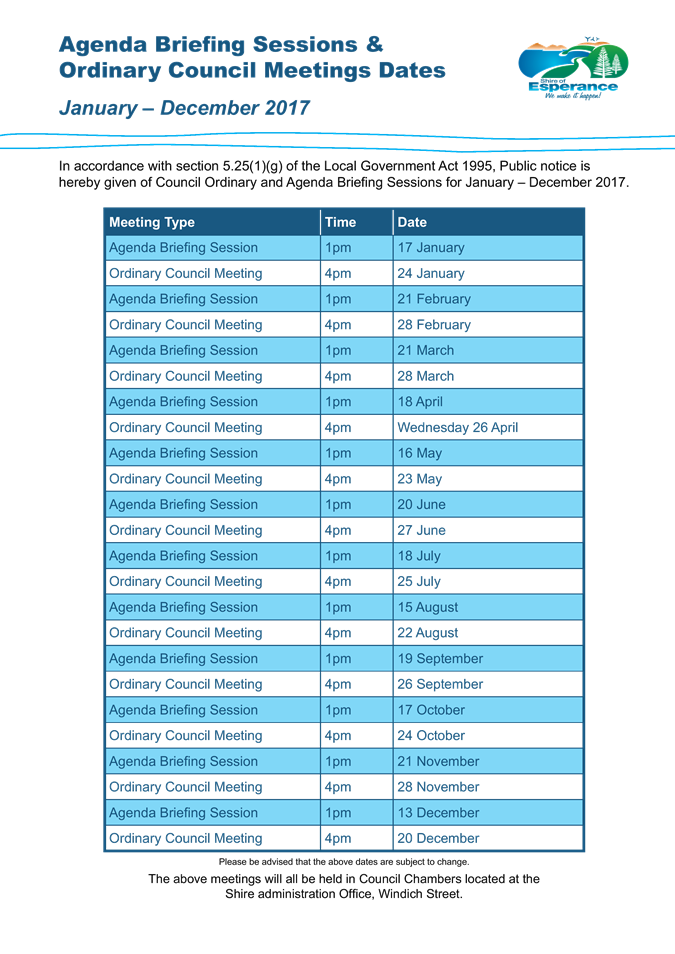
27 September 2016 Page
200
Item: 12.4.5
Information
Bulletin - August 2016
|
Author/s
|
Sarah Fitzgerald
|
Administation Officer
|
|
Authorisor/s
|
Matthew Scott
|
Chief Executive Officer
|
File Ref: D16/22465
Applicant
Internal
Strategic Implications
Strategic Community Plan 2012 - 2022
Civic Leadership
Ensure open and
consistent communication between the Shire and the community
A community who is aware
of Council decisions and activities
Attachments
|
a.
|
Information Bulletin - August 2016
|
|
|
b.
|
Minutes - GVROC Meeting - 3 August
2016 - Under Separate Cover
|
|
|
c.
|
Minutes - GVROC Meeting - 2
September 2016 - Under Separate Cover
|
|
|
d.
|
Interplan Report - August 2016 -
Under Separate Cover
|
|
|
Officer’s Recommendation
That Council accepts the
Information Bulletin and the Interplan report for August 2016 and;
1. Minutes
- GVROC - 3 August 2016
2. Minutes
- GVROC - 2 September 2016
3. Interplan
Report - July 2016
Voting Requirement Simple Majority
|
27 September 2016 Page
201

27 September 2016 Page
202
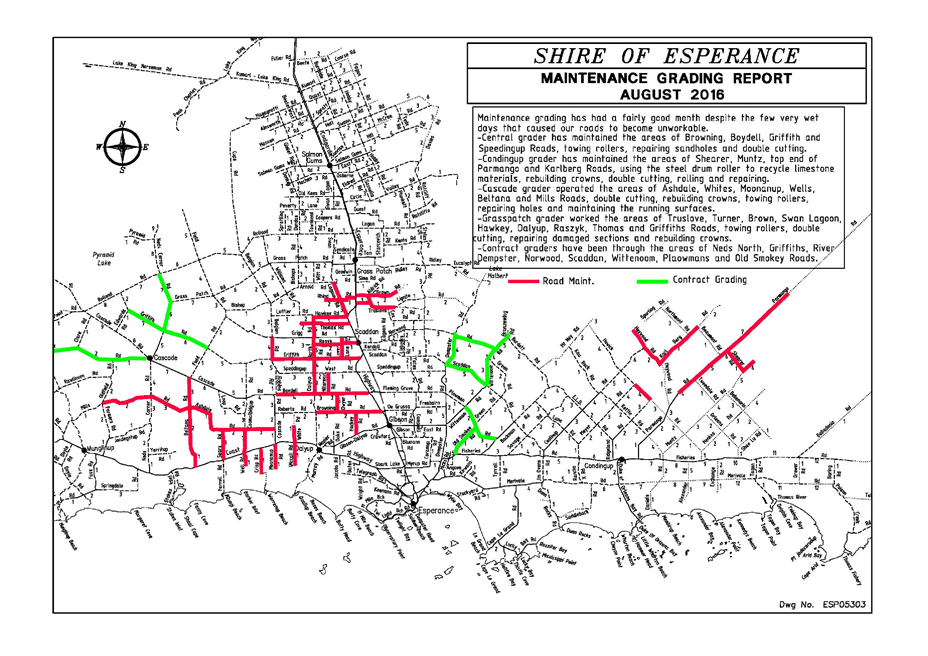
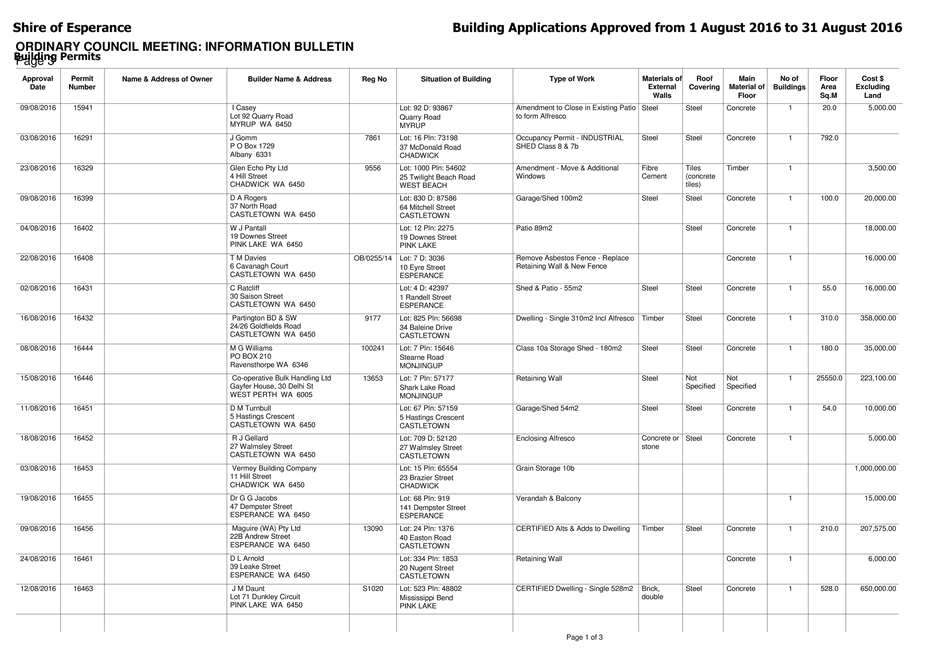
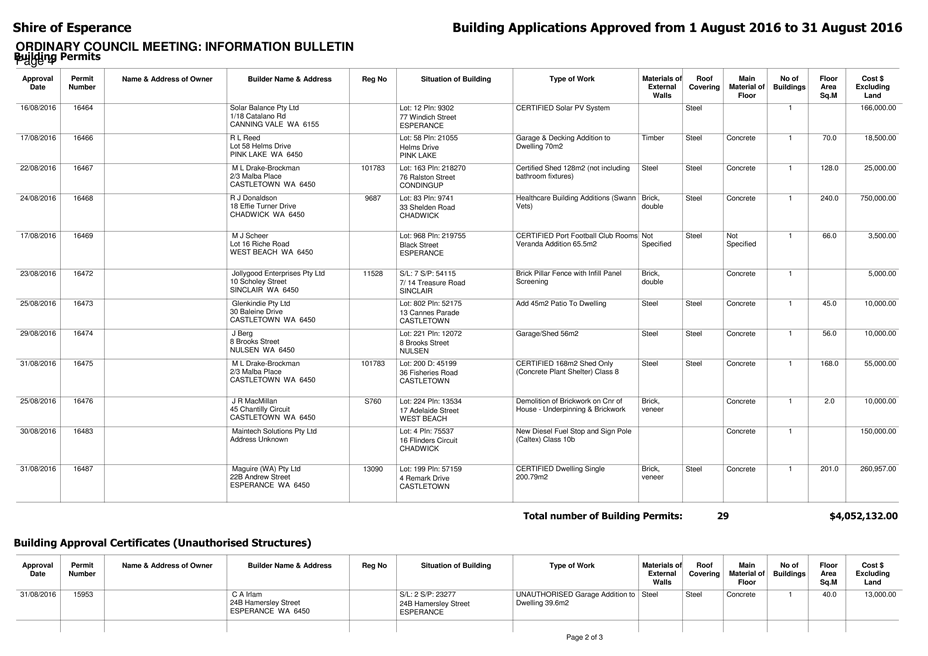
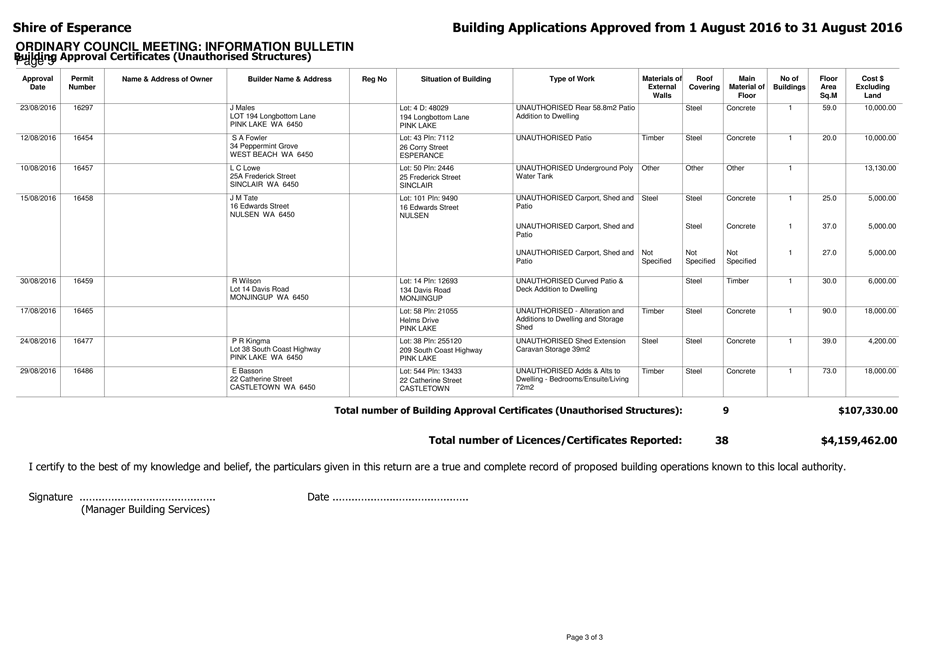
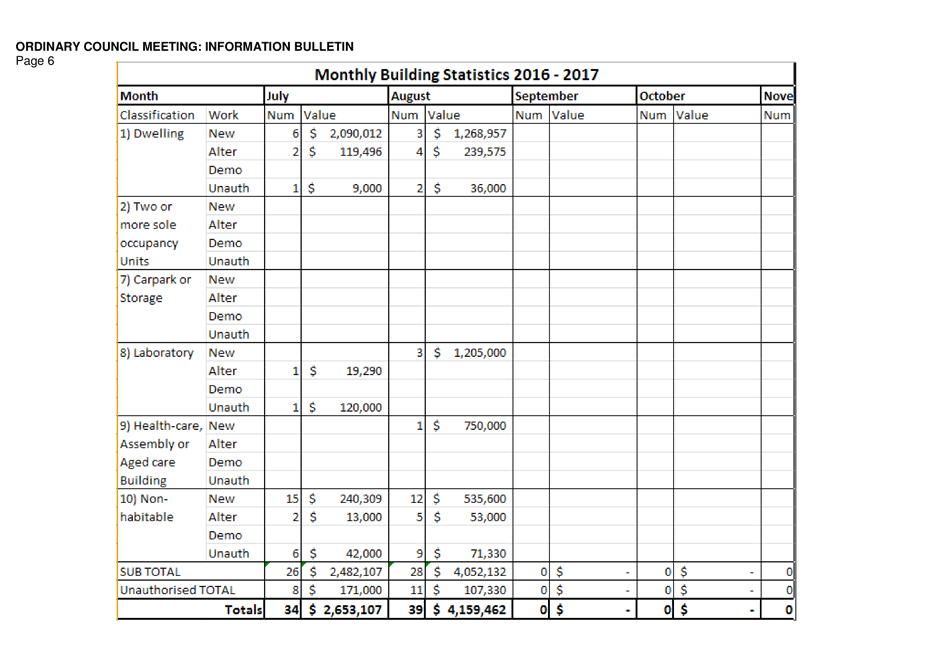
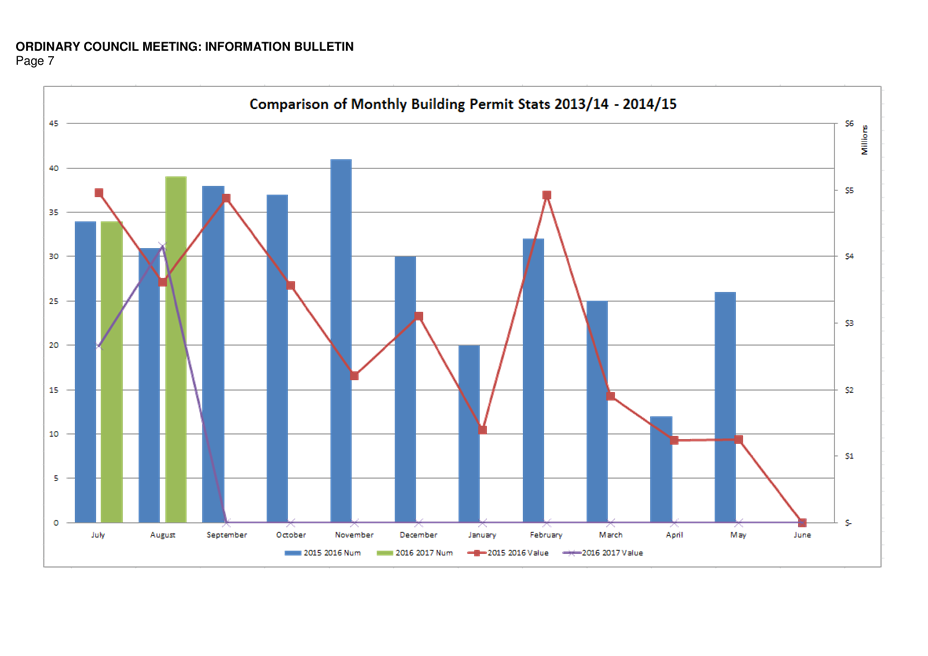
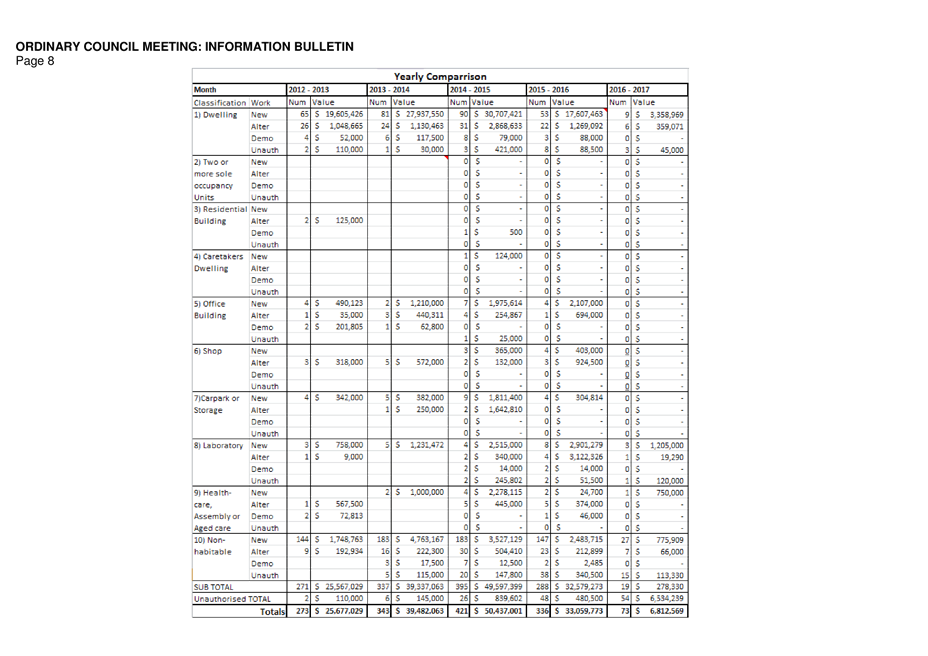
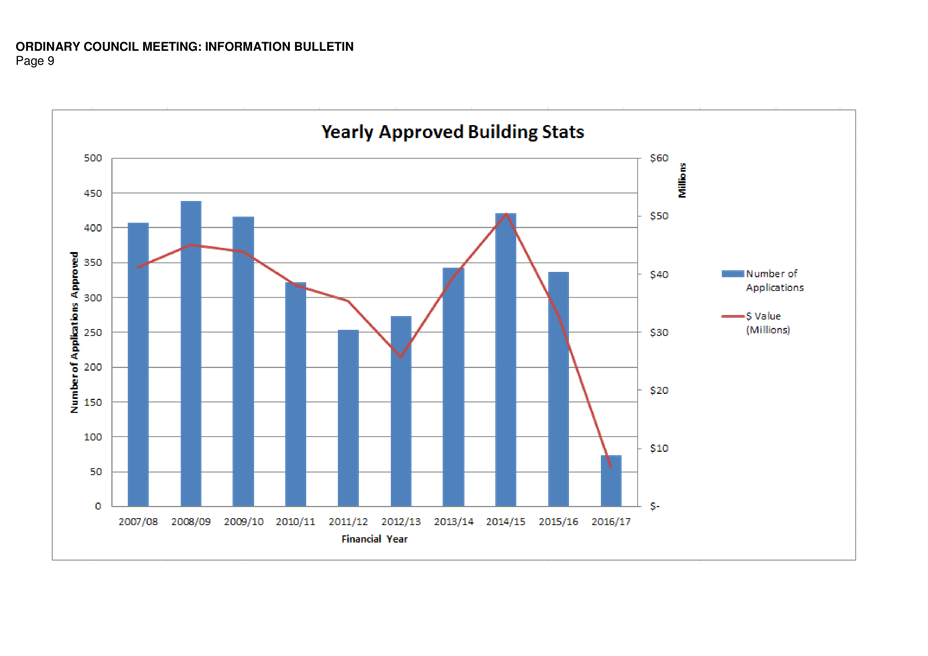
27 September 2016 Page
211
13. Reports Of Committees
14. Motions of which Notice has been Given
15. MEMBERS QUESTIONS WITH OR WITHOUT
NOTICE
16. URGENT BUSINESS APPROVED BY DECISION
17. MATTERS BEHIND CLOSED DOORS
Officer’s Comment:
It
is recommended that the meeting is behind closed doors for the following items,
in accordance with section 5.23(2) of the Local Government Act 1995.
Item: 17.1
Outstanding
Rates - Legal Action on Assessment 12500
Confidential
Item
This report is considered
confidential in accordance with the Local Government Act 1995, as it relates to
a matter that if disclosed, would reveal information about the business,
professional, commercial or financial affairs of a person, where the information
is held by, or is about, a person other than the local government (Section
5.23(2)(e)(iii)).
Item: 17.3
0022-16
- Supply, Delivery and Licensing of One New 2016/2017 Motor Grader
Confidential
Item
This report is considered
confidential in accordance with the Local Government Act 1995, as it relates to
a contract entered into, or which may be entered into, by the local government
and which relates to a matter to be discussed at the meeting (Section
5.23(2)(c)).
Item: 17.4
0021-16 - Supply,
Delivery and Licensing of One New Heavy Duty Tandem Drive 8 Wheel Tip Truck
Confidential
Item
This report is considered
confidential in accordance with the Local Government Act 1995, as it relates to
a contract entered into, or which may be entered into, by the local government
and which relates to a matter to be discussed at the meeting (Section
5.23(2)(c)).
Item: 17.5
0009-16
James Street Jetty Remediation Works
Confidential
Item
This report is considered
confidential in accordance with the Local Government Act 1995, as it relates to
a contract entered into, or which may be entered into, by the local government
and which relates to a matter to be discussed at the meeting (Section
5.23(2)(c)); and legal advice obtained, or which may be obtained, by the local
government and which relates to a matter to be discussed at the meeting
(Section 5.23(2)(d)).
Item: 17.2
0023-16
- Supply, Delivery and Licensing of One New 2016/2017 Front End Loader
Confidential
Item
This report is considered
confidential in accordance with the Local Government Act 1995, as it relates to
a contract entered into, or which may be entered into, by the local government
and which relates to a matter to be discussed at the meeting (Section
5.23(2)(c)).
18. PUBLIC QUESTION TIME
19. CLOSURE
A list
of delegated authority approvals for development and subdivision applications
is to be included in each monthly agenda of the All Purpose Committee meeting.
‘development’ means the development
or use of any land, including—
(a) any
demolition, erection, construction, alteration of or addition to any building
or structure on the land;
(b) the
carrying out on the land of any excavation or other works;
(c) in
the case of a place to which a Conservation Order made under section 59 of the Heritage
of Western Australia Act 1990 applies, any act or thing that—
(i) is
likely to change the character of that place or the external appearance of any
building; or
(ii) would
constitute an irreversible alteration of the fabric of any building;
A list
of delegated authority approvals for development and subdivision applications
is to be included in each monthly agenda of the All Purpose Committee Meeting.
