9. Matters Requiring a
Determination of Committee
Item: 9.1
Financial Management Review Update
|
Author/s
|
Beth O'Callaghan
|
Manager Financial Services
|
|
Authorisor/s
|
Shane Burge
|
Director Corporate Resources
|
File Ref: D18/22533
Applicant
Internal
Location/Address
Corporate Resources
Executive Summary
To advise the Audit Committee with an update of actions
implemented in response to the recommendations from Butler Settineri’s
Financial Management Review of the Shire’s policies, procedures and
practices.
Recommendation in Brief
That the Audit Committee receives the report providing an
update on actions implemented in response to Butler Settineri’s Financial
Management Review of the Shire’s policies, procedures and practices.
Background
In April 2016 Butler Settineri were engaged by the Shire to
perform a review of the policies, procedures and practices of the Shire of
Esperance. Their report received in June 2016 provided recommendations
for the Shire to implement.
At the request of the Audit Committee a report was presented
to them in November 2016 of the actions that will be implemented in response to
the recommendations.
The purpose of this report is to provide an update on the
implemented recommendations.
Officer’s Comment
Two years ago a report was presented to the Audit Committee
with the actions that will be implemented in response to Butler
Settineri’s review of the policies, procedures and practices of the Shire
of Esperance.
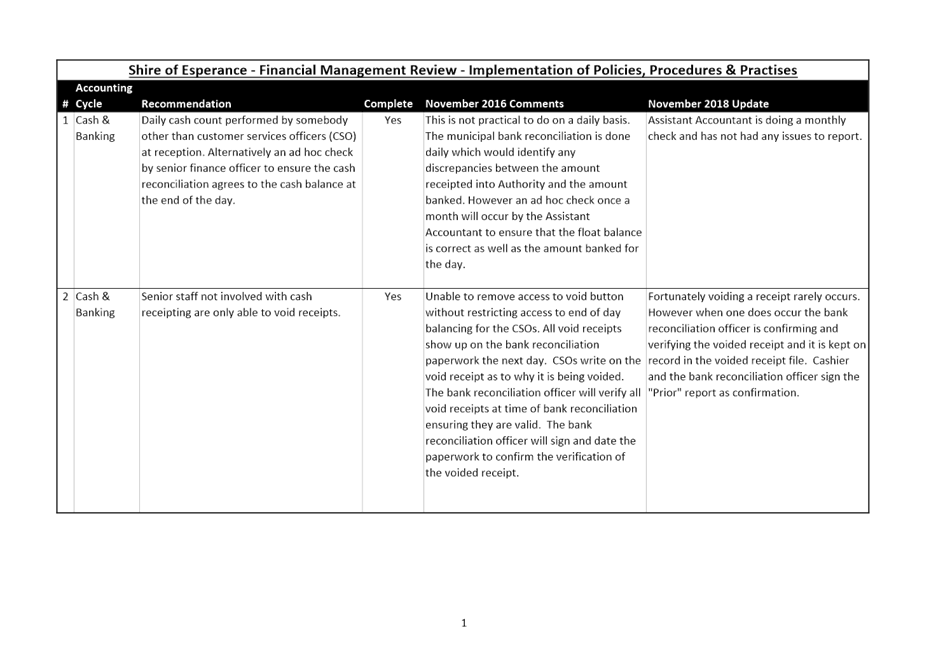
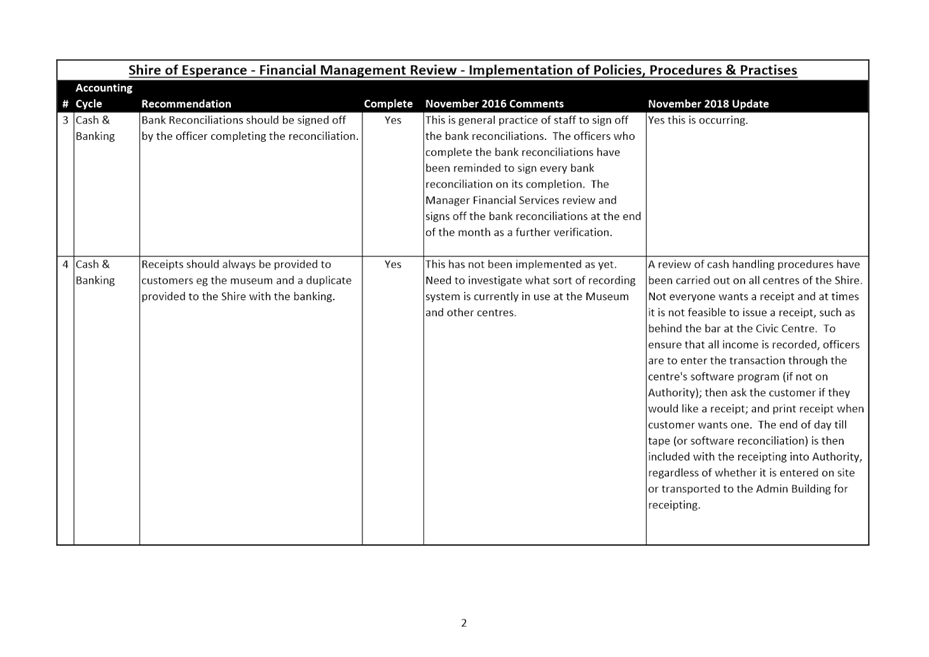
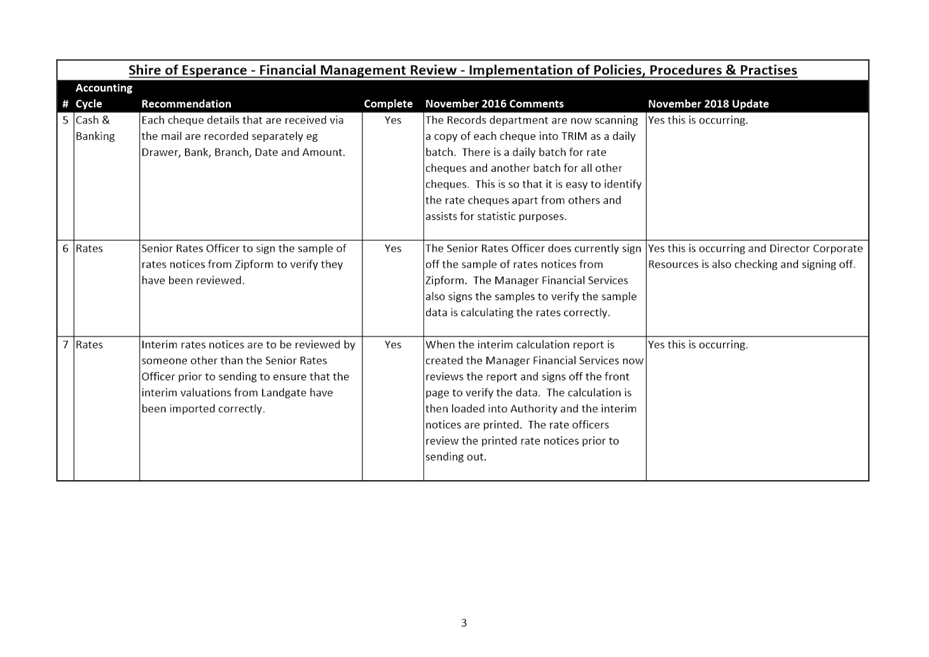
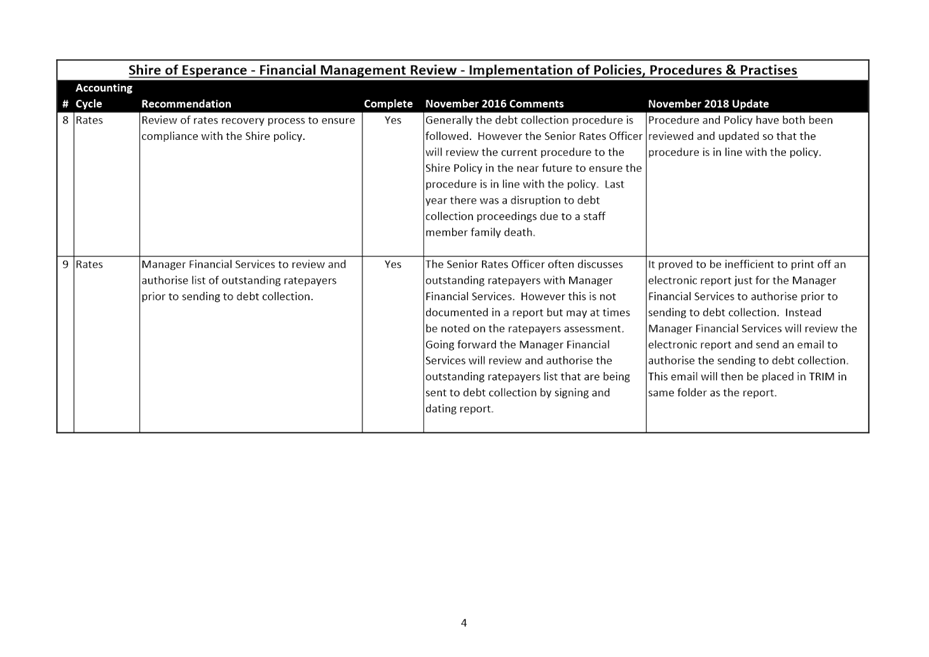
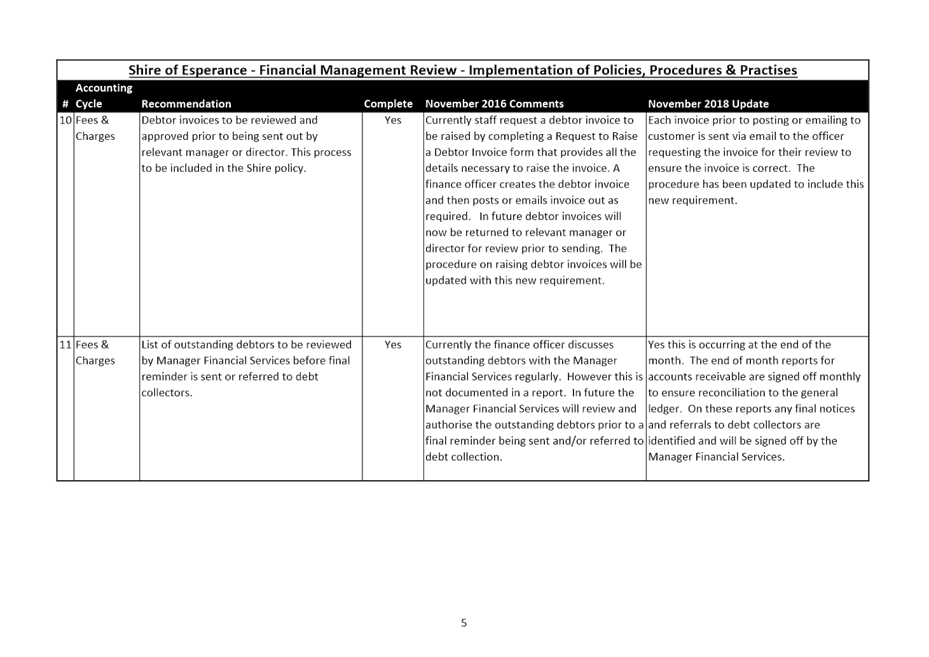
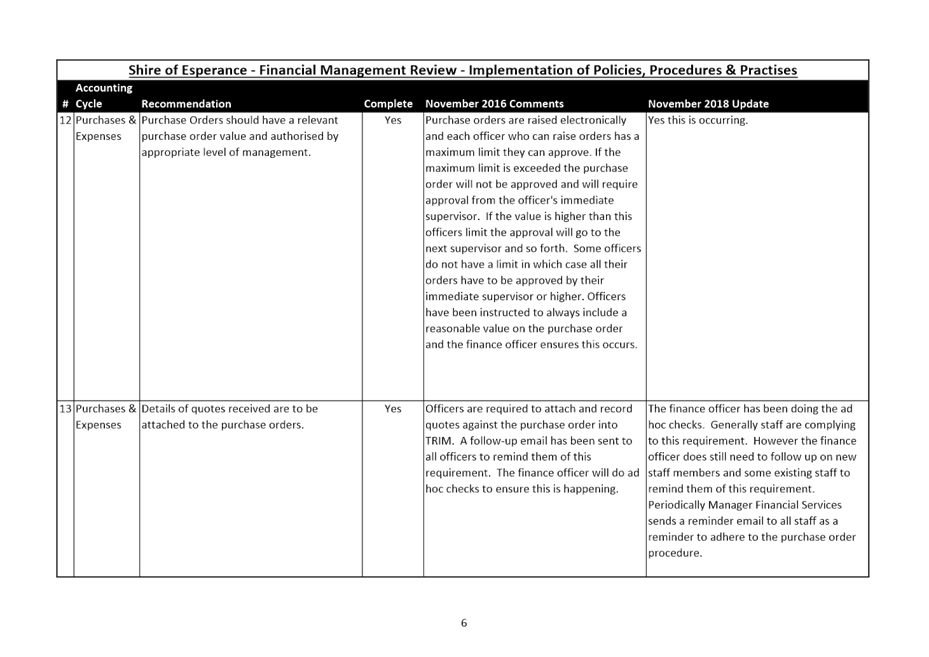
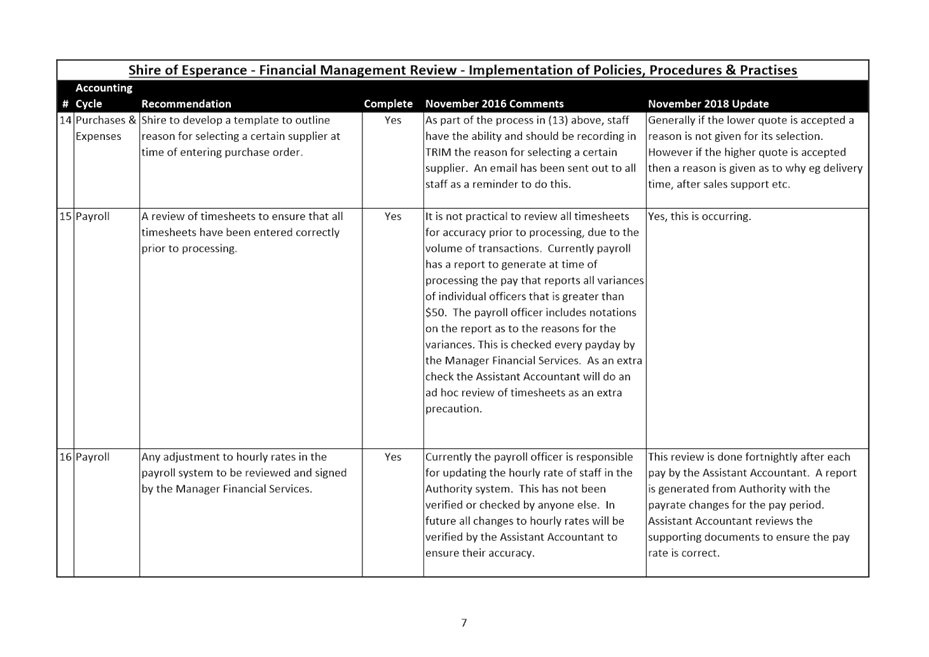
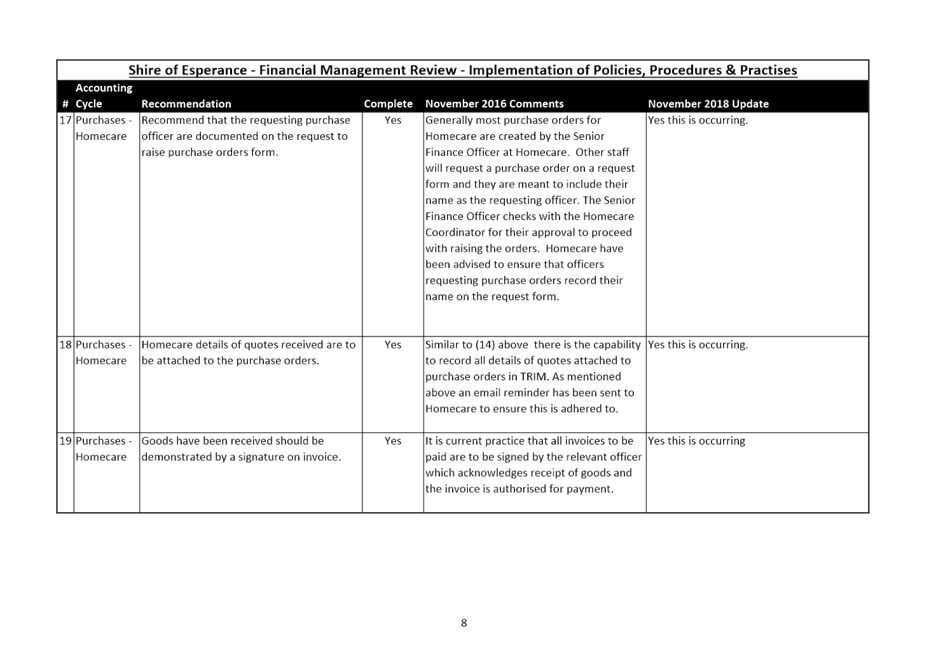
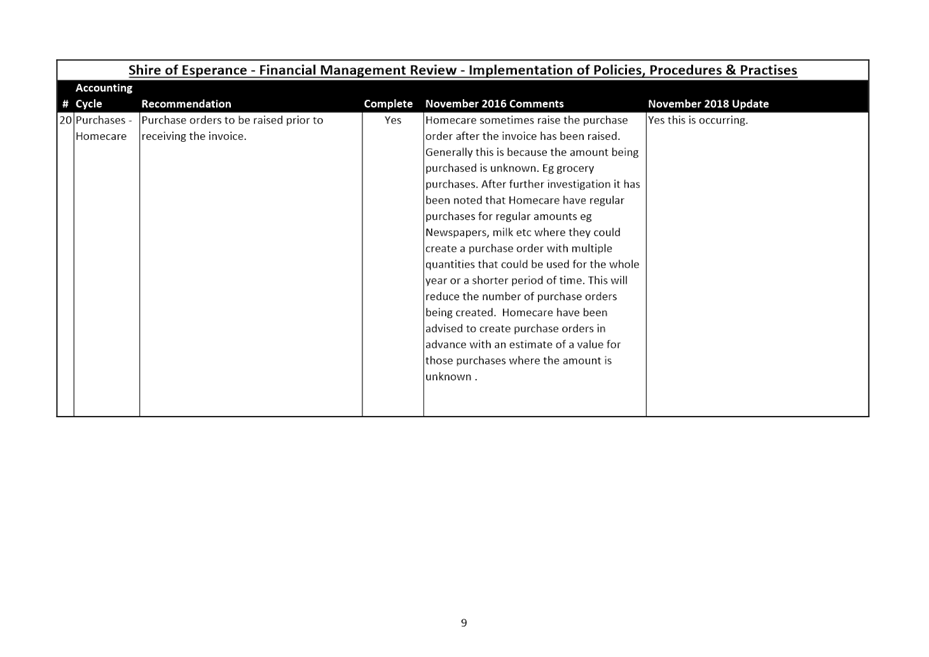
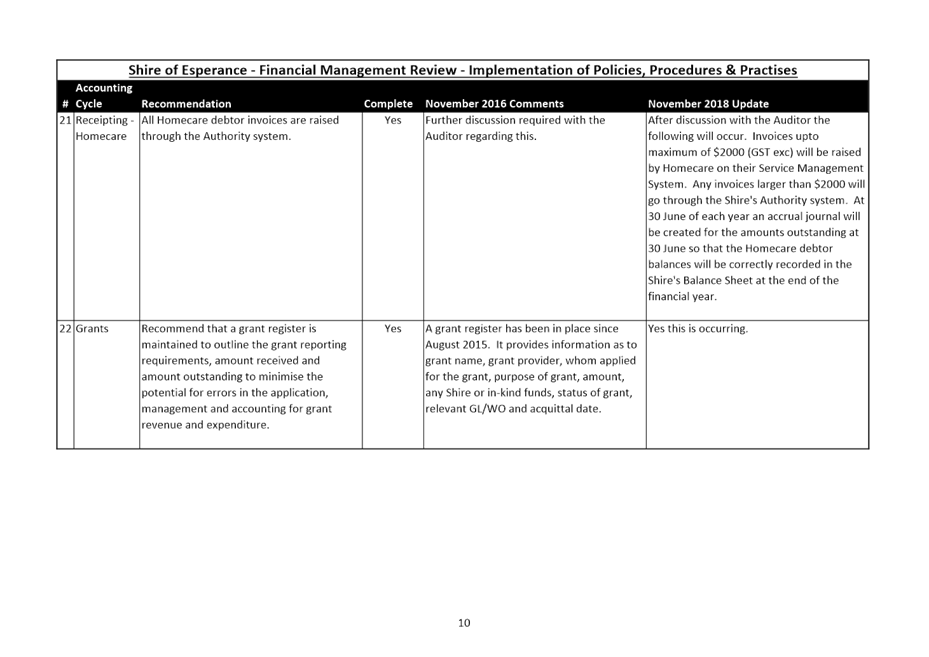
Attached is the same report with another column headed as
“November 2018 Update” in which a comment has been made for each
recommendation.
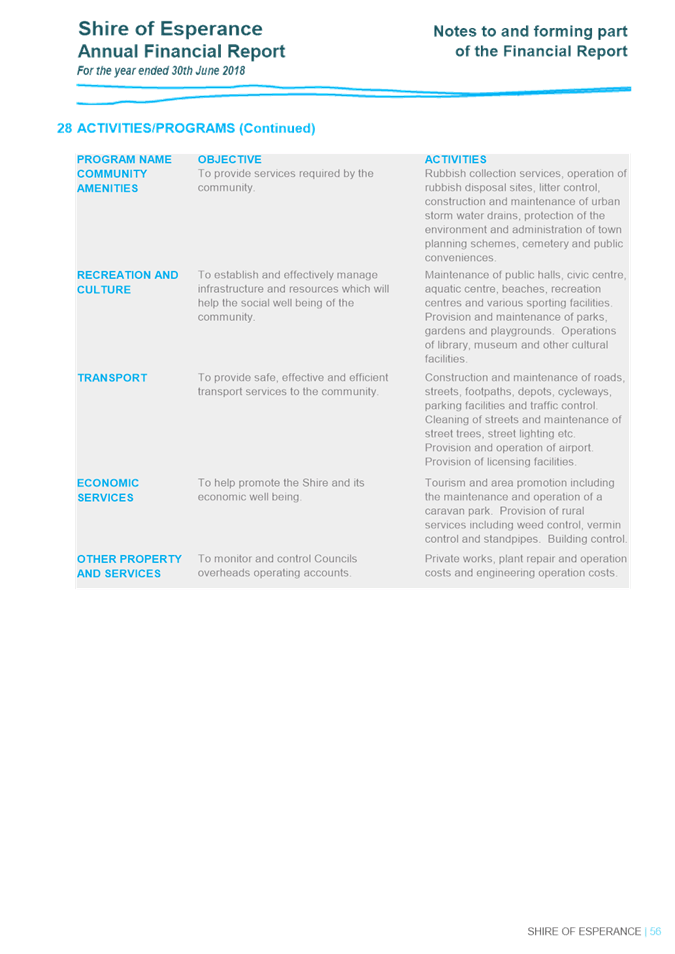
There were 7 accounting cycles addressed by Butler
Settineri. They are
· Cash and Banking
· Rates
· Fees and Charges
· Purchases and Expenses
· Payroll
· Homecare
· Grants
Generally speaking most of the actions have been successfully
implemented and have been continually actioned.
However the following have not been fully implemented or
require periodical staff reminders:
Cash and Banking
Since the last report to Council a review of the cash
handling procedures has been carried out on all areas of the Shire. This
includes Administration Building, Leisure Centre, Civic Centre, Visitor Centre,
Volunteer Centre, Homecare, Museum, Library, Wylie Bay and Caravan Park.
All areas have good cash handling procedures that took into account daily
reconciliations, security of cash and separation of duties where
possible.
One of Butler Settineri’s recommendations is that every
transaction should have a receipt provided to the customer. In some
centres this is done; other centres will offer a receipt; and one centre only
provides receipts on request from the customer.
In reality many customers do not want a receipt and to print
one is a waste of paper and time. However, it is important that every
receipt of cash is recorded and put through the register or computer software
of the centre. As a compromise it the procedure for all centres is that all
transactions are entered into the register and/or software program, then the
customer is asked if they would like a receipt. This way the transaction
is recorded and receipt is only printed when customer says yes.
Refer to the “November 2018 Update” column for
point 4 of the attachment for the comment regarding this.
Purchases and Expenses
Raising of purchase orders and providing/recording quotes by
all staff is generally done well. However, the periodical email reminder
to all staff to do so assists with this good practice. Additionally, when
an officer chooses between two quotes a reason as why one is chosen over the
other is to be recorded. Generally, officers are not providing a reason
if the cheapest quote is chosen, however when the higher quote is accepted a
reason is provided as to why. This could be a number of reasons eg after
sales support, timeframe for the goods to arrive, availability etc.
Consultation
Nil
Financial Implications
Nil
Asset Management Implications
Nil
Statutory Implications
Local Government (Financial Management) Regulation
1996 5(2)
Policy Implications
Nil
Strategic Implications
Strategic Community Plan 2017 - 2027
Community
Leadership
A financially
sustainable and supportive organisation achieving operational excellence
Corporate Business Plan 2017/2018
– 2020/2021
Provide
responsible resource and planning management for now and the future
Environmental Considerations
Nil
Attachments
|
a⇩.
|
Financial Management
Review Implementation 2018
|
|
|
Officer’s
Recommendation
That the Audit Committee receive the report providing an
update on actions implemented in response to Butler Settineri’s
Financial Management Review of the Shire’s policies, procedures and
practices.
Voting Requirement Simple Majority
|
Item: 9.2
Audit Report 2017/18
|
Author/s
|
Beth O'Callaghan
|
Manager Financial Services
|
|
Authorisor/s
|
Shane Burge
|
Director Corporate Resources
|
File Ref: D18/26177
Applicant
Corporate Resources
Location/Address
Internal
Executive Summary
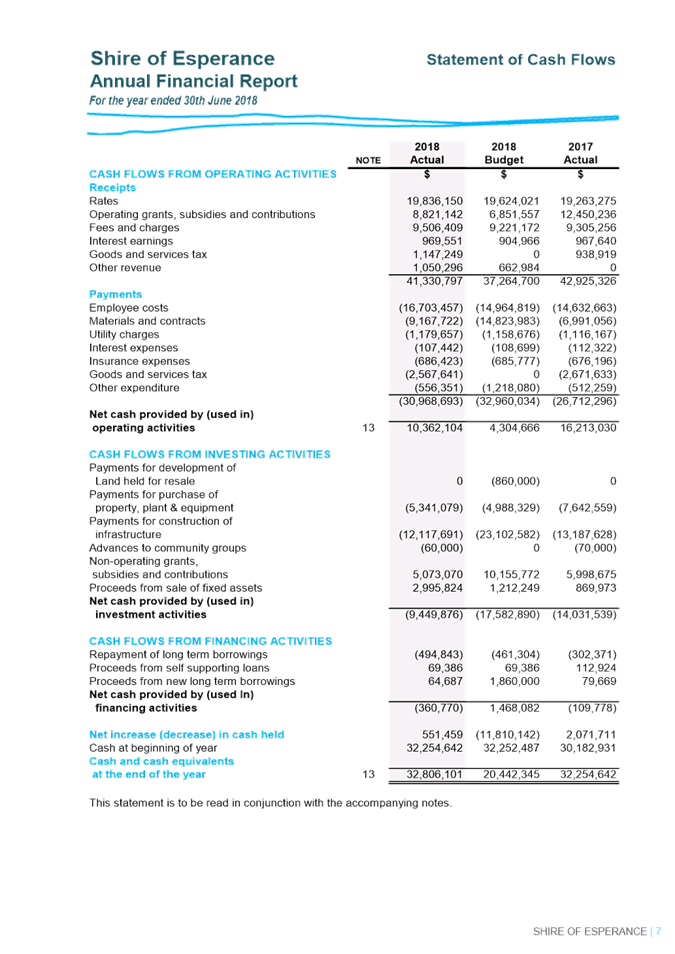
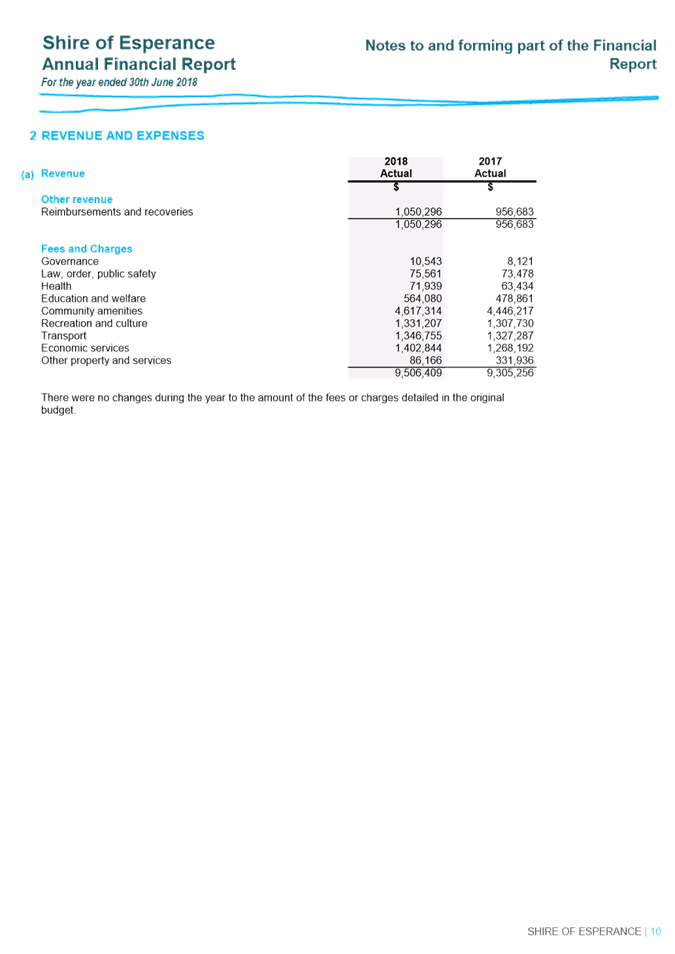
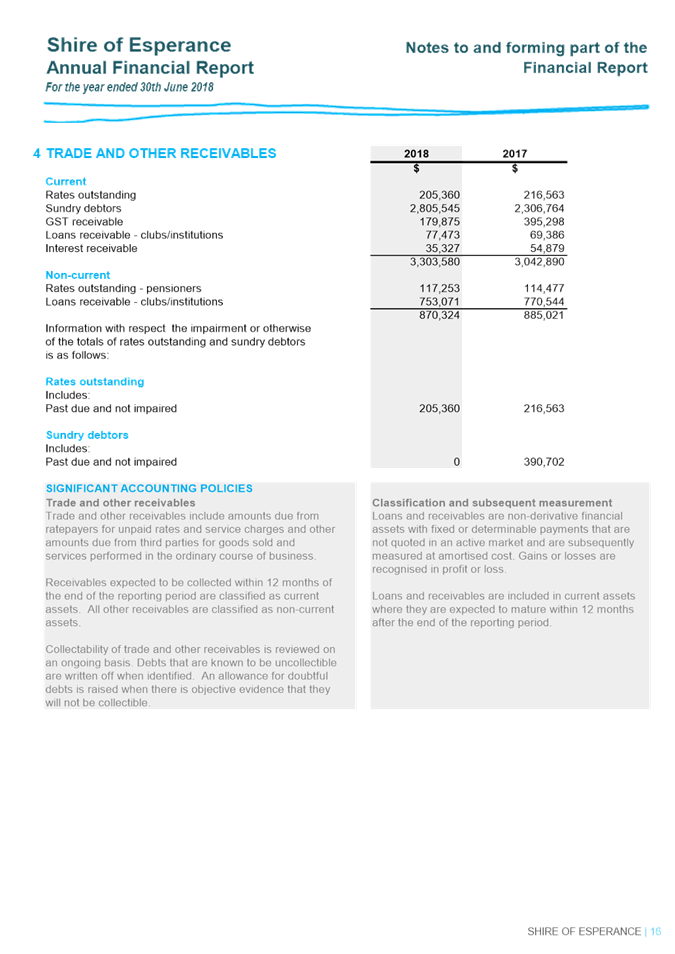
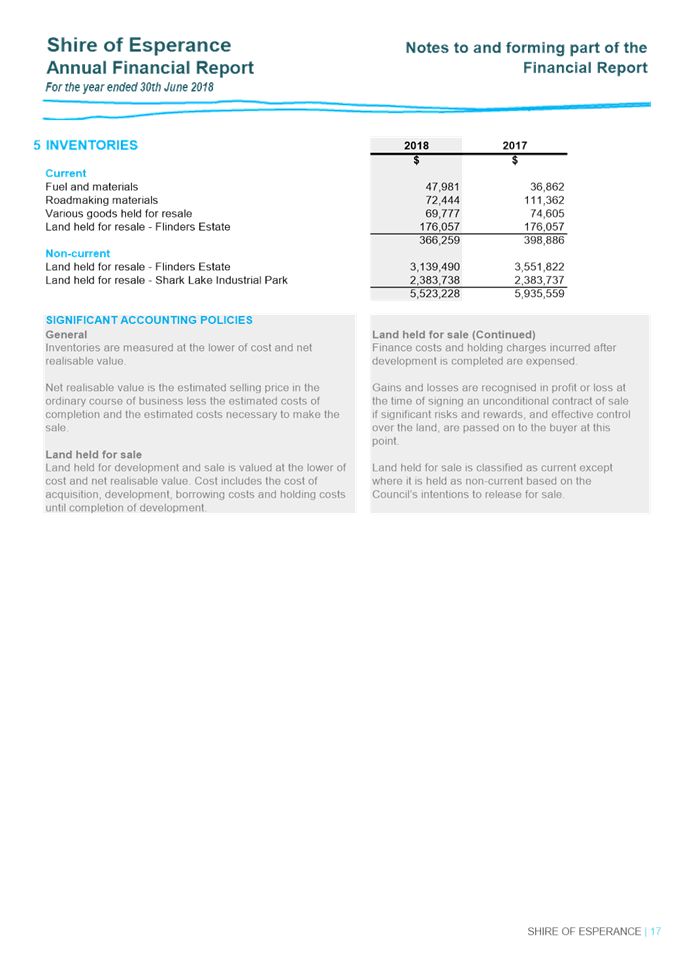
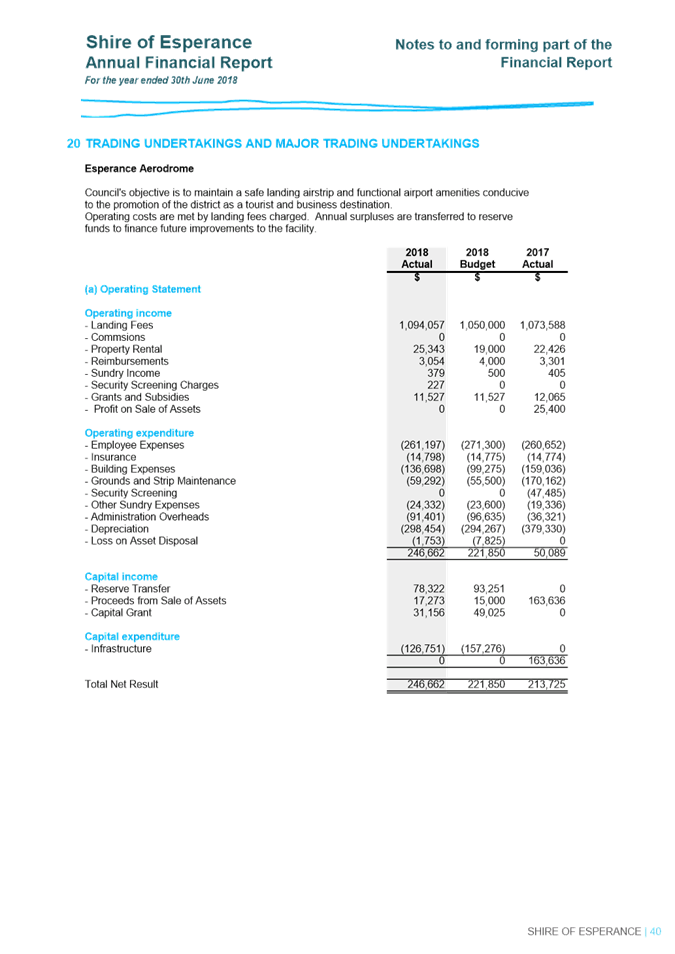
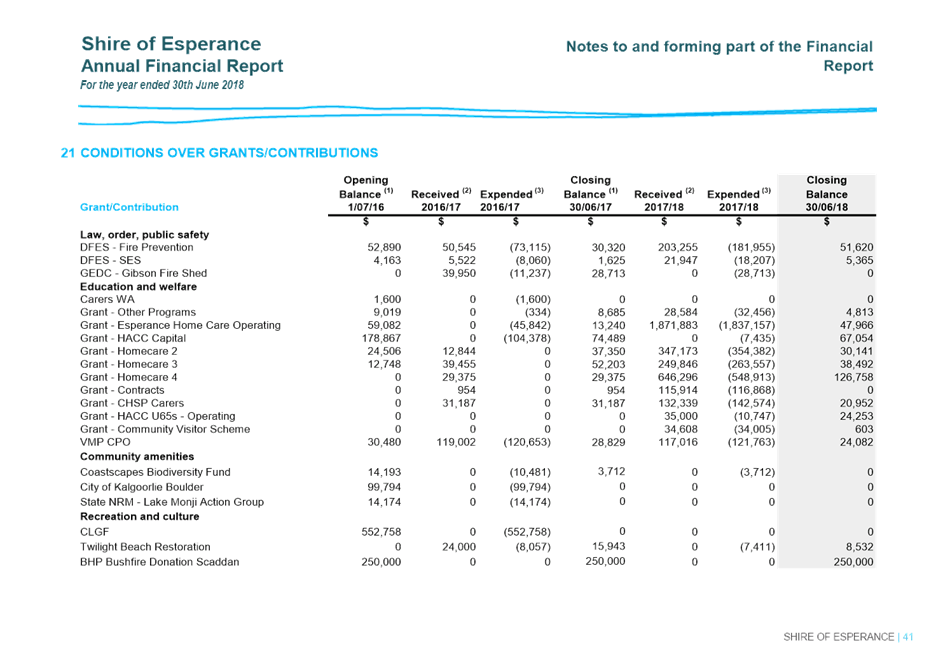
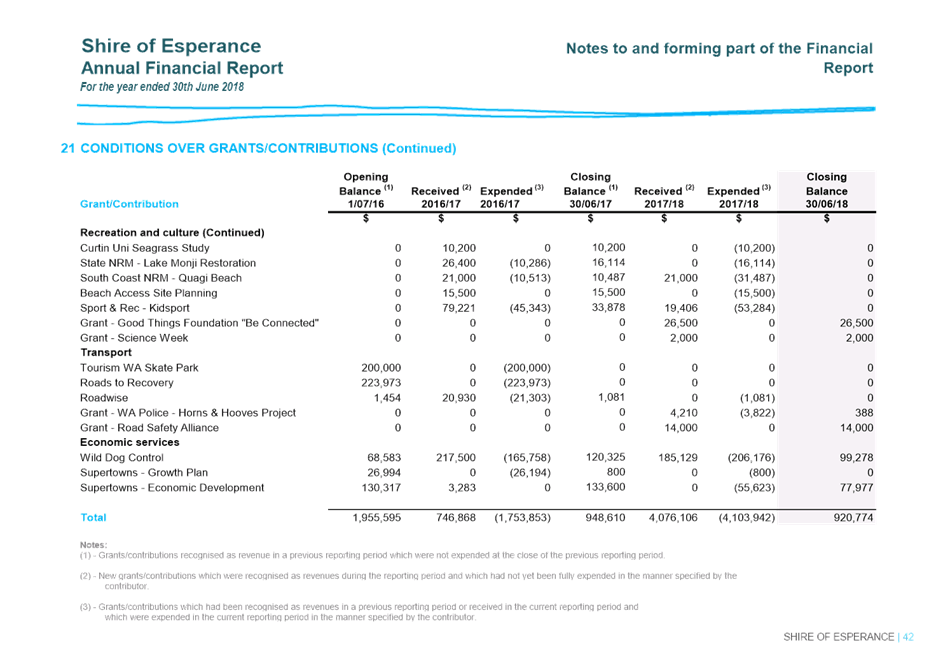
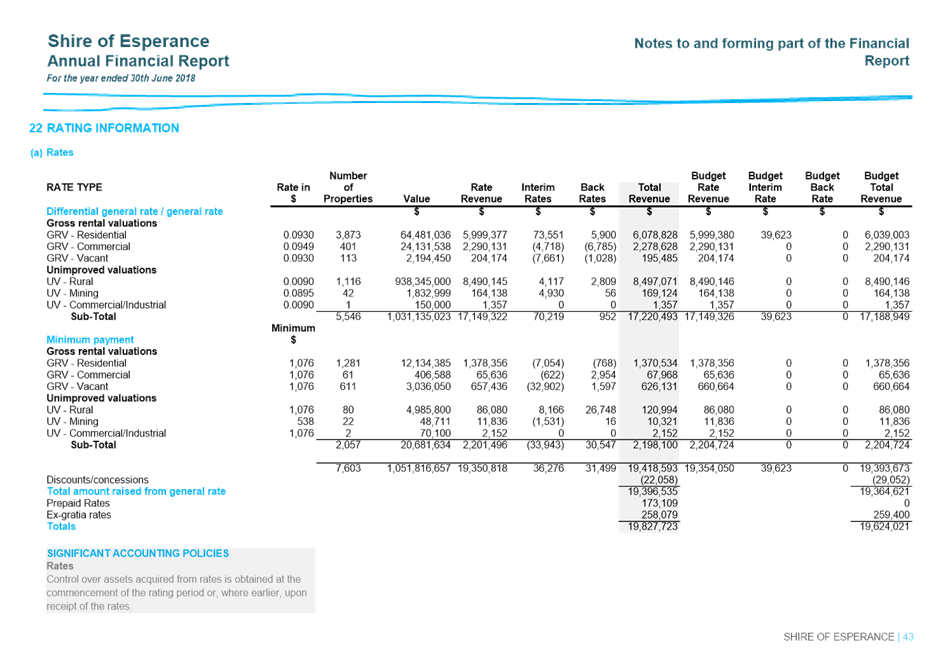
To present to the Audit Committee the 2017/18 audit report
and management letter prepared by the Council’s Auditor, Mr Marius Van
Der Merwe from Butler Settineri.
Recommendation in Brief
That the Audit Committee
1. Receive the
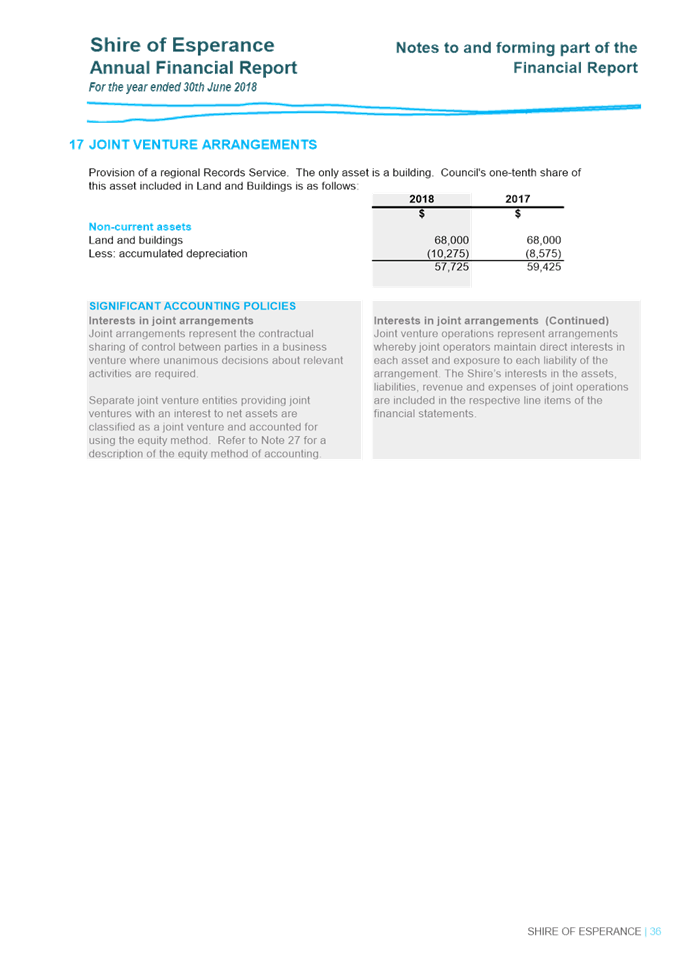
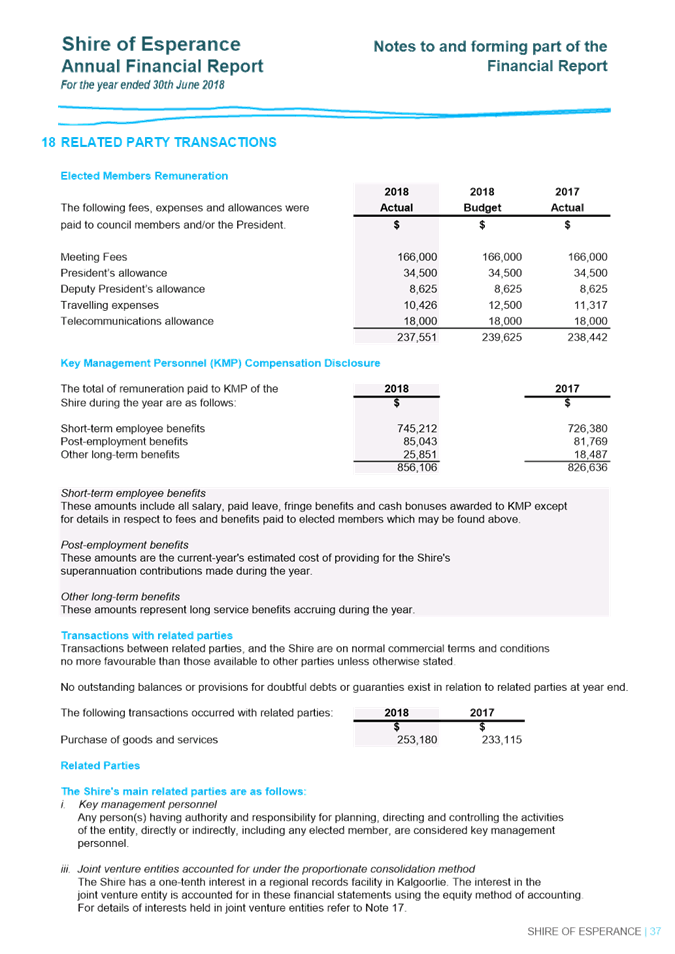
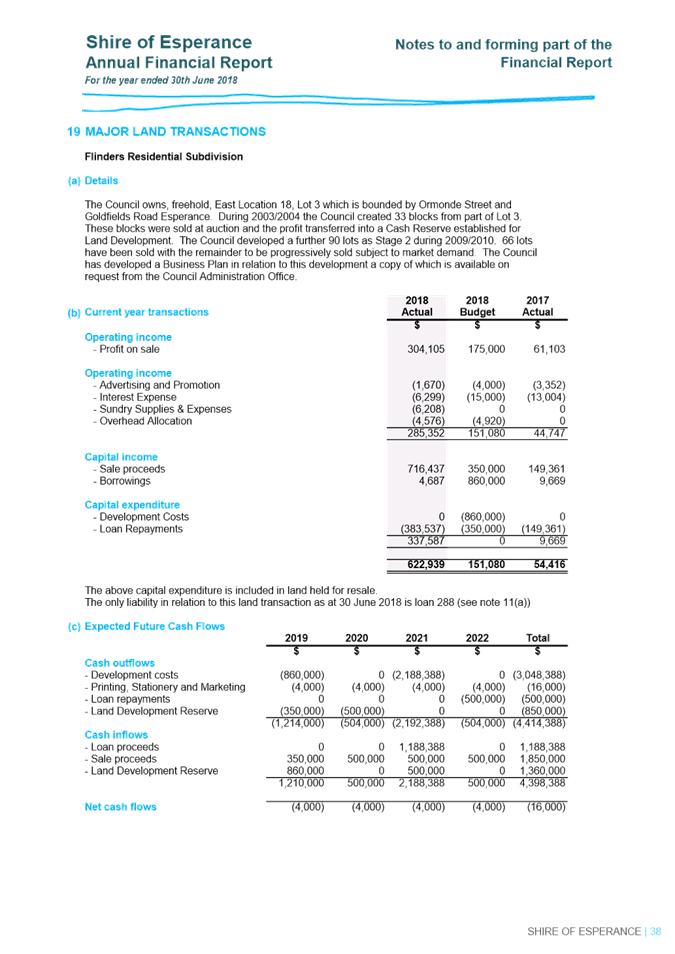
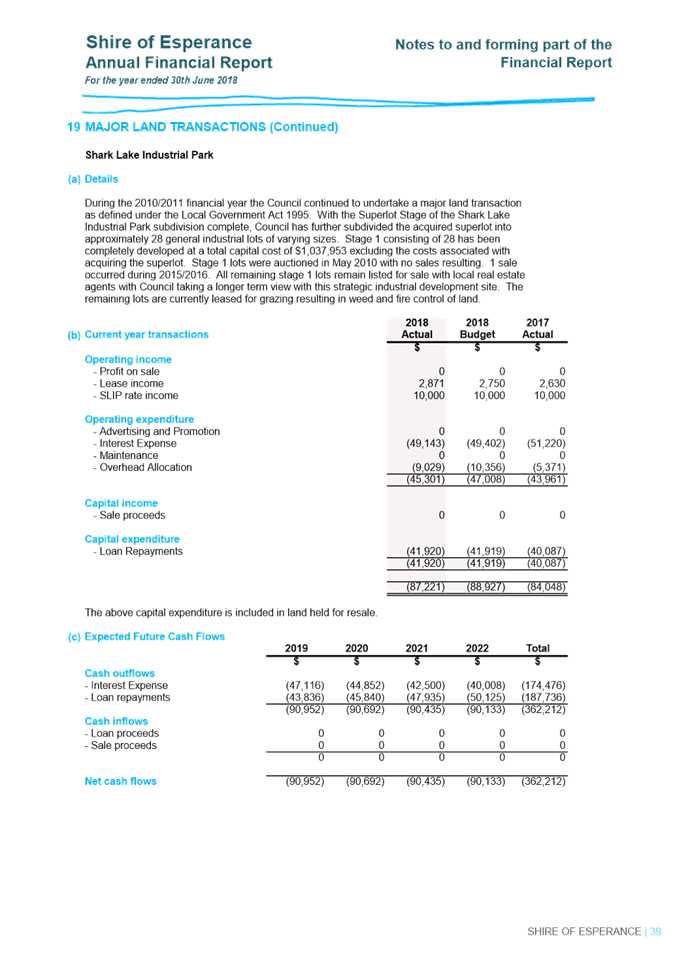
2017/18 Annual Financial Report incorporating the Audit Report as attached at
Attachment A.
2. Receive the
Management Letter for the 2017/18 financial year as attached at Attachment B.
3. Recommends
the Annual Financial Report, Audit Report and Management Letter for the 2017/18
financial year to Council for adoption.
Background
Council is required to prepare a financial report and present
it to Council’s Auditor by 30 September each year. This has been
completed and the Audit Report, Management Letter and Annual Financial Report
are presented at Attachment A and B.
The Local Government Act (1995) requires that the
audit report and any management letter be examined by the local government to
determine if any matters raised in the report(s) require action to be
taken. After considering the audit report the local government is to
prepare a report on any actions to be taken in response to the audit report and
is to forward a copy of that report to the Minister for Local Government.
Officer’s Comment
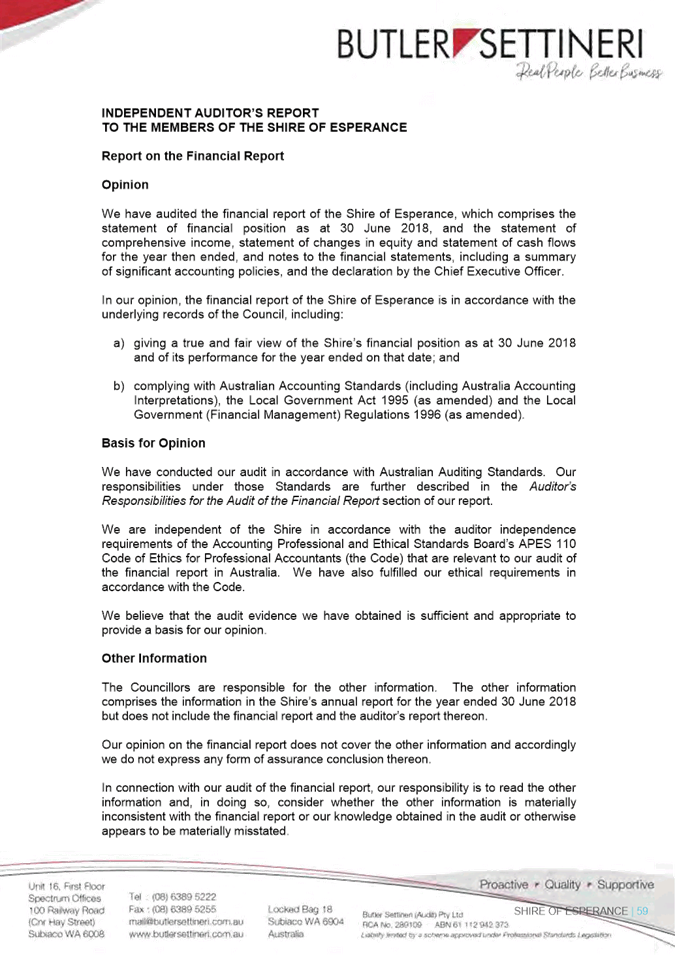
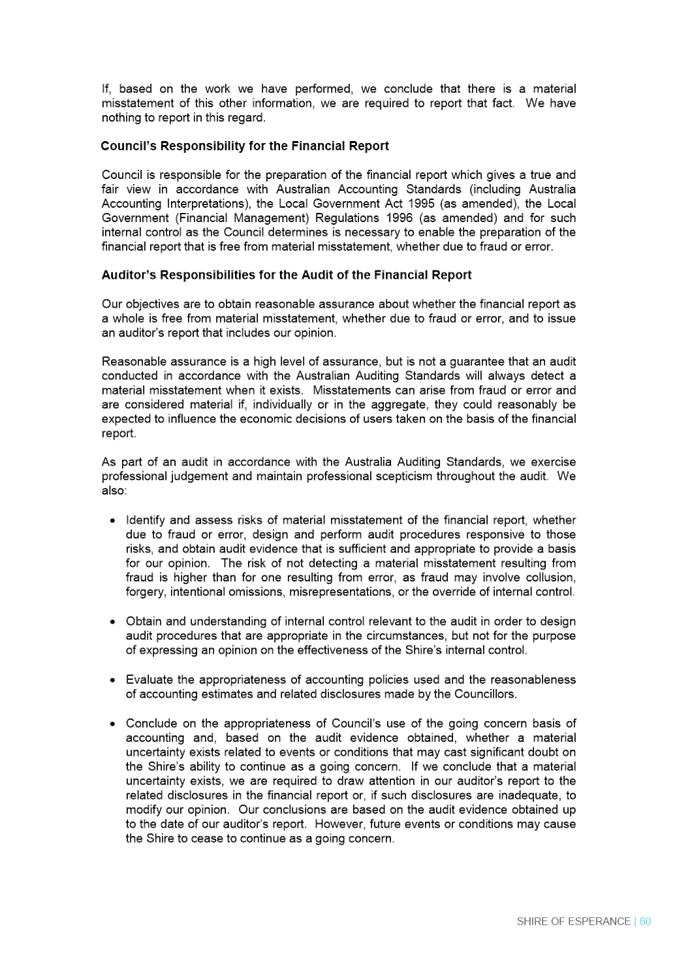
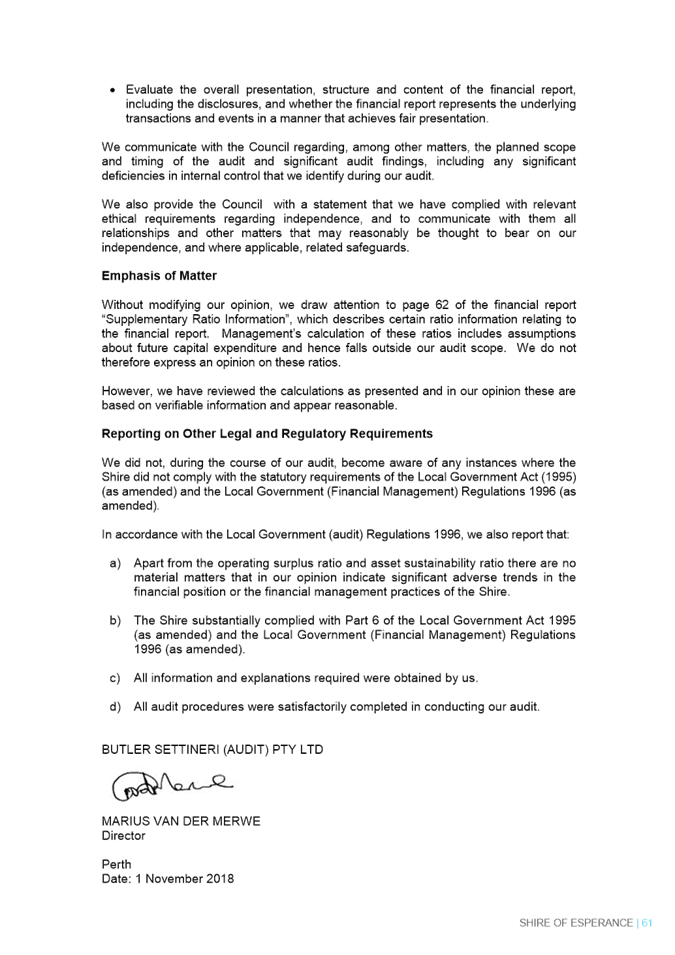
The Council has received an unqualified or
“clean” audit report from Mr Van Der Merwe. The auditors
opinion states that “In our opinion, the financial report of the Shire of
Esperance is in accordance with the underlying records of the Council,
including:
a. giving a
true and fair view of the Shire’s financial position as at 30 June 2018
and of its performance for the year ended on that date; and
b. complying
with Australian Accounting Standards (including Australia Accounting
Interpretations), the Local Government Act 1995 (as amended) and the Local
Government (Financial Management) Regulations 1996 (as amended).”
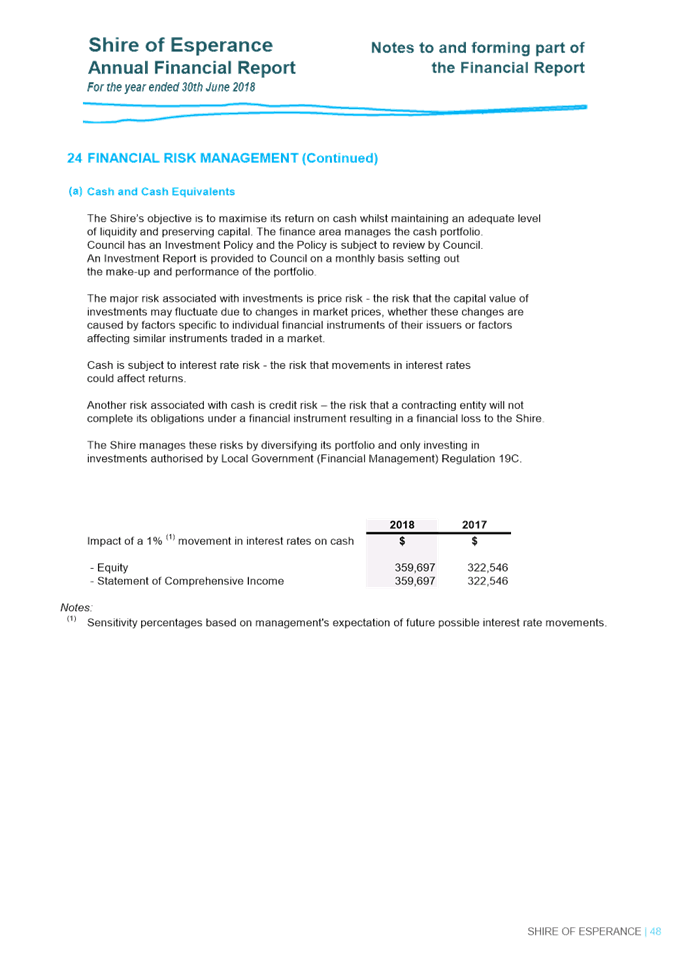
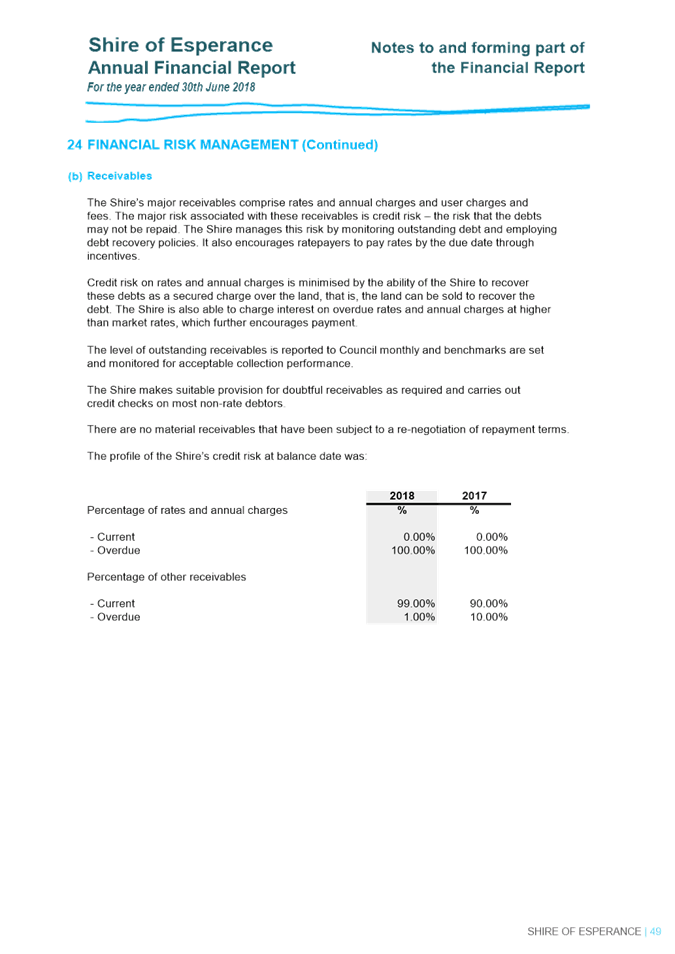
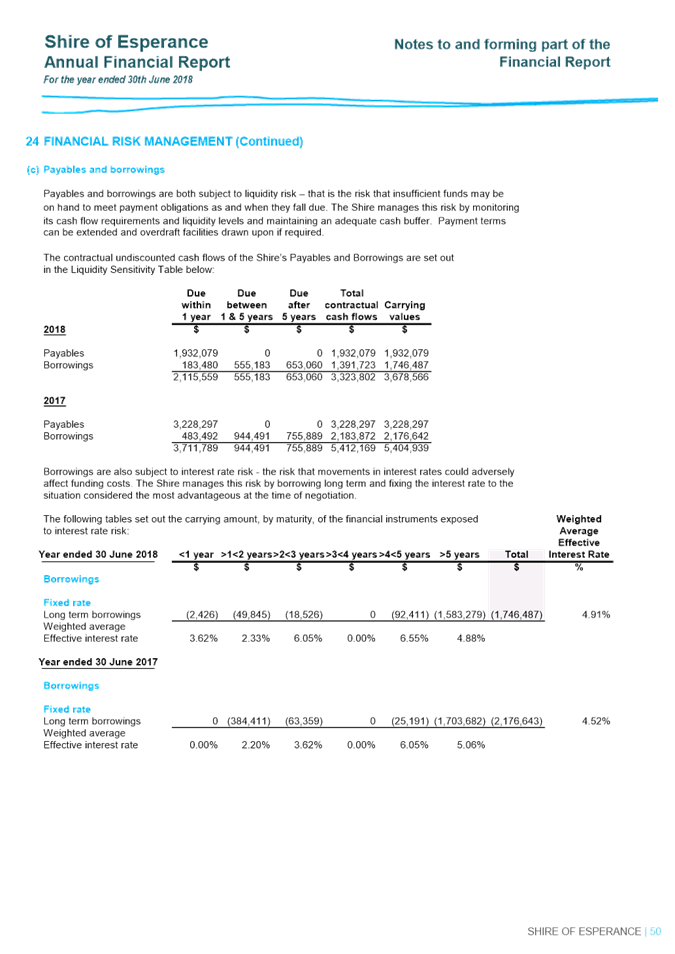
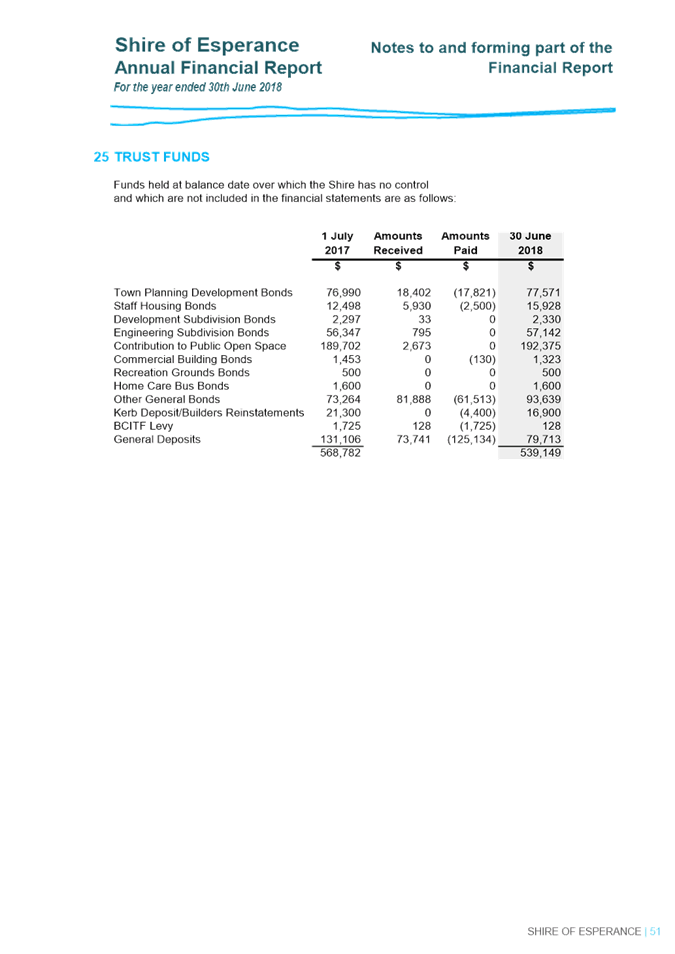
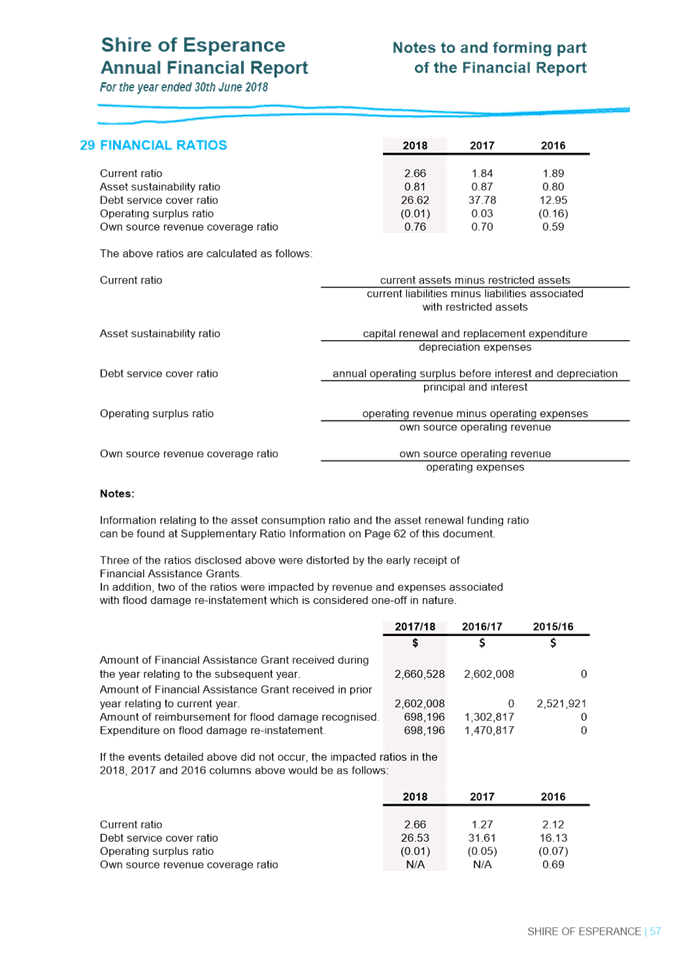
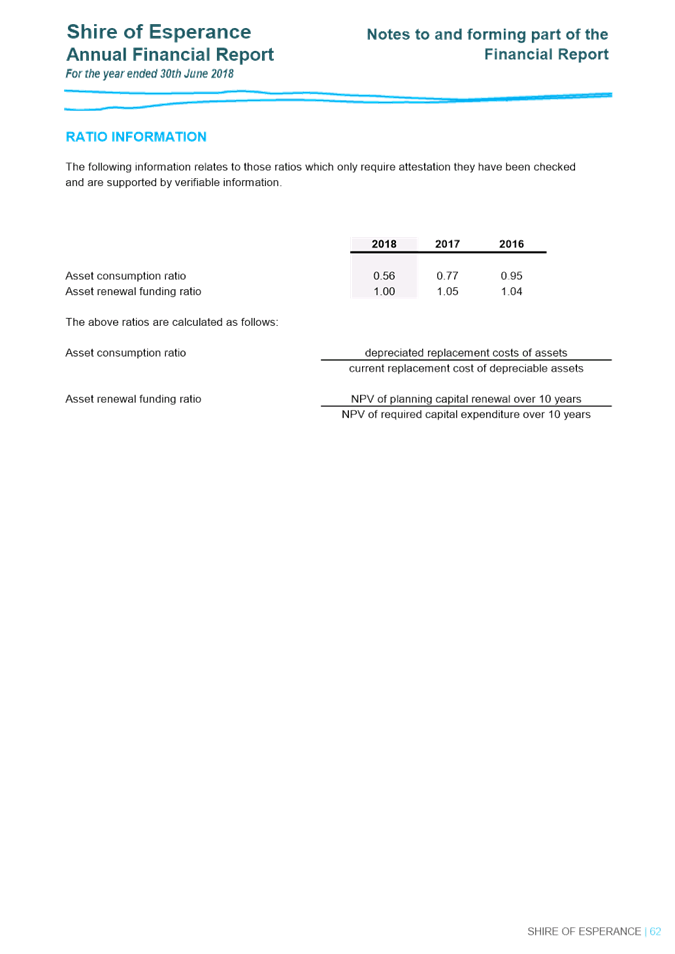
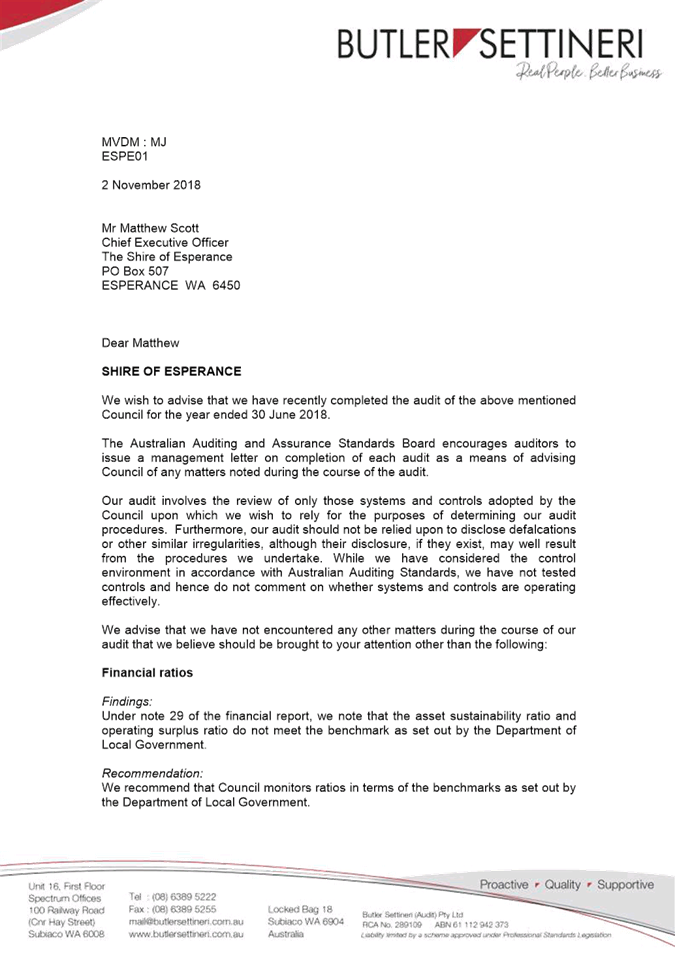
The audit did not note any adverse trends apart from two
ratio’s not meeting the minimum benchmark as determined by the Department
of Local Government guidelines.
The two ratios in question is the Operating Surplus ratio and
Asset Sustainability ratio. This is something Council has been addressing
over the past few years and will be continuing to do so over the next five
years. Strategies to achieve this are identified in the Long Term Financial
Plan. This should see a gradual improvement in both of these ratios.
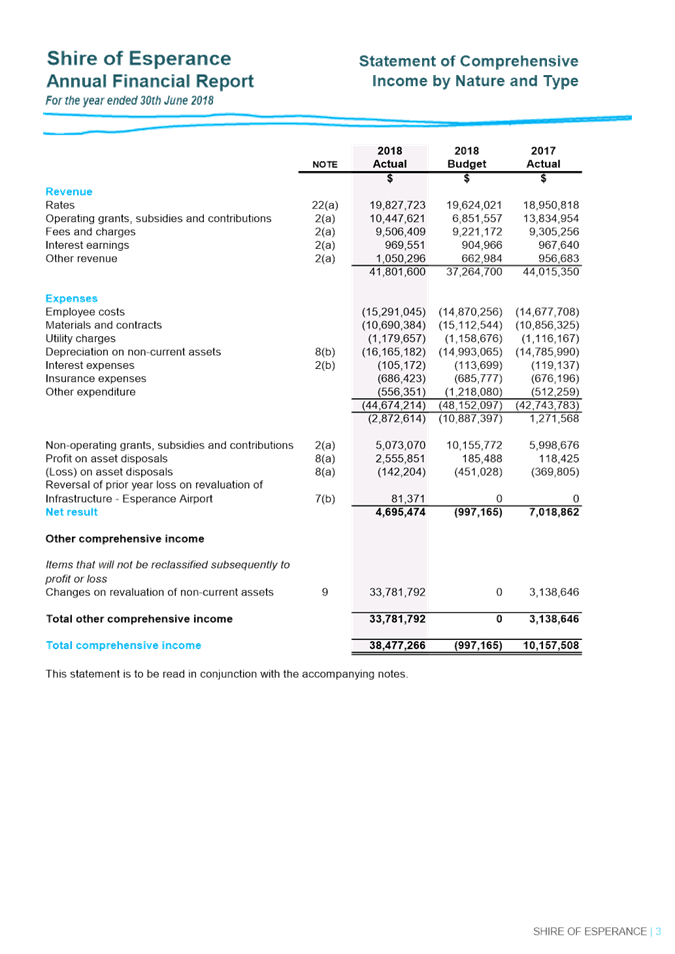
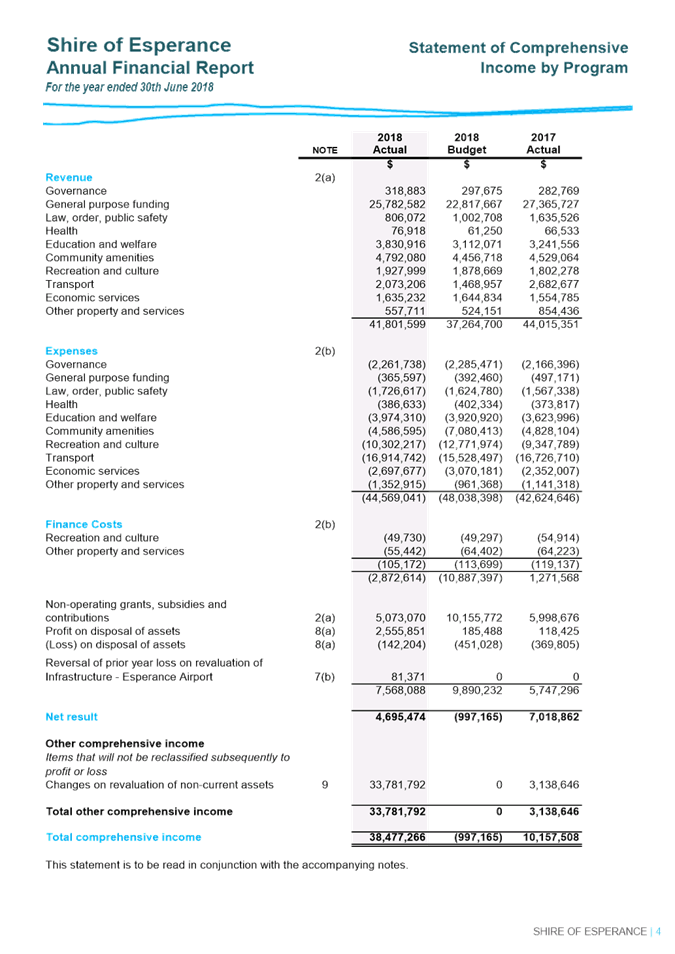
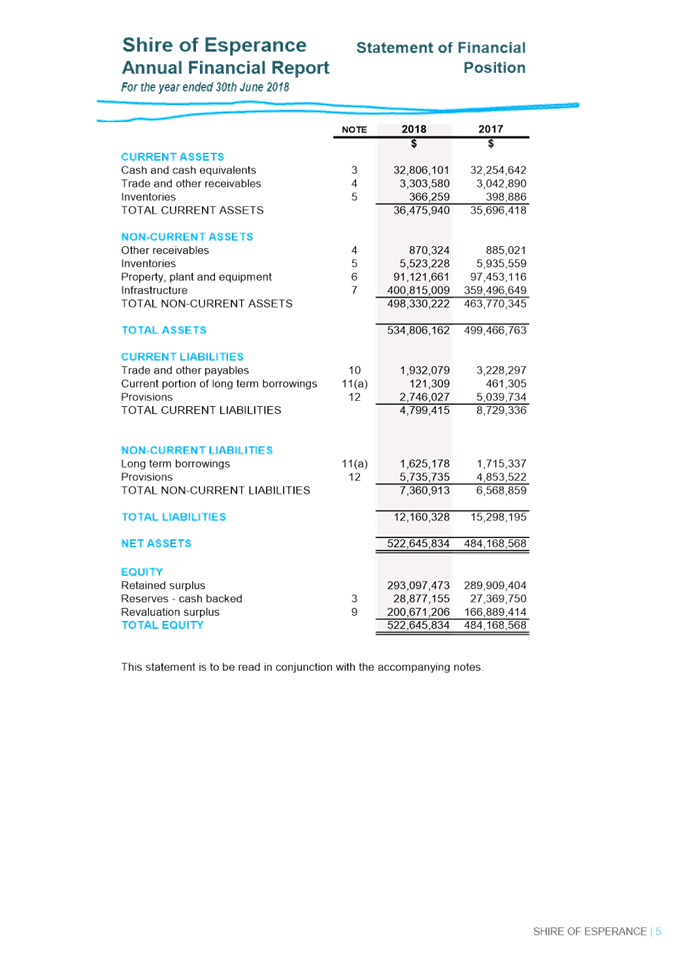
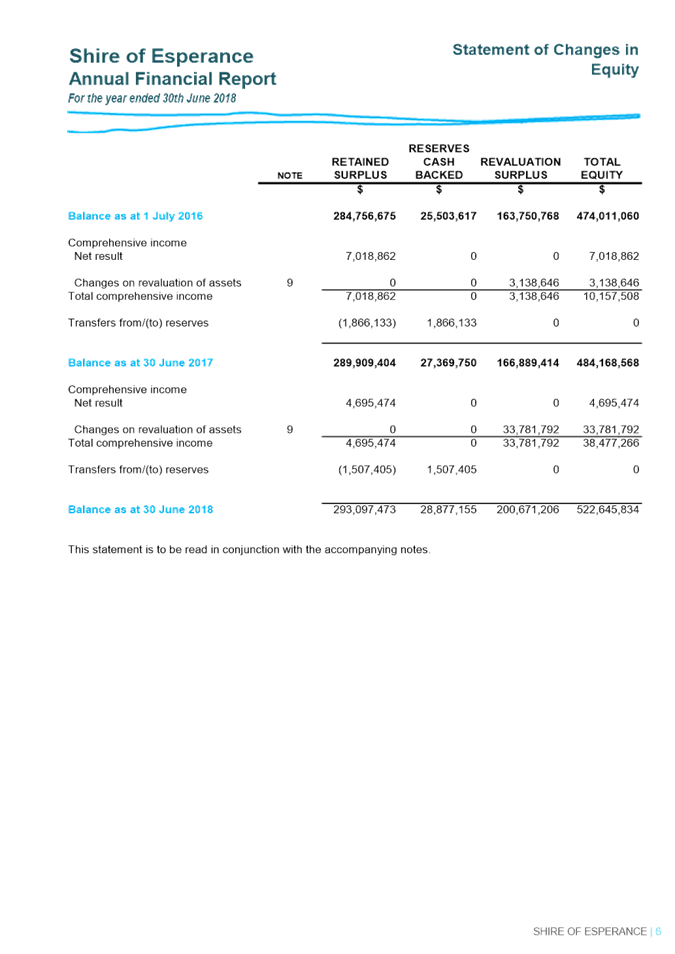
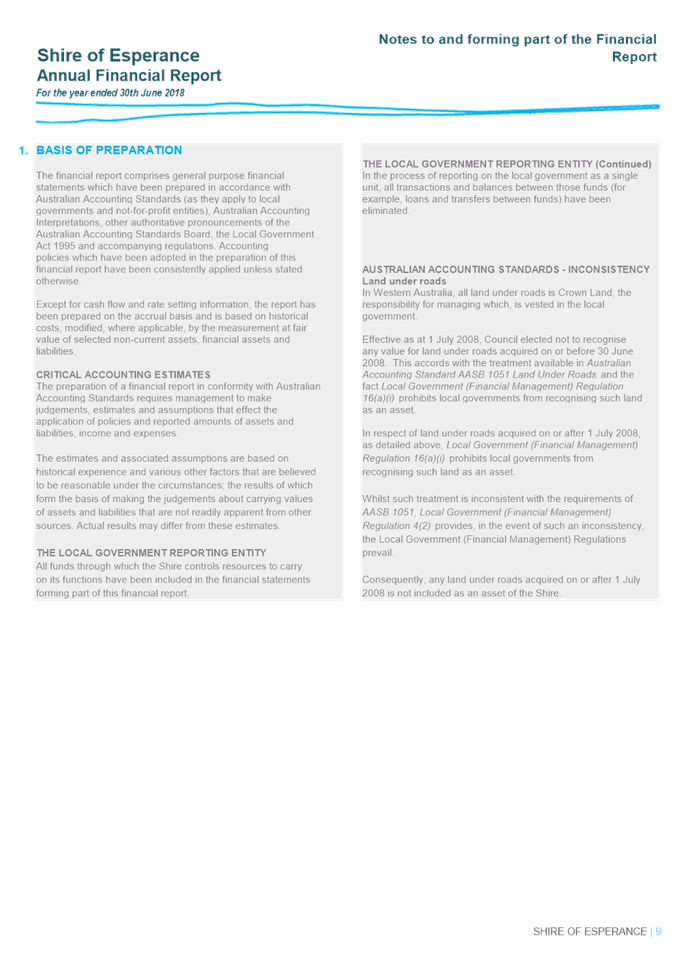
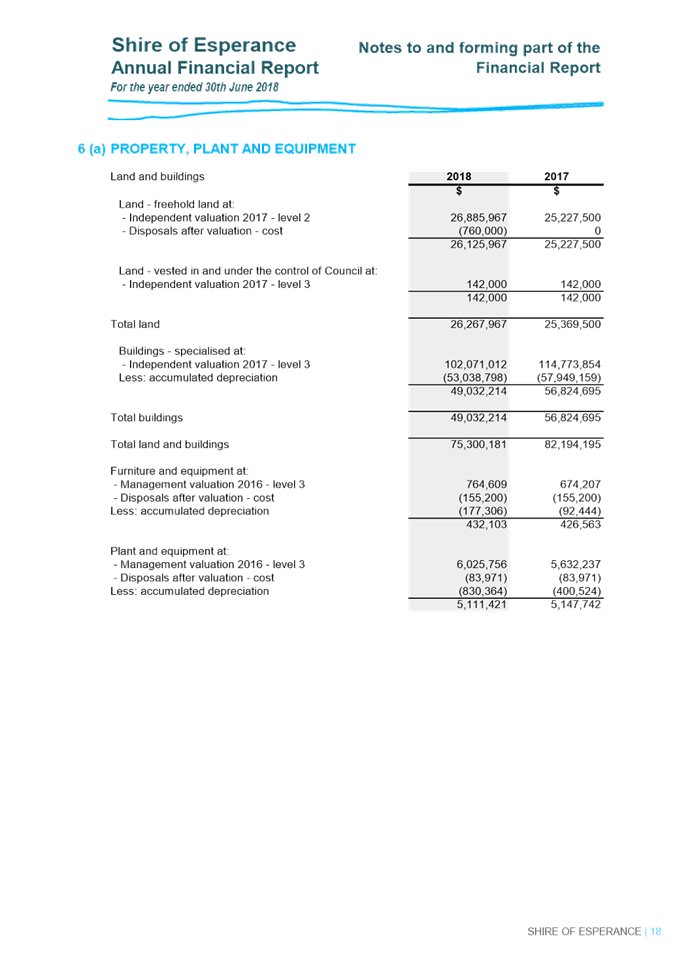
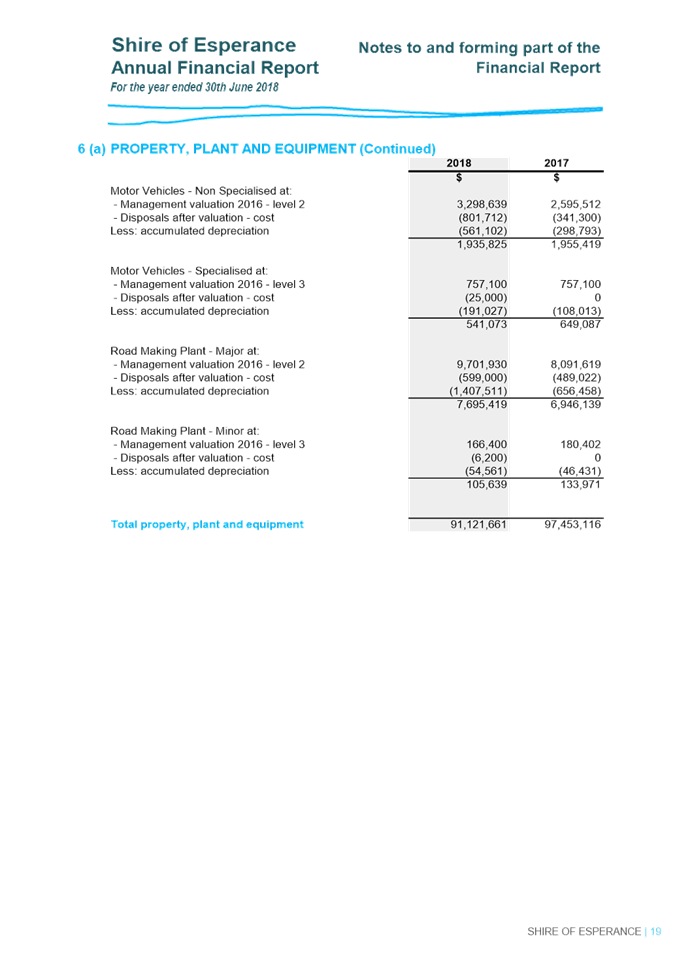
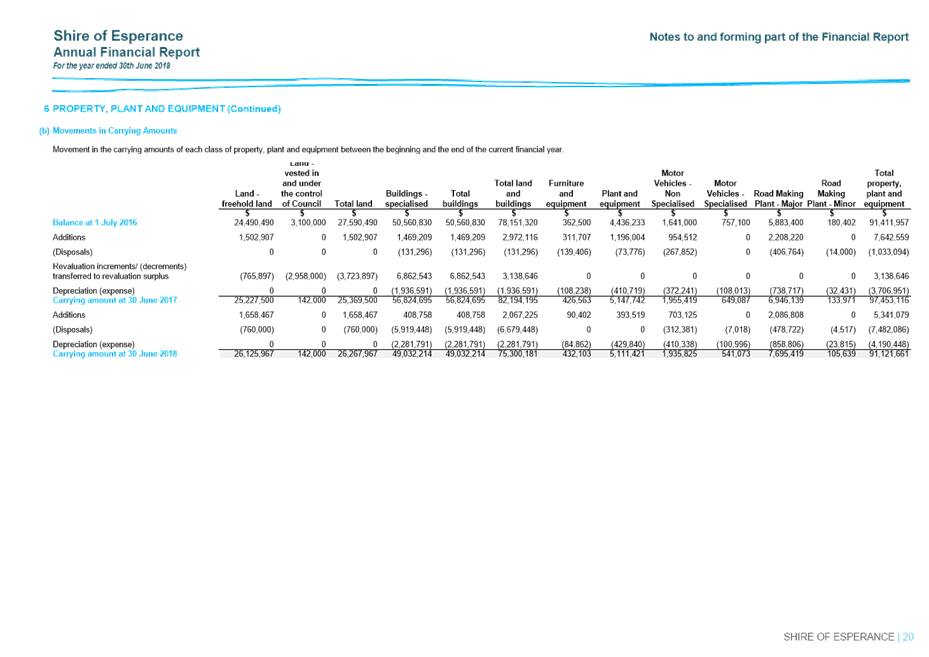
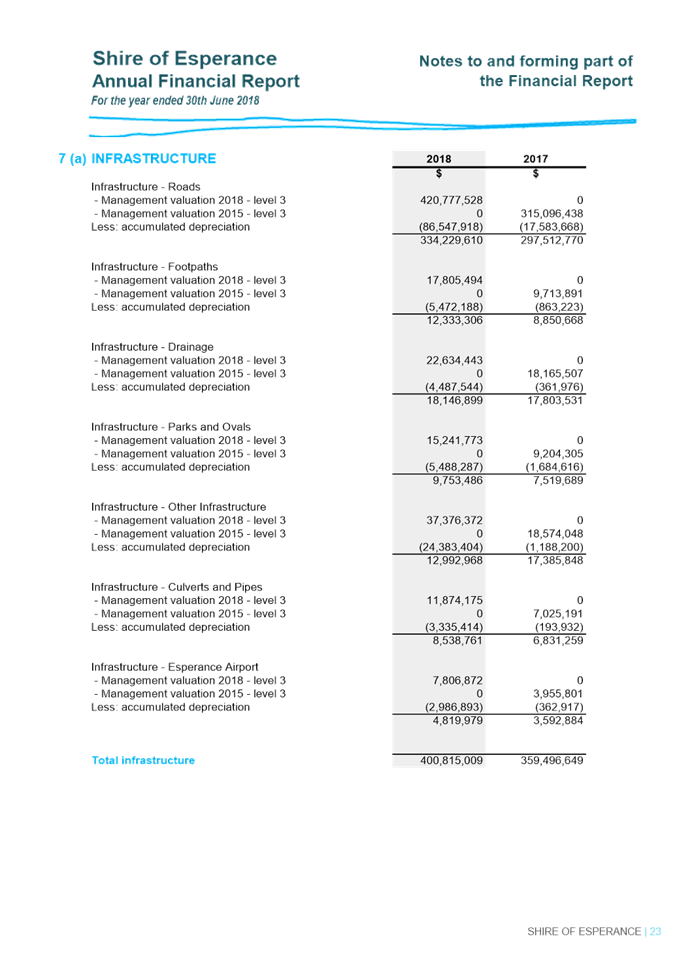
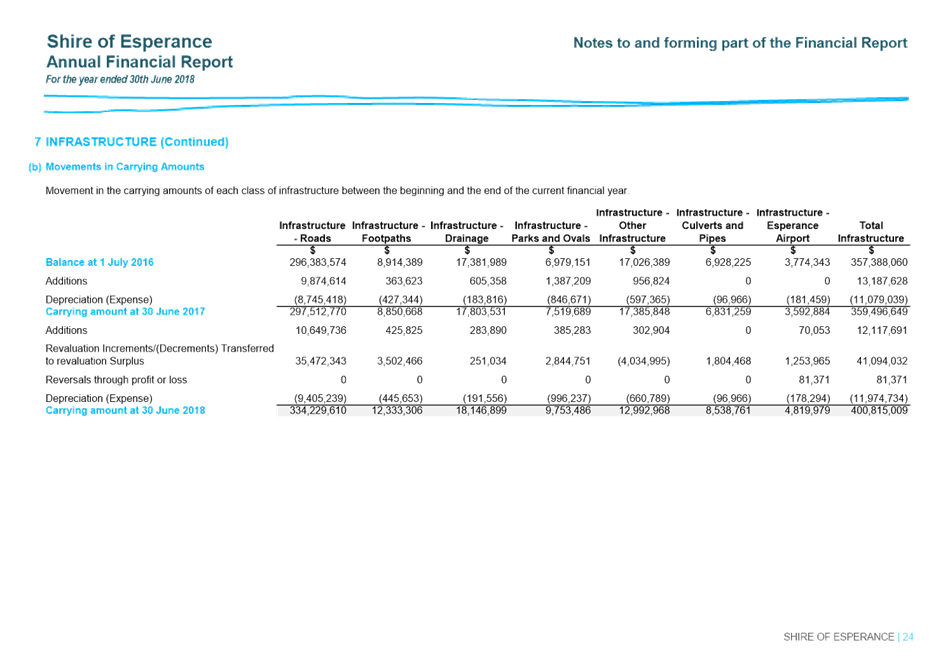
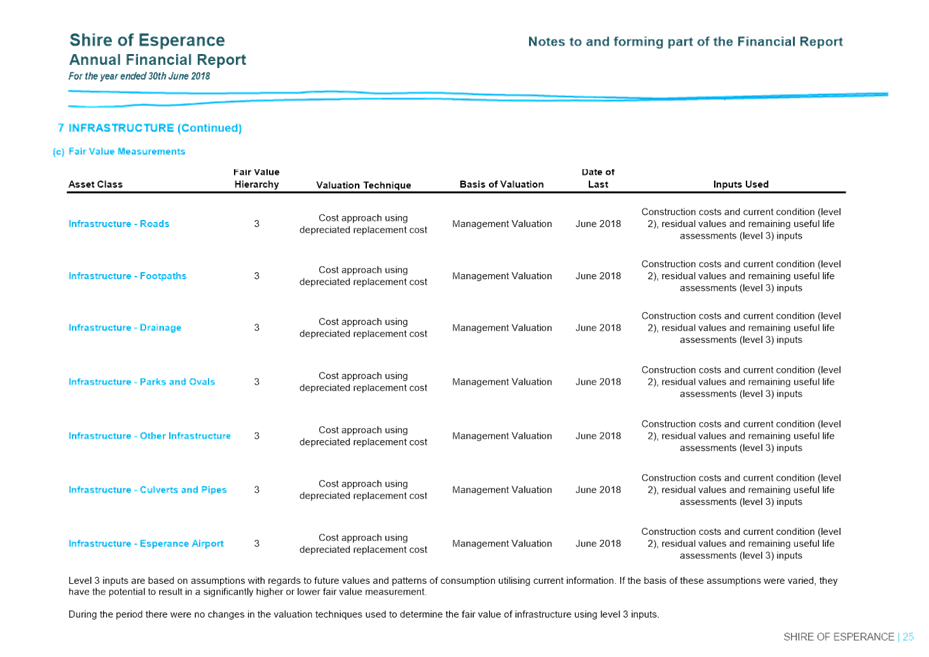
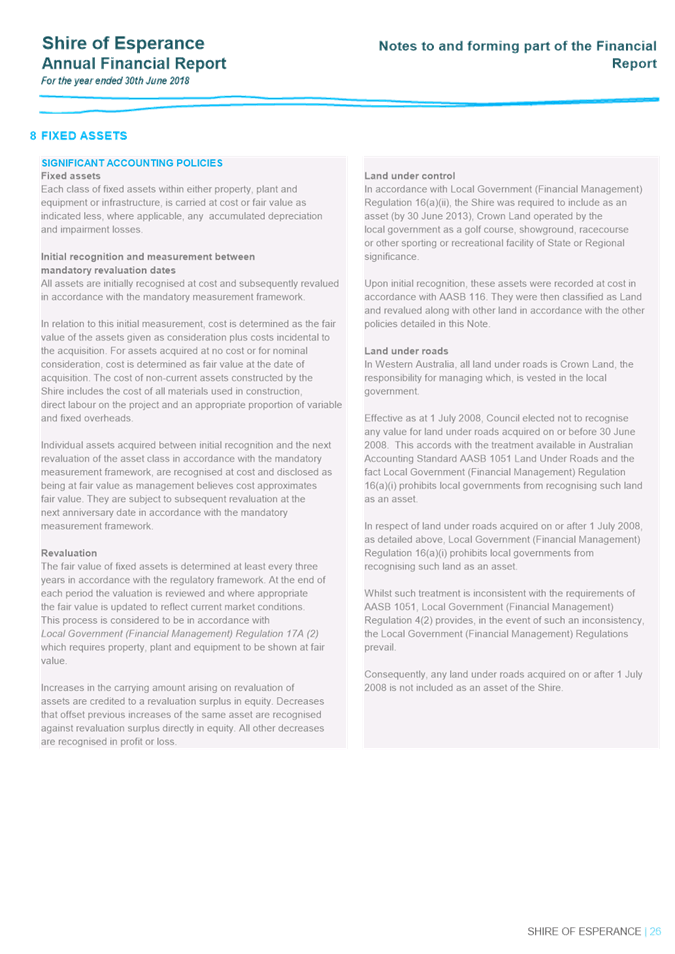
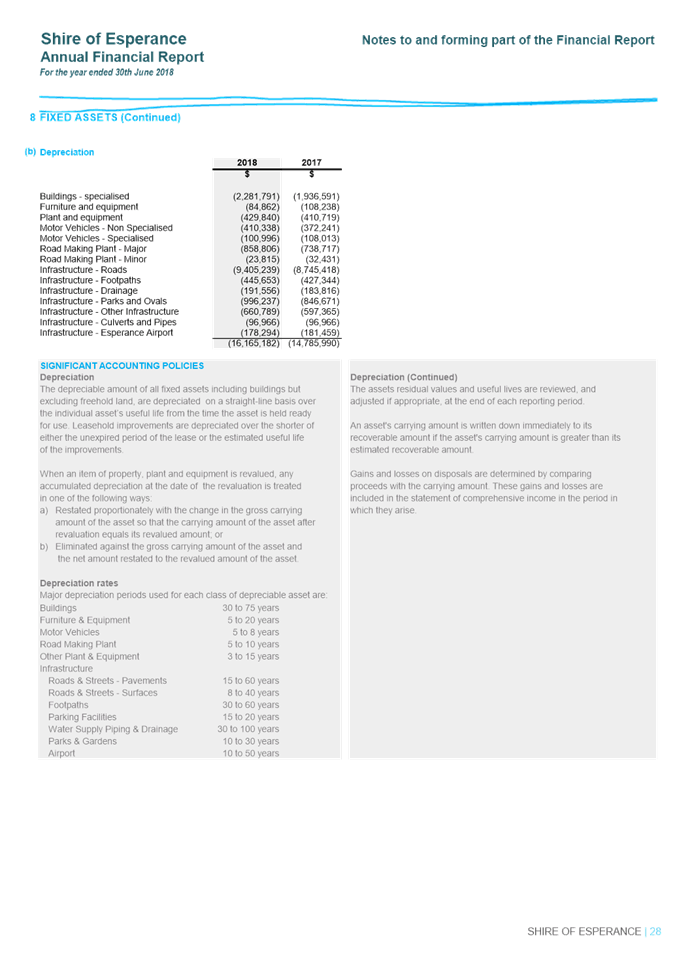
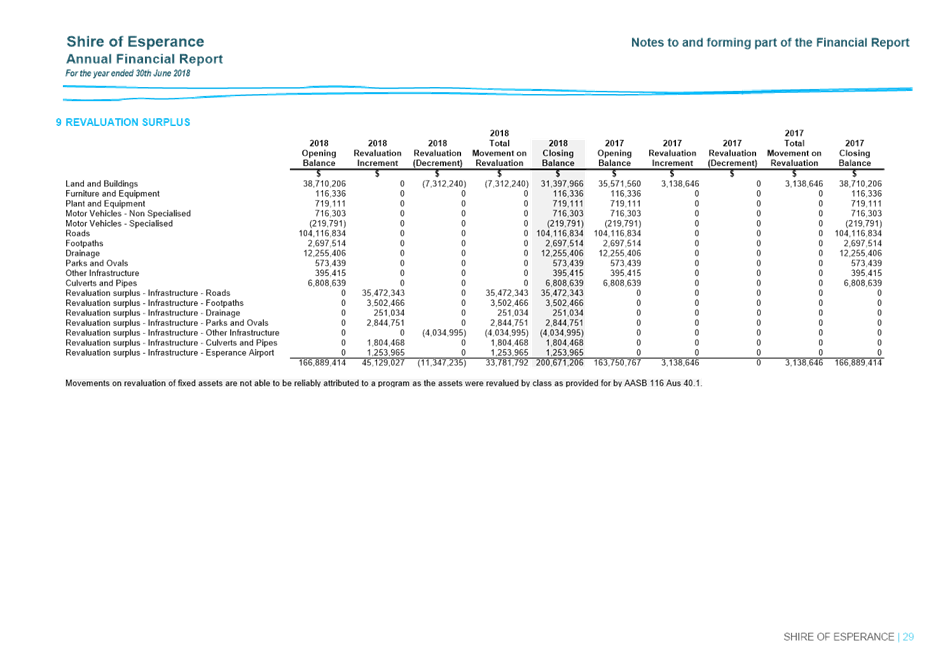
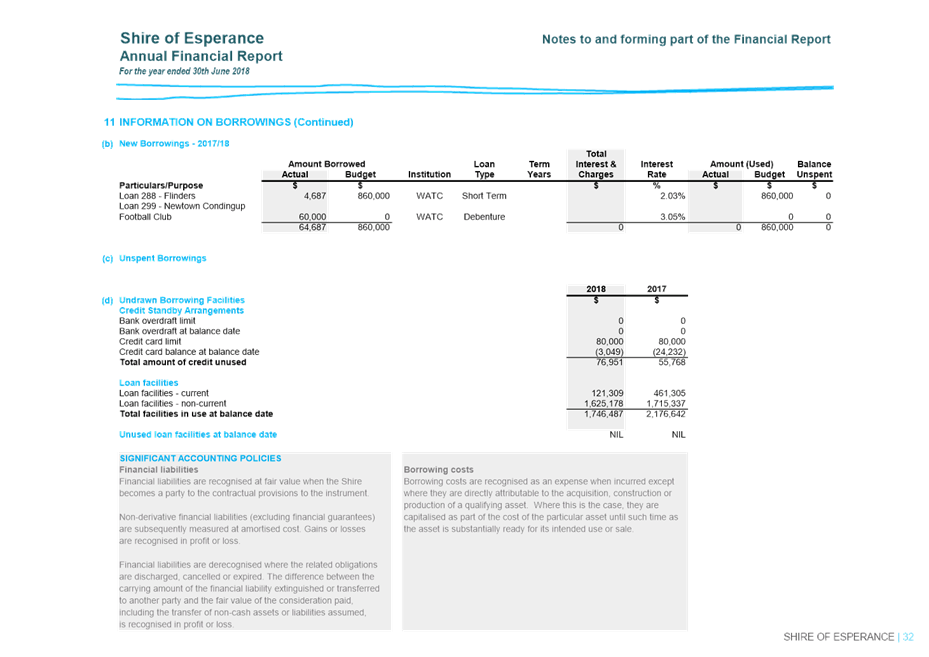
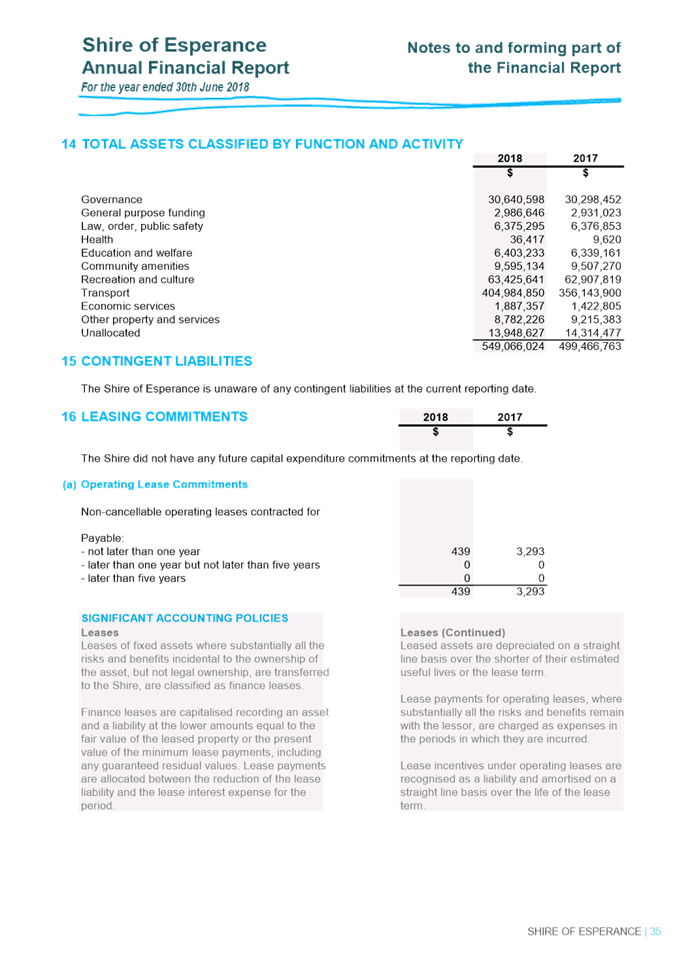
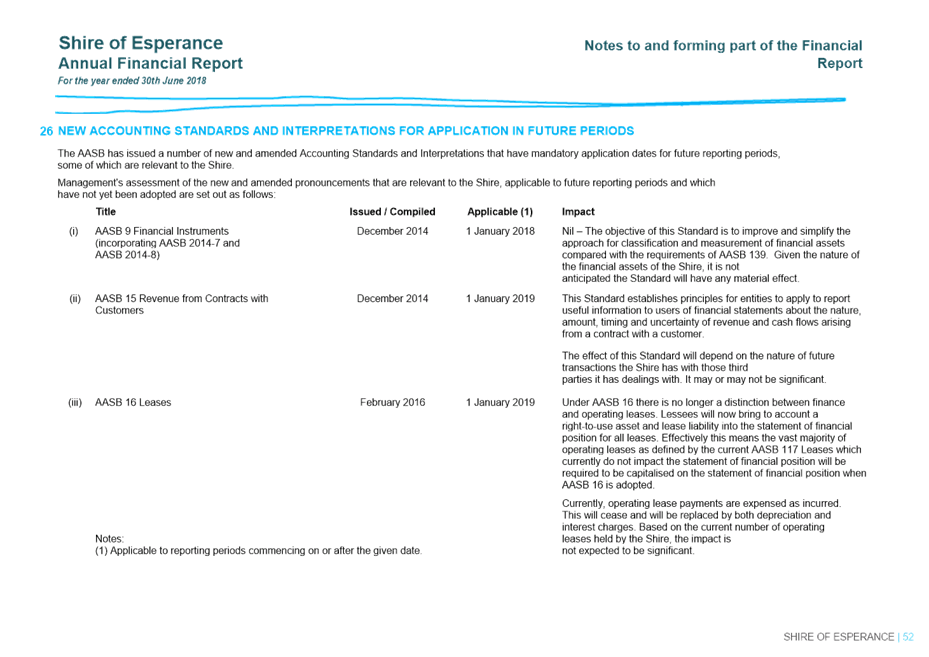
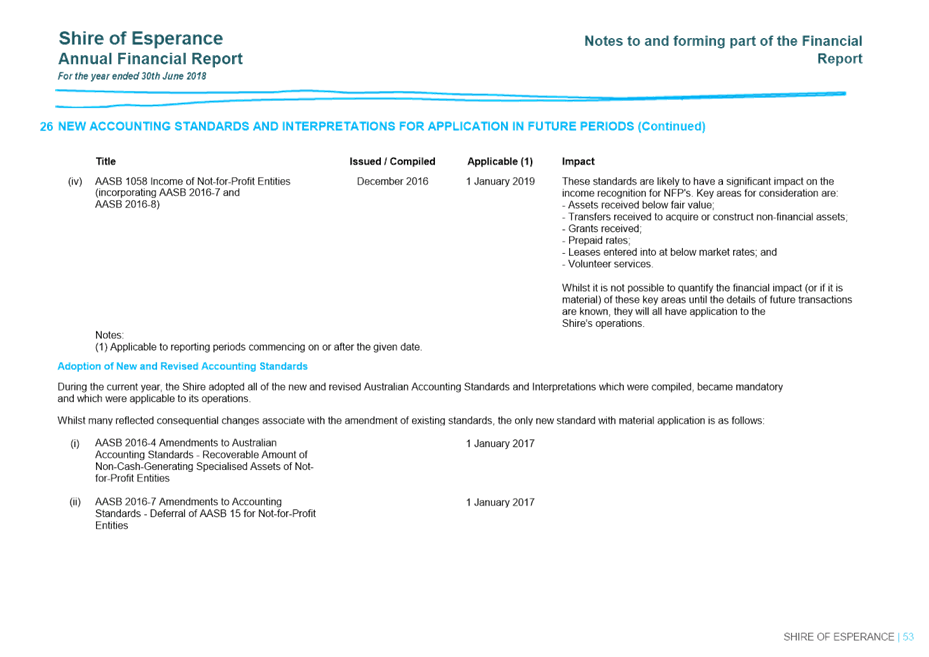
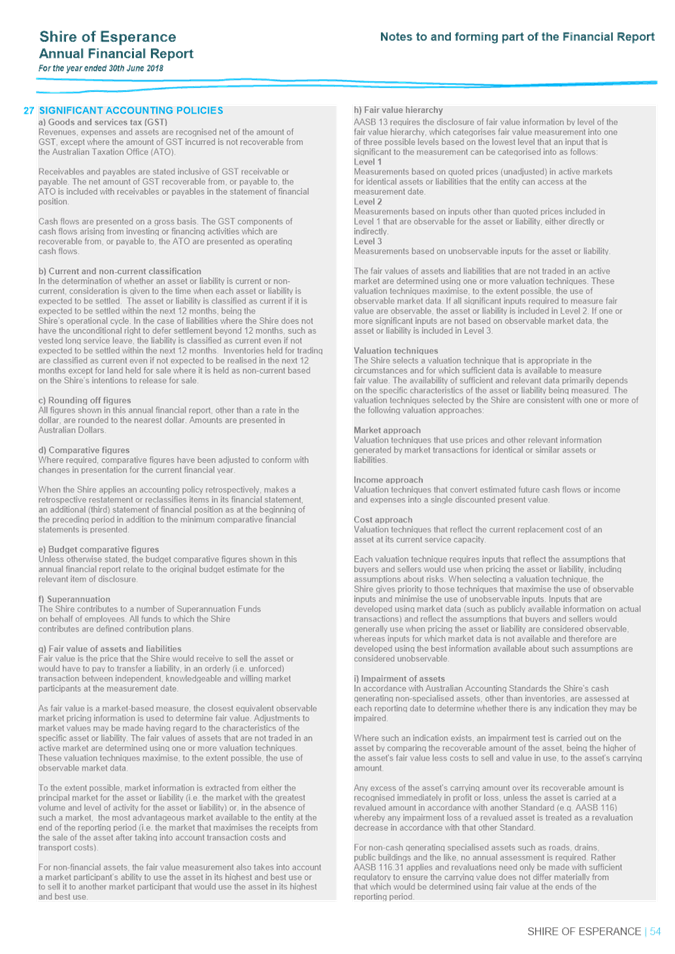
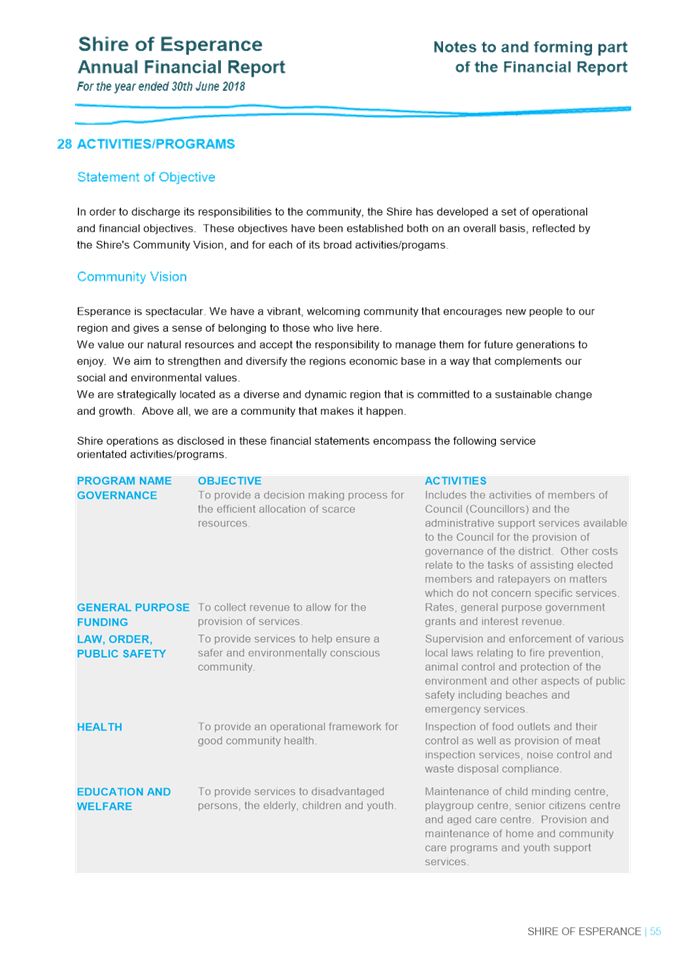
Revaluation of Infrastructure occurred during 2018 resulting
in a net increase of nearly $34m. At the same time the five golf courses
and their assets were removed from the Shire’s asset register as they are
not owned or in the control of the Shire. However the golf courses’ land
still remains on the asset register as the land is Shire owned.
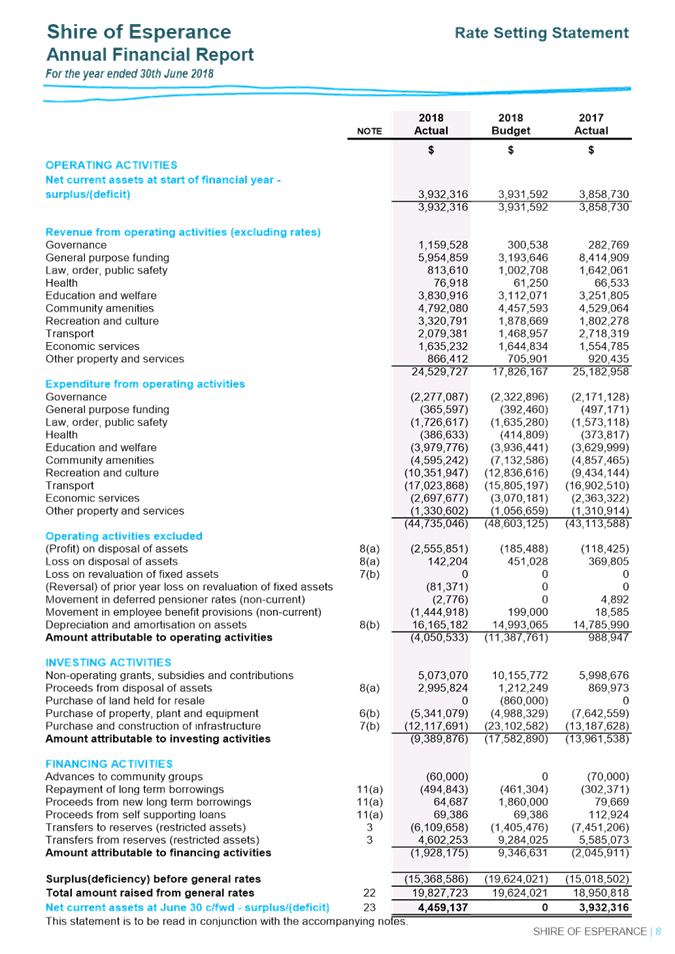
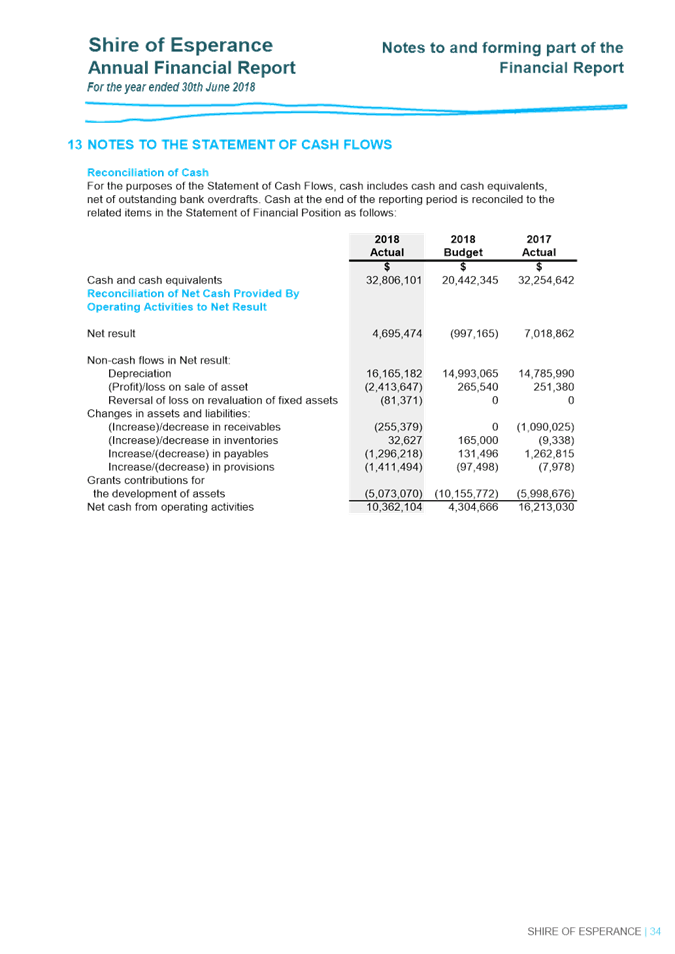
There was a slight reduction to the 2018 surplus closing
position of $4,928 to what was presented to Council at Budget adoption.
This was due to end of year processing that had not been completed when the
budget was presented to Council.
Consultation
Nil
Financial Implications
As per the 2018/19 Budget.
Asset Management Implications
Nil
Statutory Implications
The statutory implications associated with this item
are Local Government Act (1995) Section 7.12A which details duties with respect
to audits.
Policy Implications
Nil
Strategic Implications
Strategic Community Plan 2017 - 2027
Community
Leadership
A financially
sustainable and supportive organisation achieving operational excellence
Provide
responsible resource and planning management for now and the future
Environmental Considerations
Nil
Attachments
|
a⇩.
|
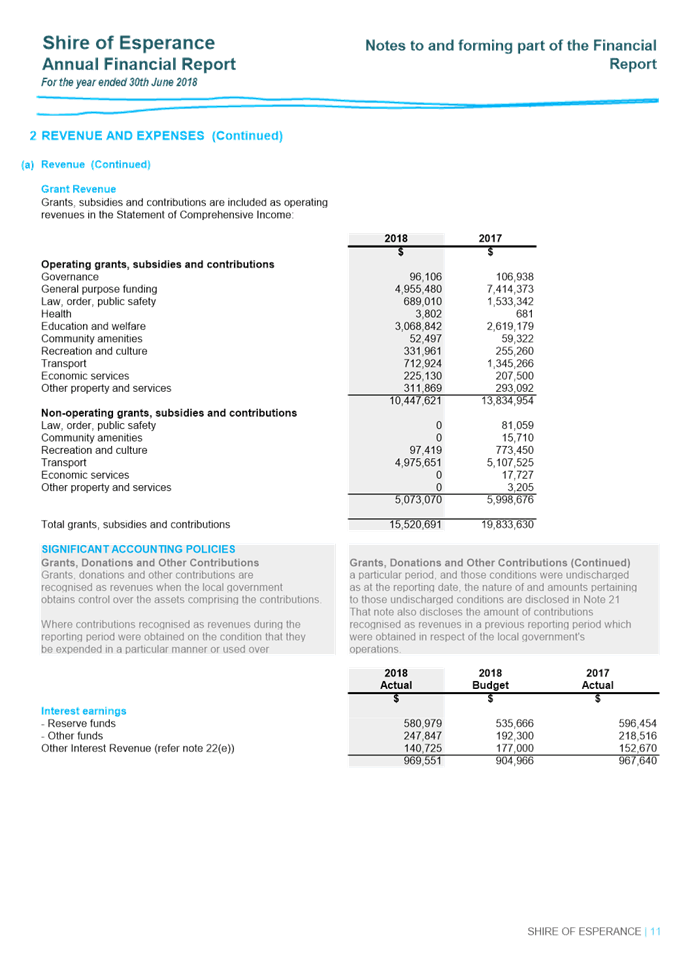
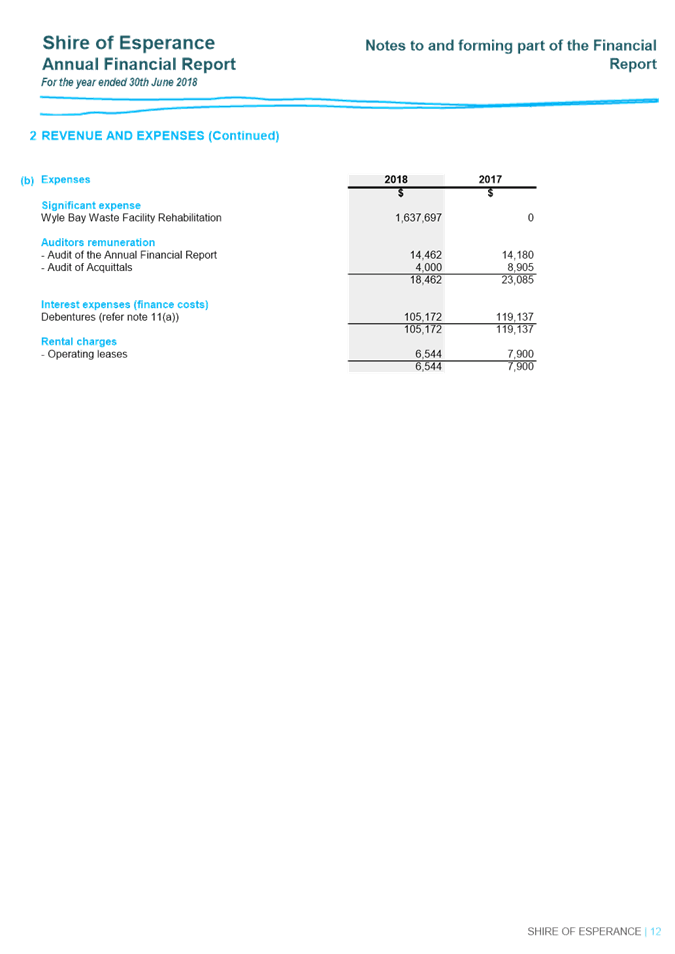
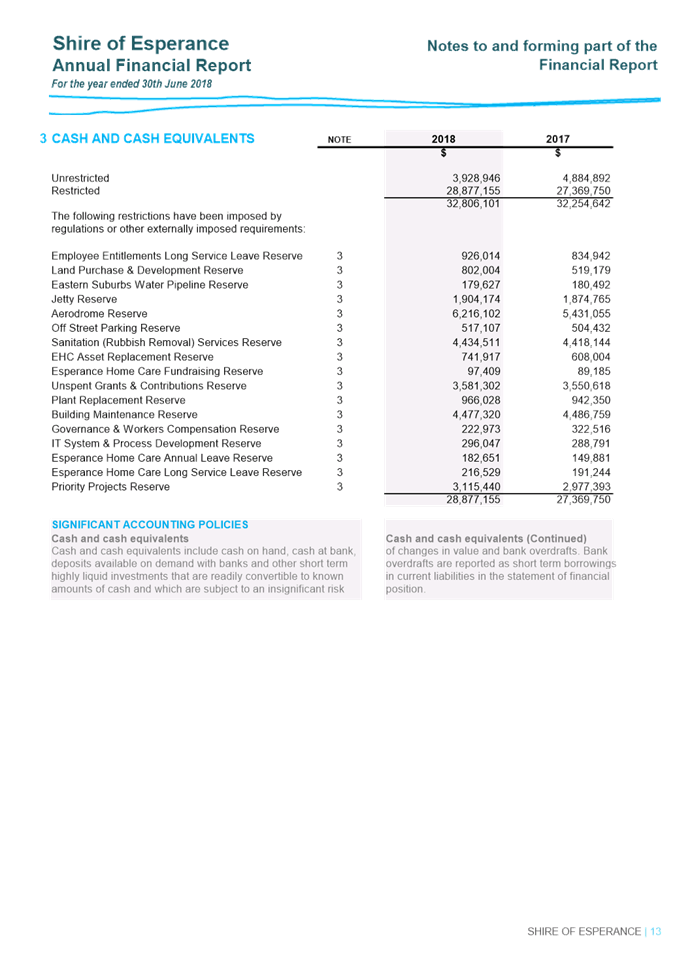
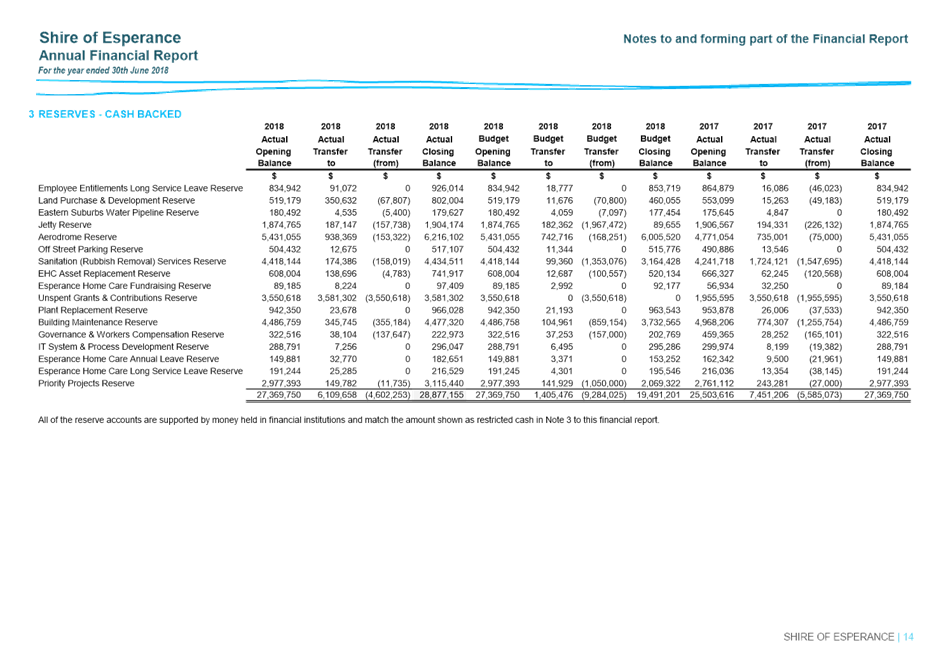
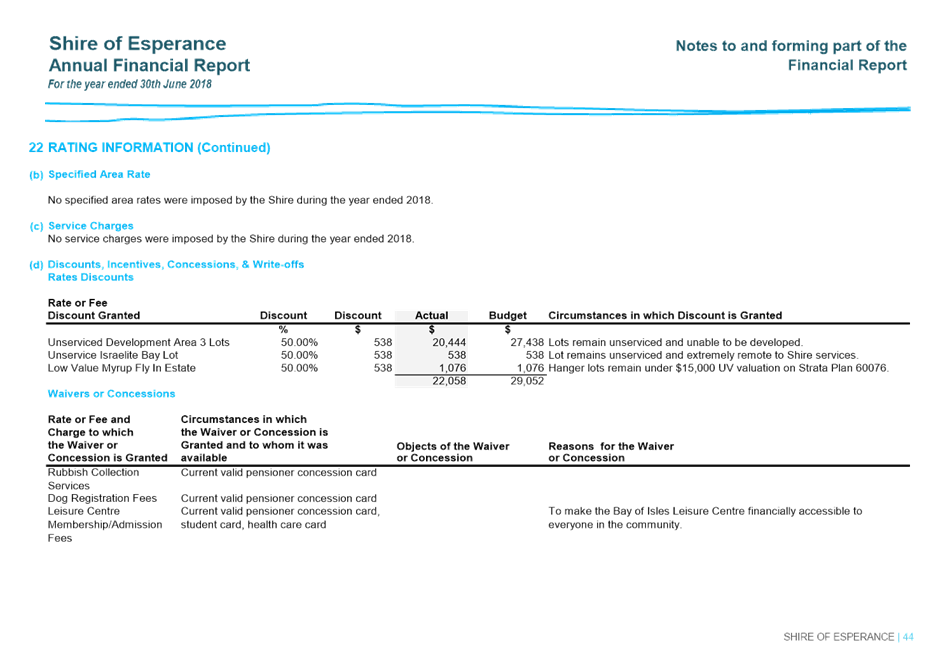
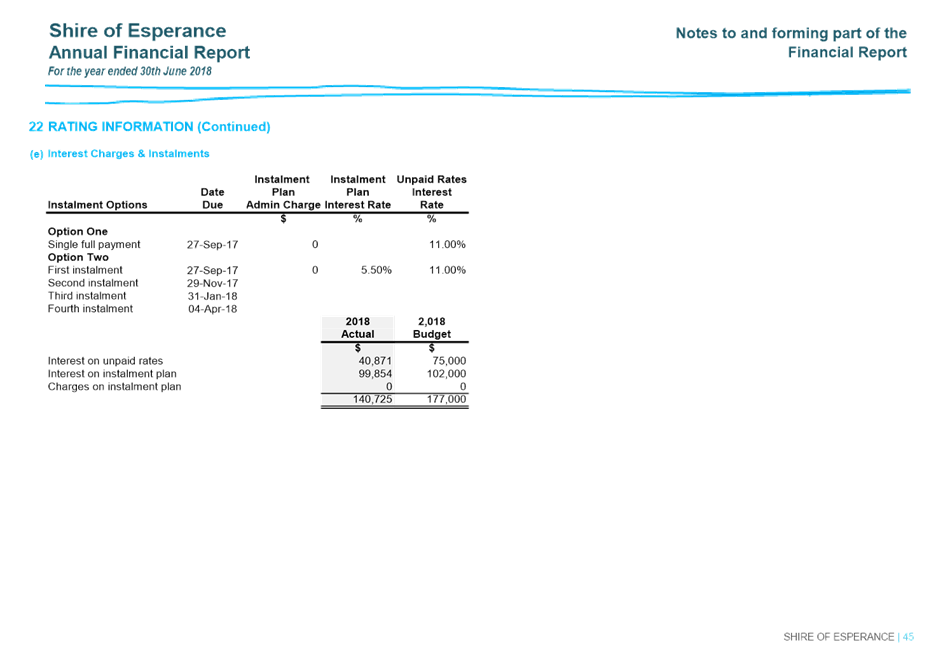
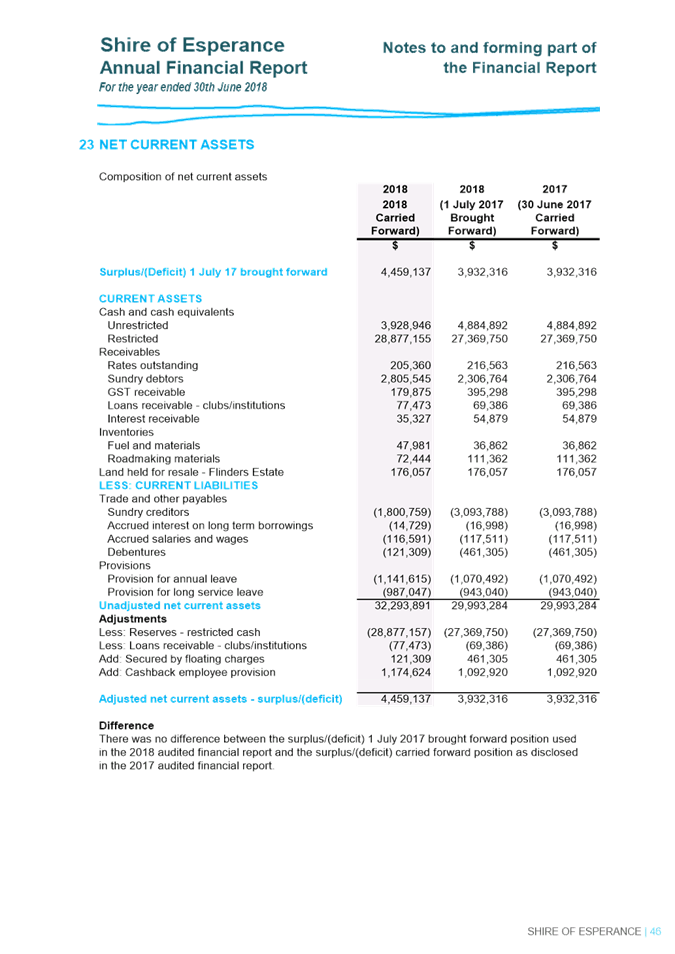
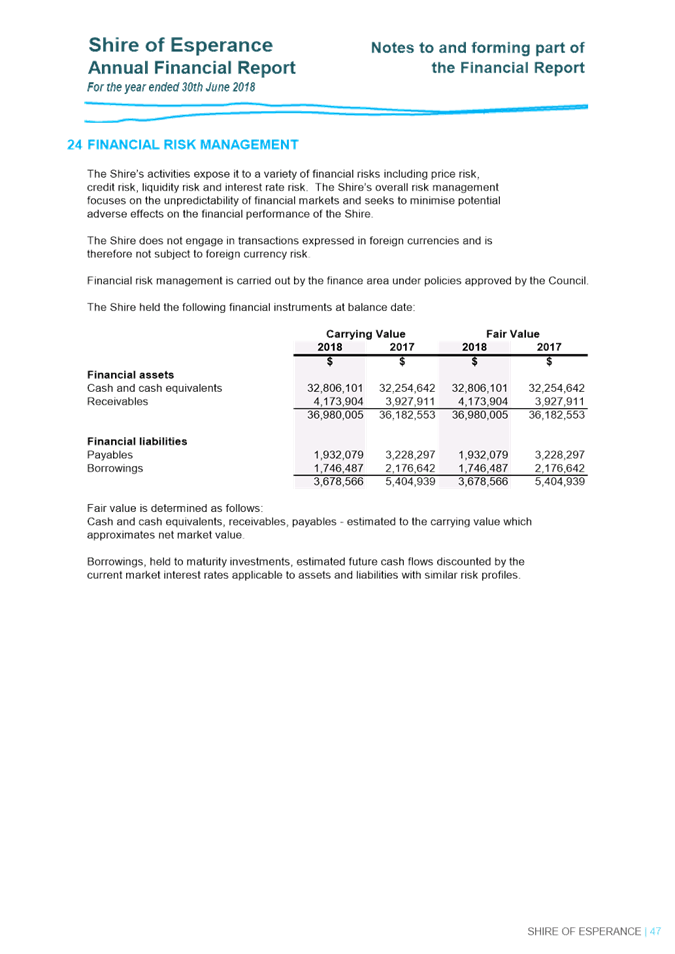
Annual Financial Report
2017/18
|
|
|
b⇩.
|
Management Letter
2017/18
|
|
|
Officer’s Recommendation
That the Audit Committee
1. Receive
the 2017/18 Annual Financial Report incorporating the Audit Report as
attached at Attachment A.
2. Receive
the Management Letter for the 2017/18 financial year as attached at
Attachment B.
3. Recommends
the Annual Financial Report, Audit Report and Management Letter for the
2017/18 financial year to Council for adoption.
Voting Requirement Simple Majority
|
Item: 9.3
CEO Review of Systems and Procedures
|
Author/s
|
Sarah Walsh
|
Coordinator Corporate Support
|
|
Authorisor/s
|
Shane Burge
|
Director Corporate Resources
|
File Ref: D18/26571
Applicant
Internal
Location/Address
Shire of Esperance
Executive Summary
For the Audit Committee to consider the report from the CEO
on the appropriateness and effectiveness of the Shire of Esperance systems and
procedures in relation to risk management, internal control and legislative
requirements.
Recommendation in Brief
That the Audit Committee accept the report from the CEO on
the appropriateness and effectiveness of the Shire of Esperance systems and
procedures in relation to risk management, internal control and legislative
requirements and recommend the review to Council for endorsement.
Background
In accordance with Regulation 17 of the Local
Government (Audit) Regulations 1996, the CEO is required to review the
appropriateness and effectiveness of the Shire of Esperance’s systems and
procedures in relation to risk management, internal control and legislative
requirements not less than once every three years.
The review process was developed along with Local Government
Insurance Service (LGIS) during 2014 in regards to risk, internal control and
legislative compliance. The Department of Local Government has developed
guidelines to assist Local Governments in determining the issues that should be
considered in any review process -
Risk Management
Internal control and risk management systems and
programs are a key expression of a local government’s attitude to
effective controls. Good audit committee practices in monitoring internal
control and risk management programs typically include:
· Reviewing whether the local
government has an effective risk management system and that material operating
risks to the local government are appropriately considered;
· Reviewing whether the local
government has a current and effective business continuity plan (including
disaster recovery) which is tested from time to time;
· Assessing the internal processes for
determining and managing material operating risks in accordance with the local
government’s identified tolerance for risk, particularly in the following
areas;
–
Potential non-compliance with legislation, regulations, standards and local
government’s policies;
– Important
accounting judgements or estimates that prove to be wrong;
– Litigation and
claims;
– Misconduct, fraud
and theft;
– Significant
business risks, recognising responsibility for general or specific risk areas.
For example, environmental, occupational health and safety risk, and how they
are managed by the local government;
· Obtaining regular risk reports, which
identify key risks, the status and the effectiveness of the risk management
systems, to ensure that identified risks are monitored and new risks are
identified, mitigated and reported;
· Assessing the adequacy of local
government processes to manage insurable risks and ensure the adequacy of
insurance cover, and if applicable, the level of self-insurance;
· Reviewing the effectiveness of the
local government’s internal control system with management and the
internal and external auditors;
· Assessing whether management has
controls in place for unusual types of transactions and/or any potential
transactions that might carry more than an acceptable degree of risk;
· Assessing the local
government’s procurement framework with a focus on the probity and
transparency of policies and procedures/processes and whether these are being
applied;
· Should the need arise, meeting
periodically with key management, internal and external auditors, and
compliance staff, to understand and discuss any changes in the local
government’s control environment;
· Ascertaining whether fraud and
misconduct risks have been identified, analysed, evaluated and have an
appropriate treatment plan which has been implemented, communicated, monitored
and there is regular reporting and ongoing management of fraud and misconduct
risks.
Internal Control
Internal control is a key component of a sound
governance framework, in addition to leadership, long-term planning,
compliance, resource allocation, accountability and transparency. Strategies to
maintain sound internal controls are based on risk analysis of the internal
operations of a local government.
An effective and transparent internal control
environment is built on the following key areas:
· integrity and ethics;
· policies and delegated authority;
· levels of responsibilities and
authorities;
· audit practices;
· information system access and
security;
· management operating style; and
· human resource management and
practices.
Internal control systems involve policies and
procedures that safeguard assets, ensure accurate and reliable financial
reporting, promote compliance with legislation and achieve effective and
efficient operations and may vary depending on the size and nature of the local
government.
Aspects of an effective control framework will
include:
· delegation of authority;
· documented policies and procedures;
· trained and qualified employees;
· system controls;
· effective policy and process review;
· regular internal audits;
· documentation of risk identification
and assessment; and
· regular liaison with auditor and
legal advisors.
The following are examples of controls that are
typically reviewed:
· separation of roles and functions,
processing and authorisation;
· control of approval of documents,
letters and financial records;
· comparison of internal data with
other or external sources of information;
· limit of direct physical access to
assets and records;
· control of computer applications and
information system standards;
· limit access to make changes in data
files and systems;
· regular maintenance and review of
financial control accounts and trial balances;
· comparison and analysis of financial
results with budgeted amounts;
· the arithmetical accuracy and content
of records;
· report, review and approval of
financial payments and reconciliations; and
· comparison of the result of physical
cash and inventory counts with accounting records.
Legislative Compliance
The compliance programs of a local government are a
strong indication of attitude towards meeting legislative requirements. Audit
committee practices in regard to monitoring compliance programs typically
include:
· Monitoring compliance with
legislation and regulations;
· Reviewing the annual Compliance Audit
Return and reporting to Council the results of that review;
· Staying informed about how management
is monitoring the effectiveness of its compliance and making recommendations
for change as necessary;
· Reviewing whether the local
government has procedures for it to receive, retain and treat complaints,
including confidential and anonymous employee complaints;
· Obtaining assurance that adverse
trends are identified and review management’s plans to deal with these;
· Reviewing management disclosures in
financial reports of the effect of significant compliance issues;
· Reviewing whether the internal and/or
external auditors have regard to compliance and ethics risks in the development
of their audit plan and in the conduct of audit projects, and report compliance
and ethics issues to the audit committee;
· Considering the internal
auditor’s role in assessing compliance and ethics risks in their plan;
· Monitoring the local
government’s compliance frameworks dealing with relevant external
legislation and regulatory requirements; and
· Complying with legislative and
regulatory requirements imposed on audit committee members, including not
misusing their position to gain an advantage for themselves or another or to
cause detriment to the local government and disclosing conflicts of interest.
The last review was undertaken in November 2016 and
the review recently undertaken by the CEO is now to be considered.
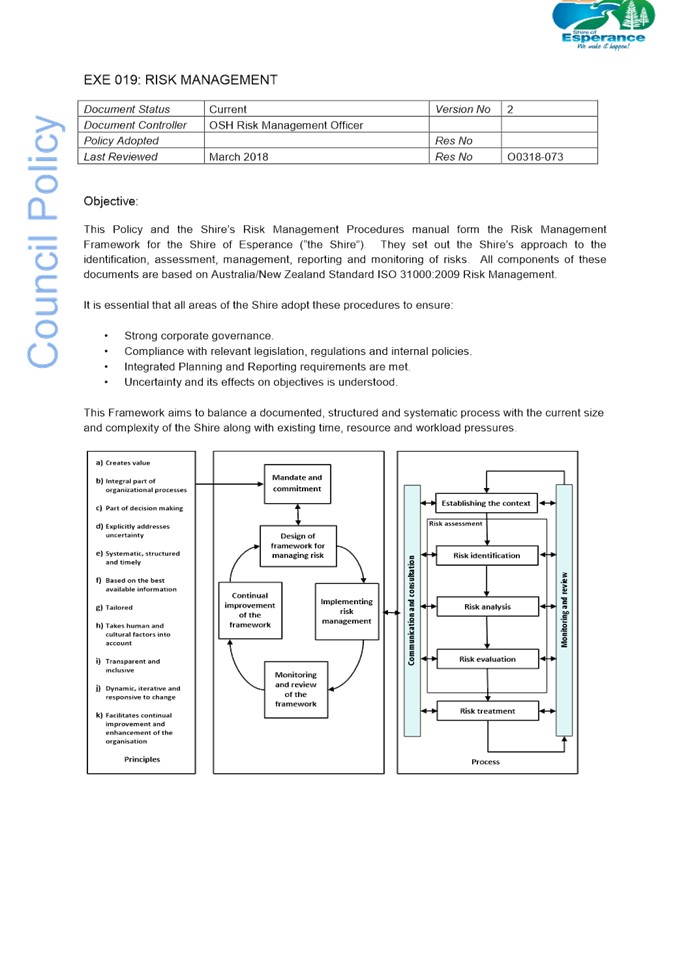
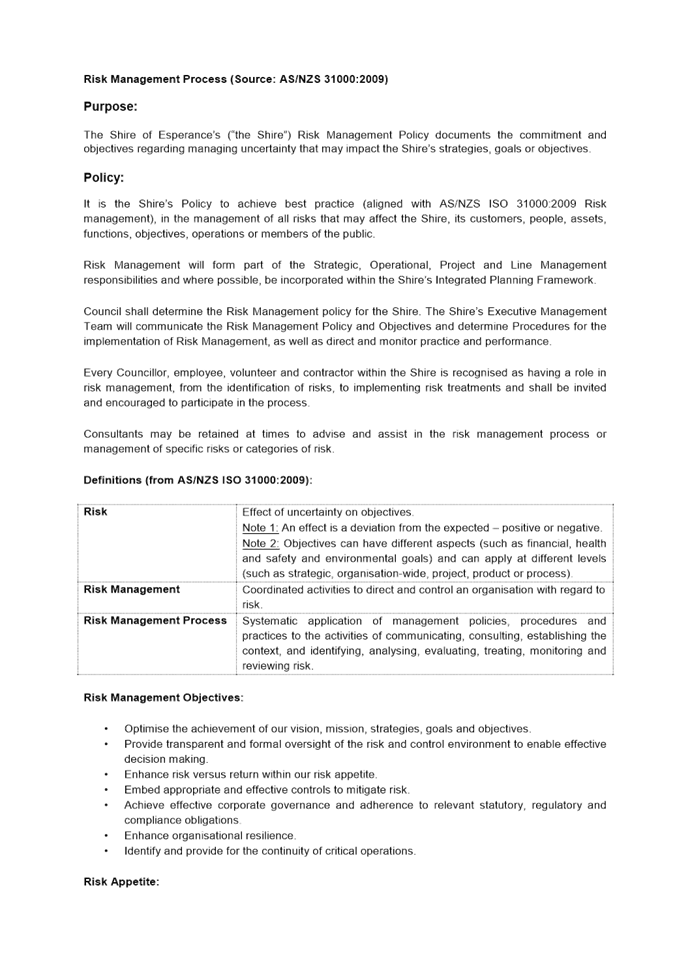
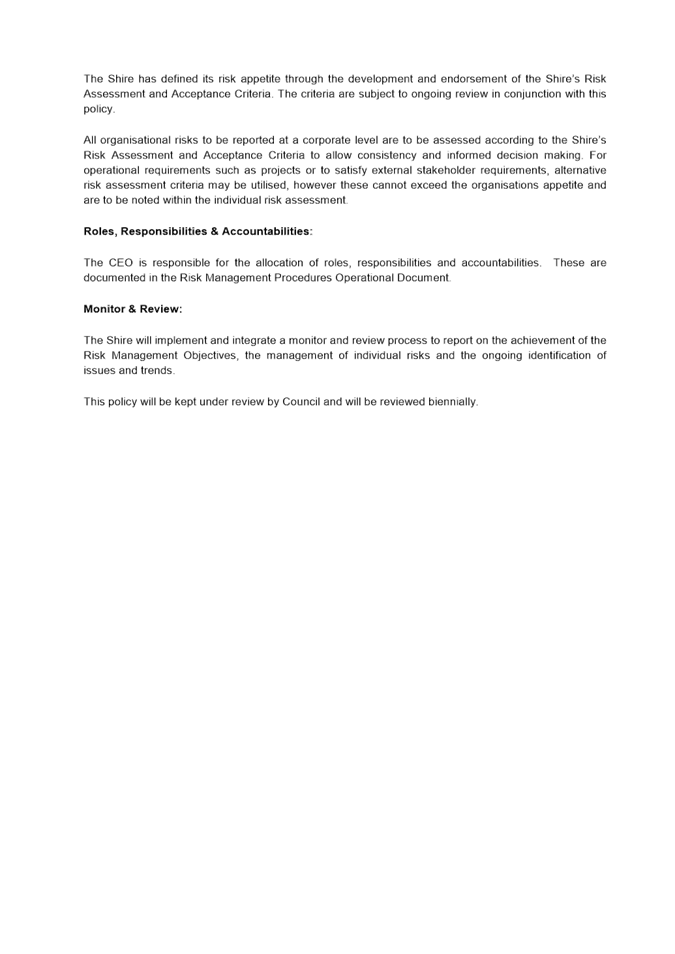
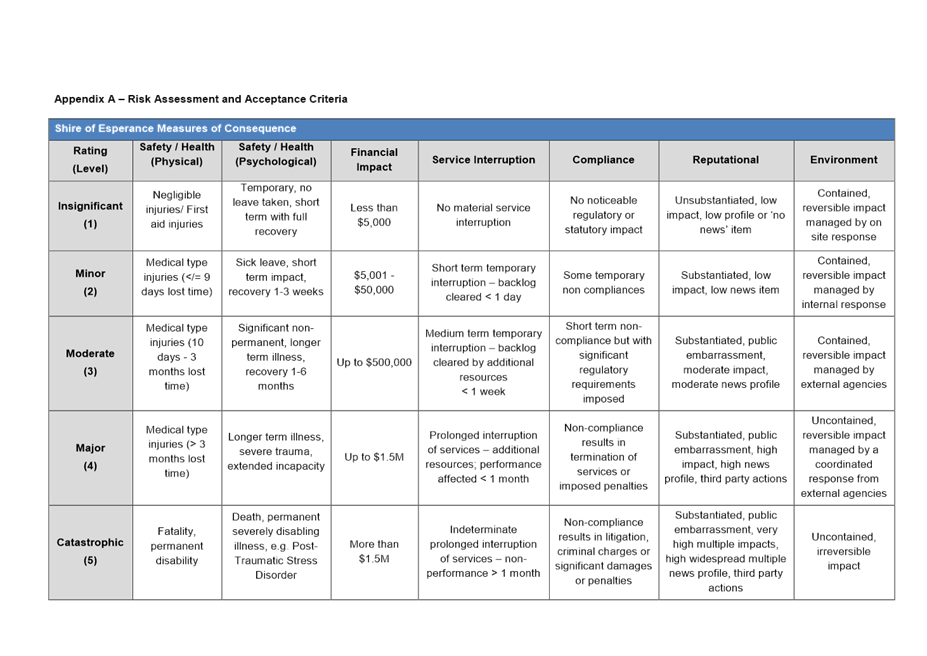
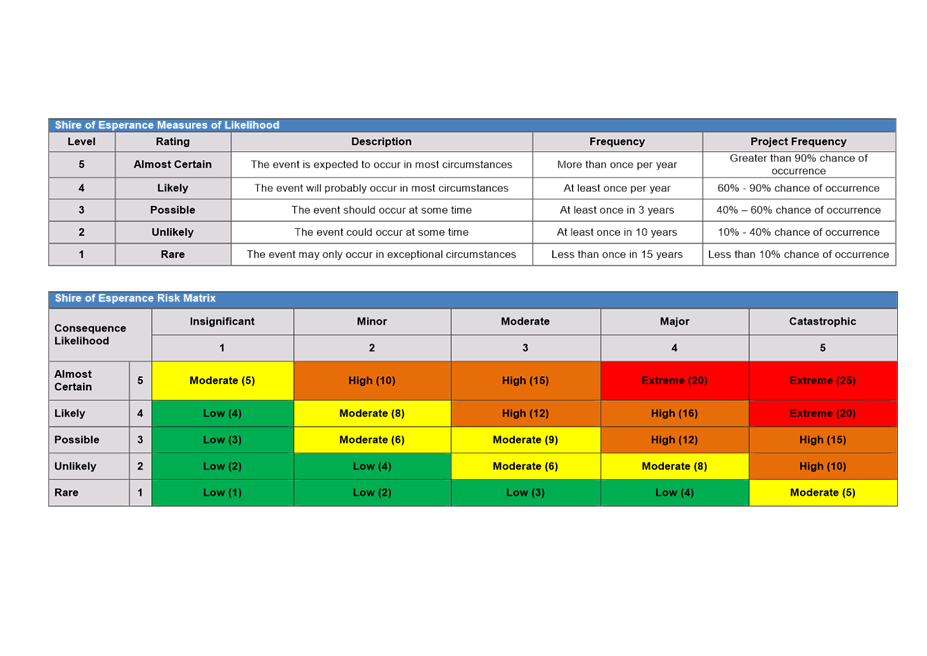
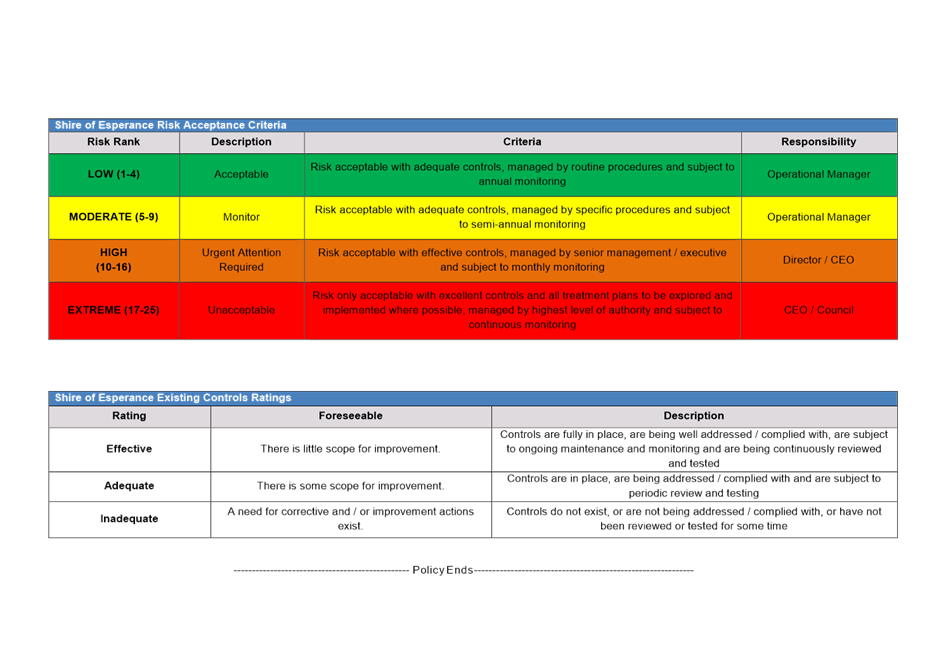
The Shire’s Risk Management Policy (Attachment
A) provides guidance and direction in relation to risk management and
determines the Shire’s risk appetite with regard to the measures of
consequence and likelihood of each risk.
Officer’s Comment
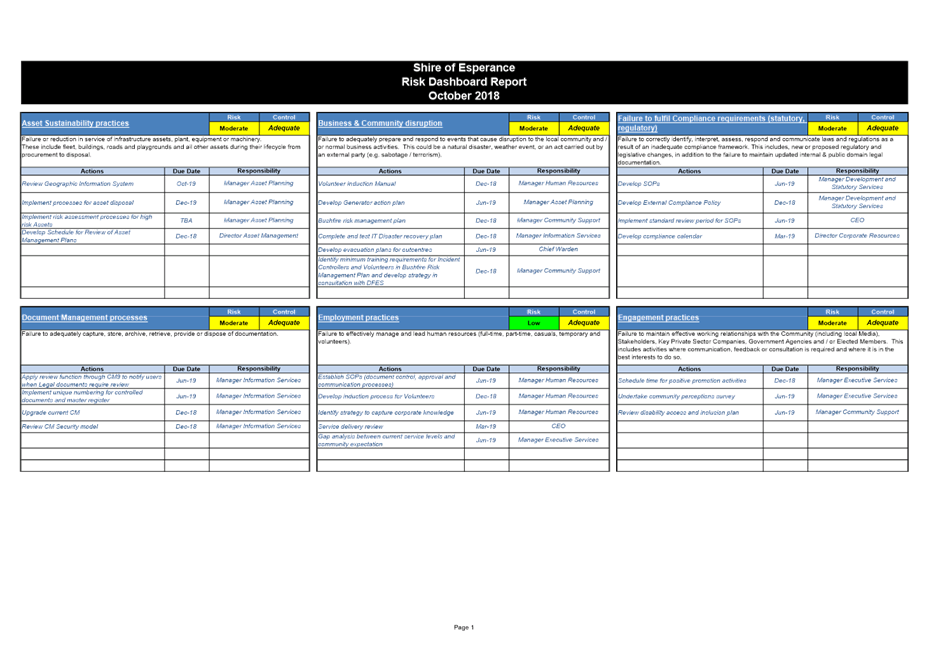
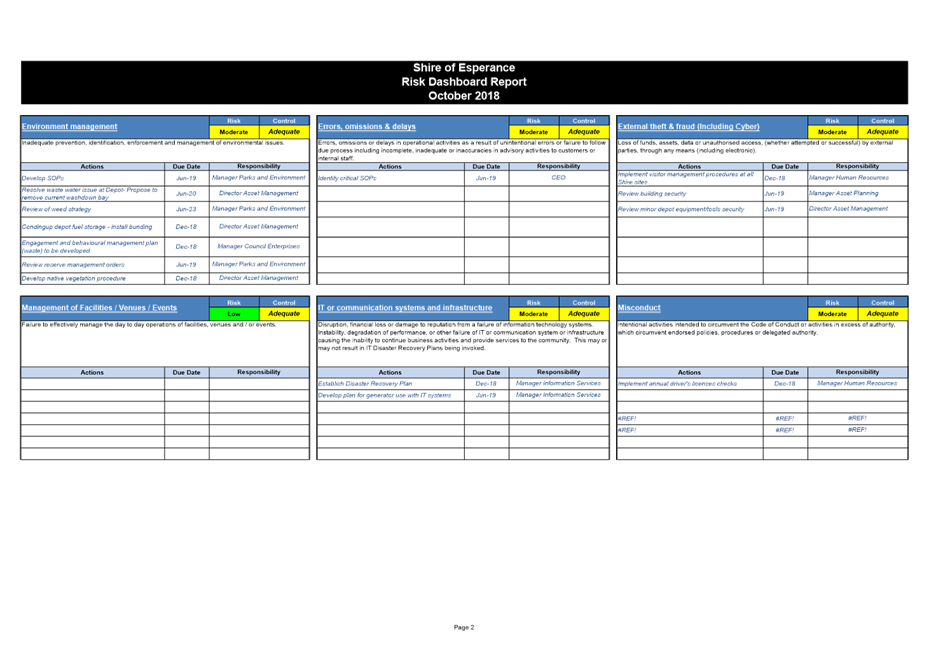
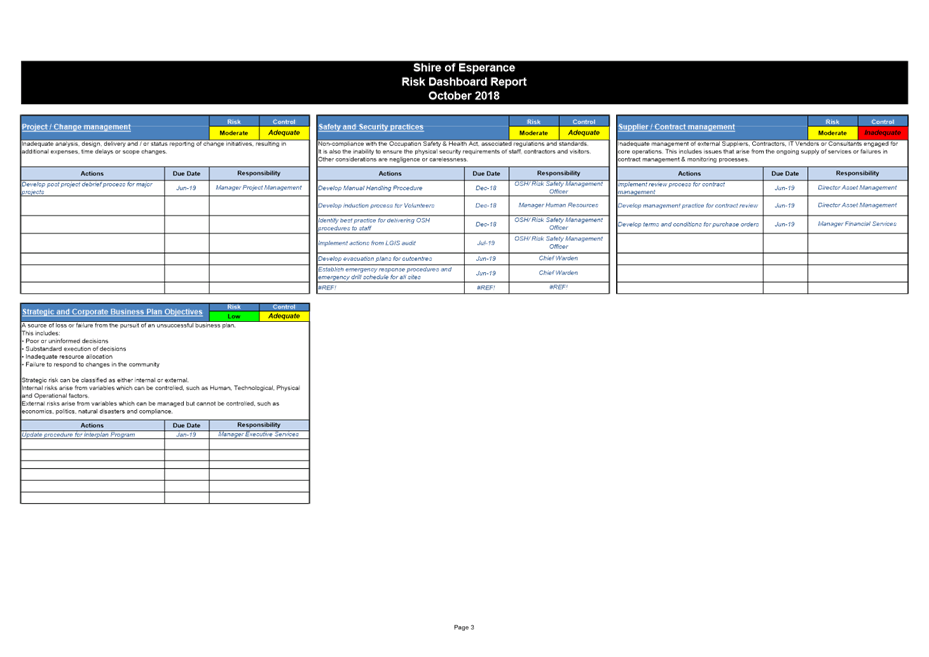
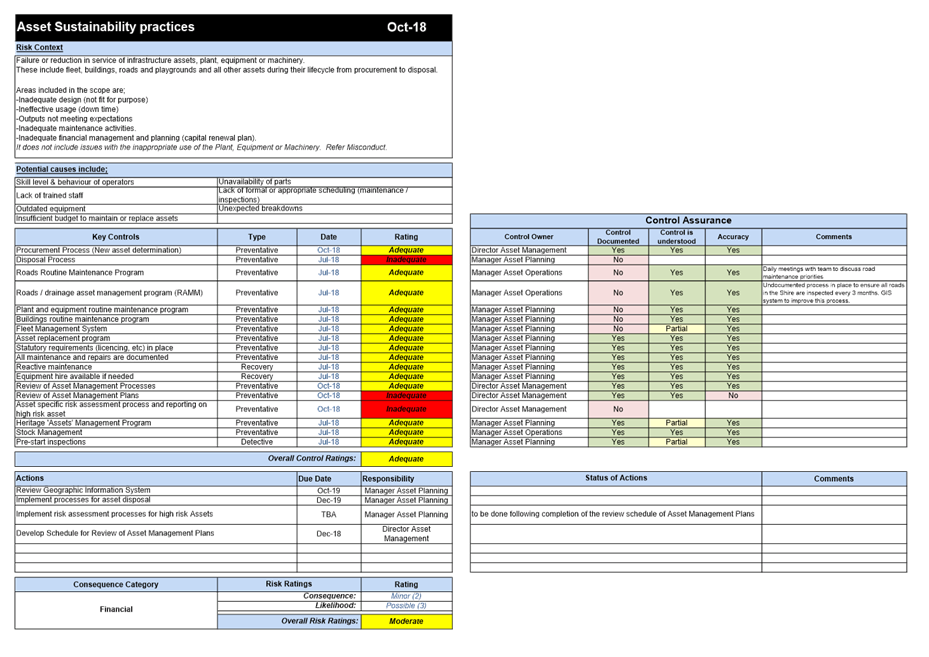
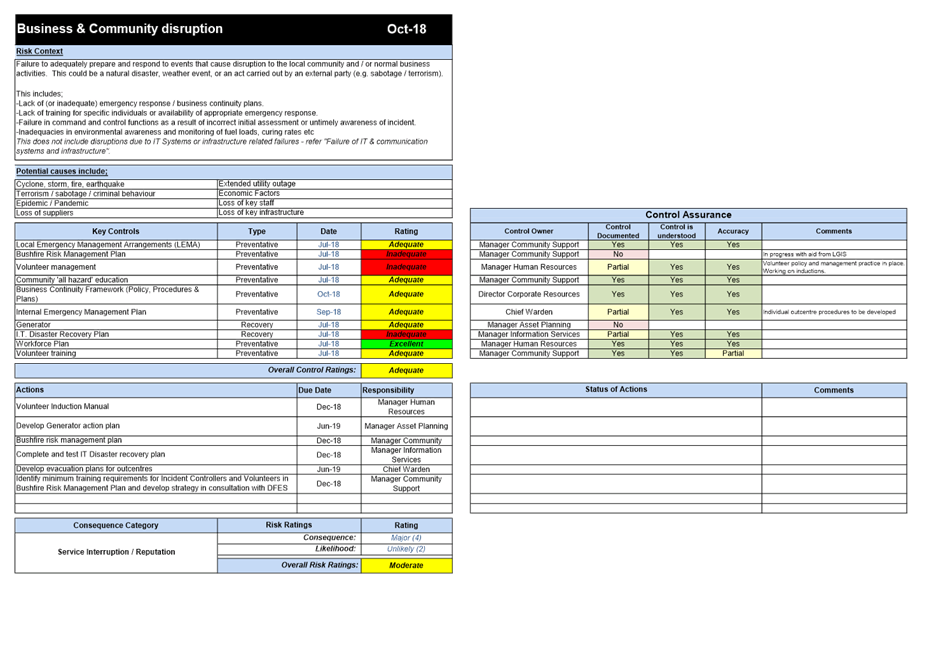
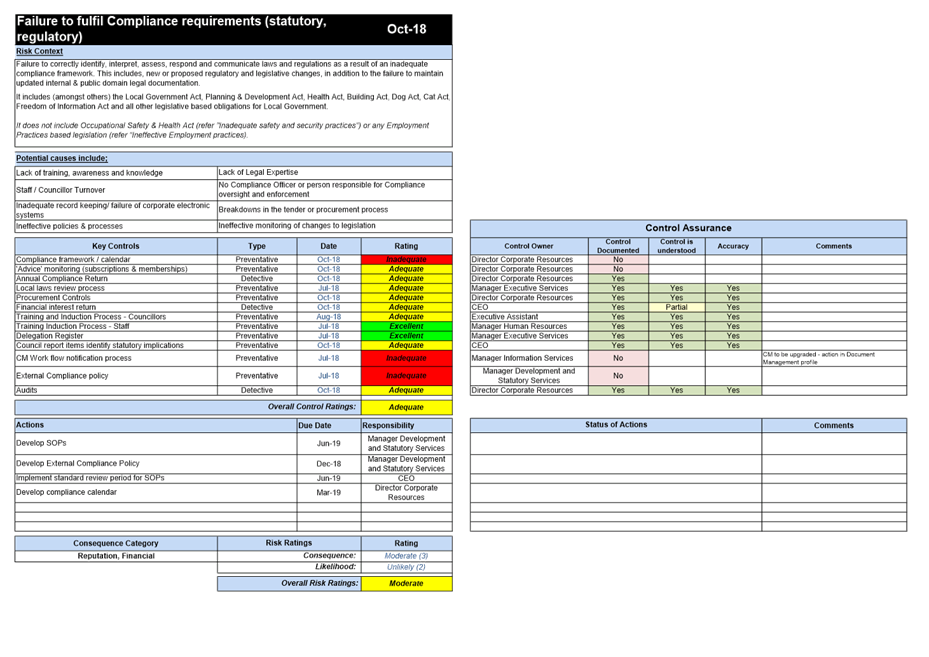
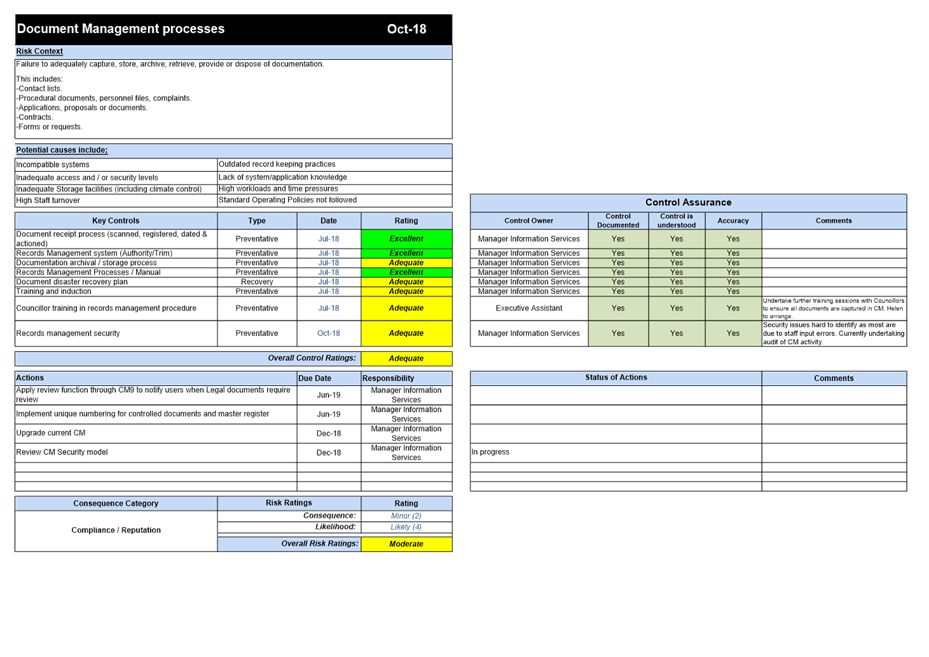
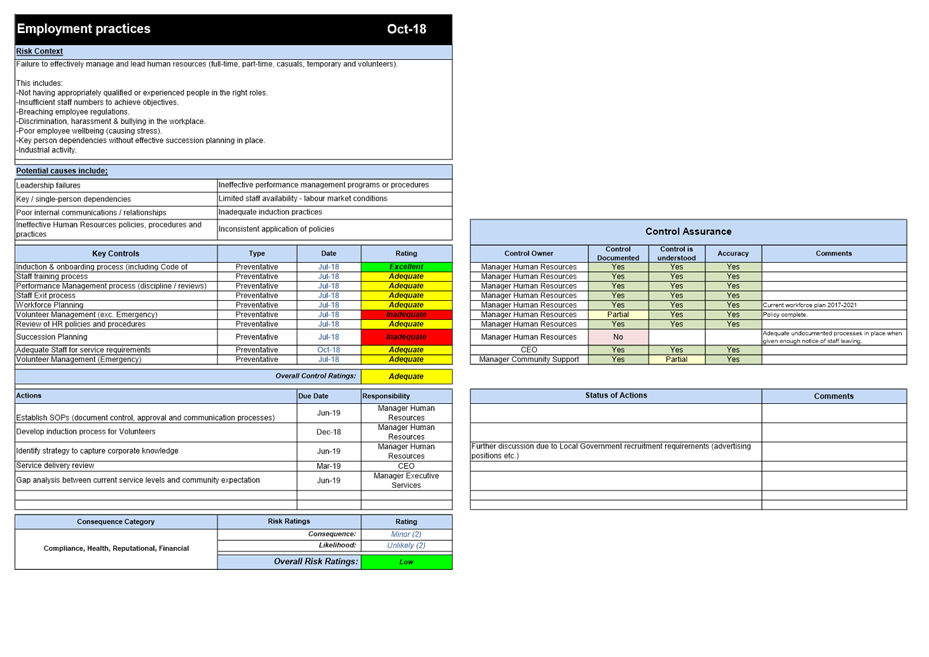
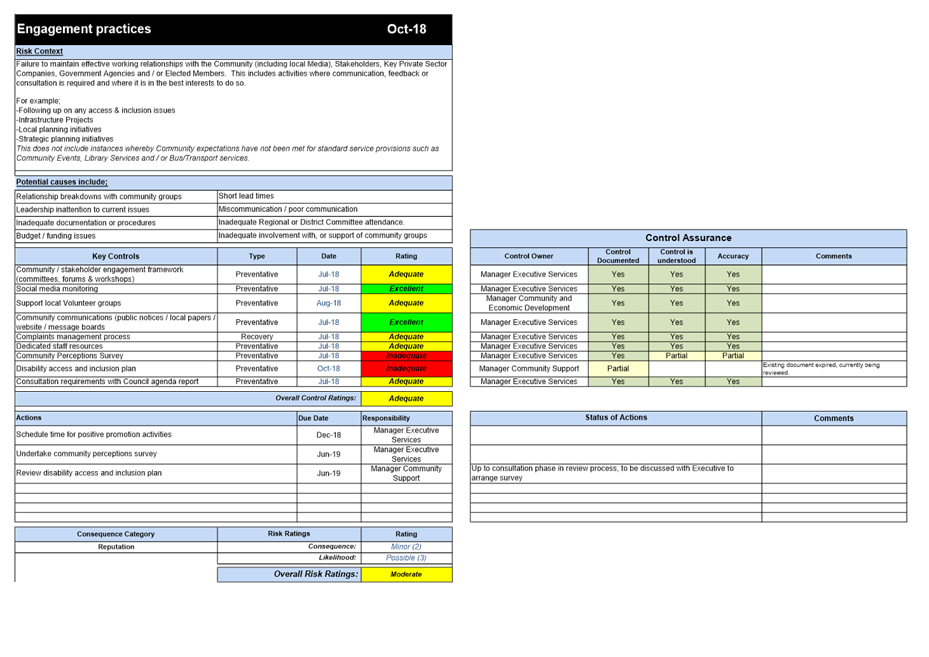
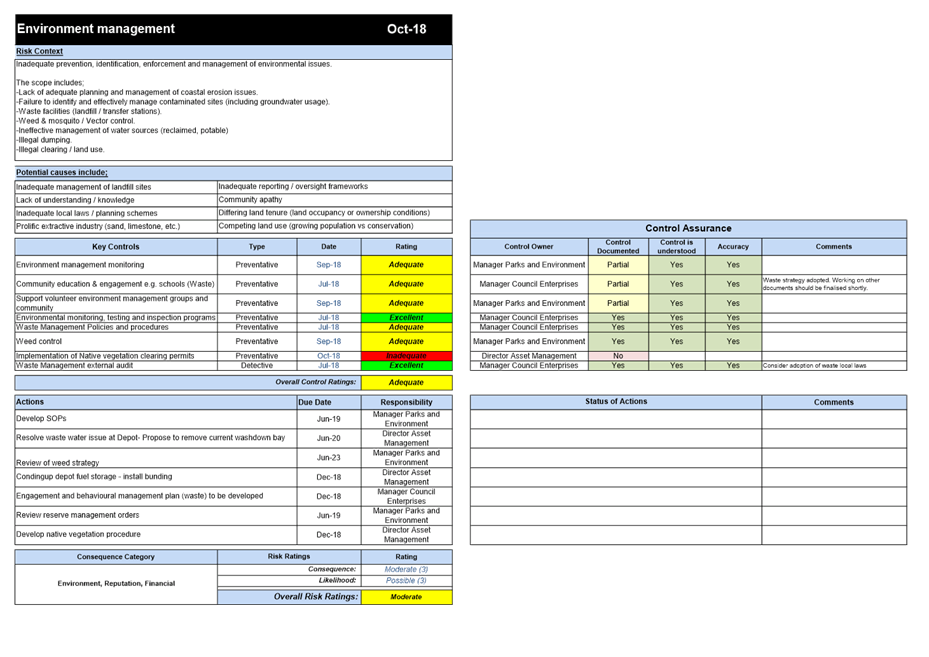
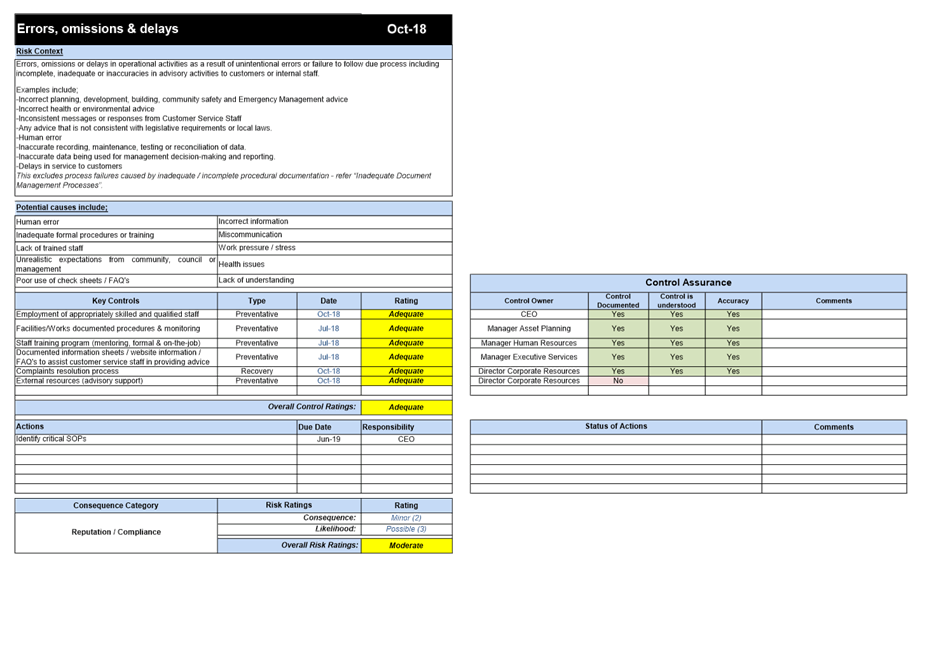
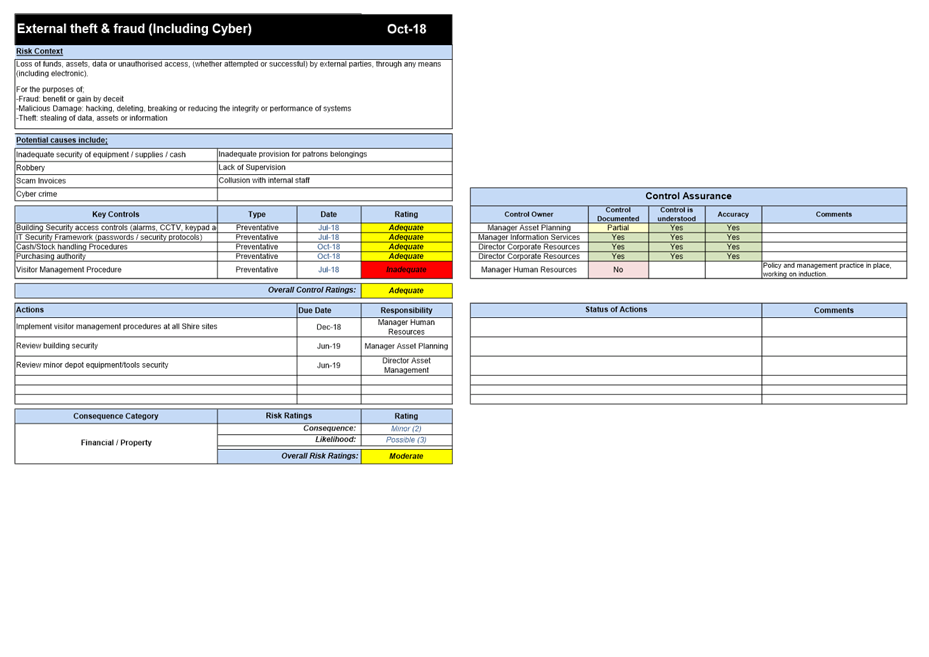
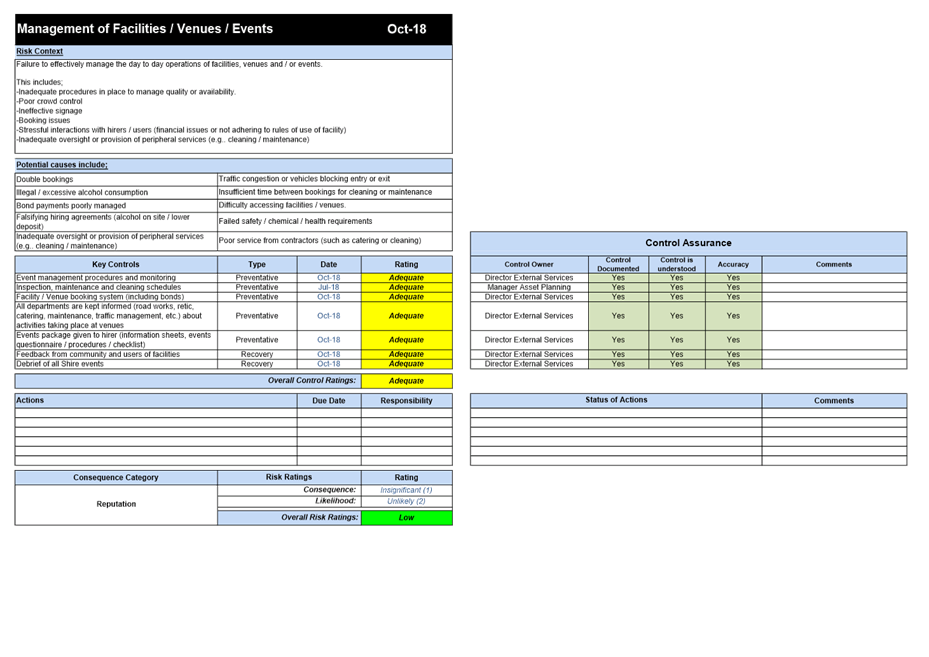
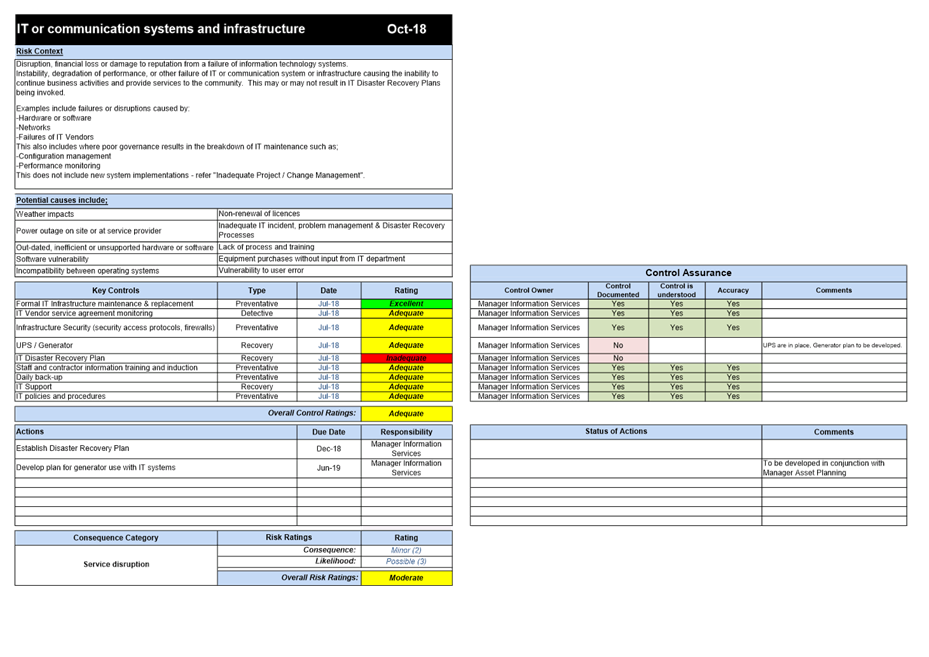
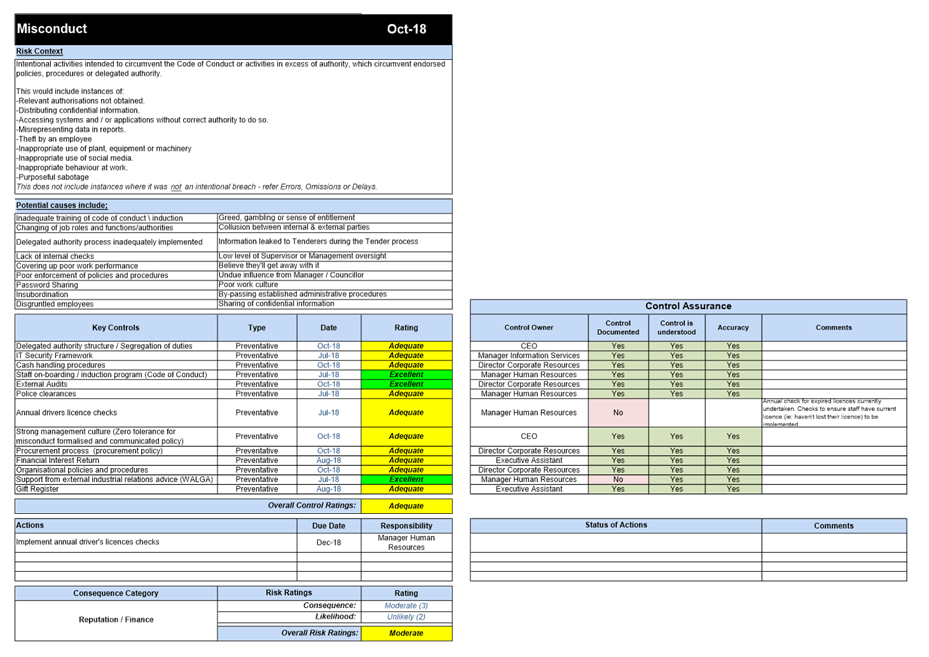
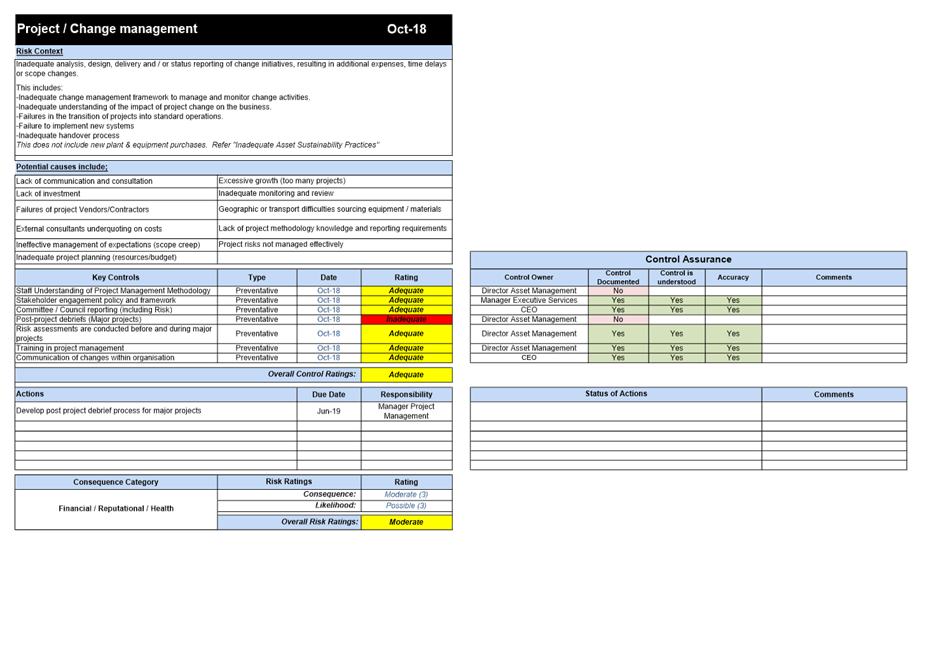
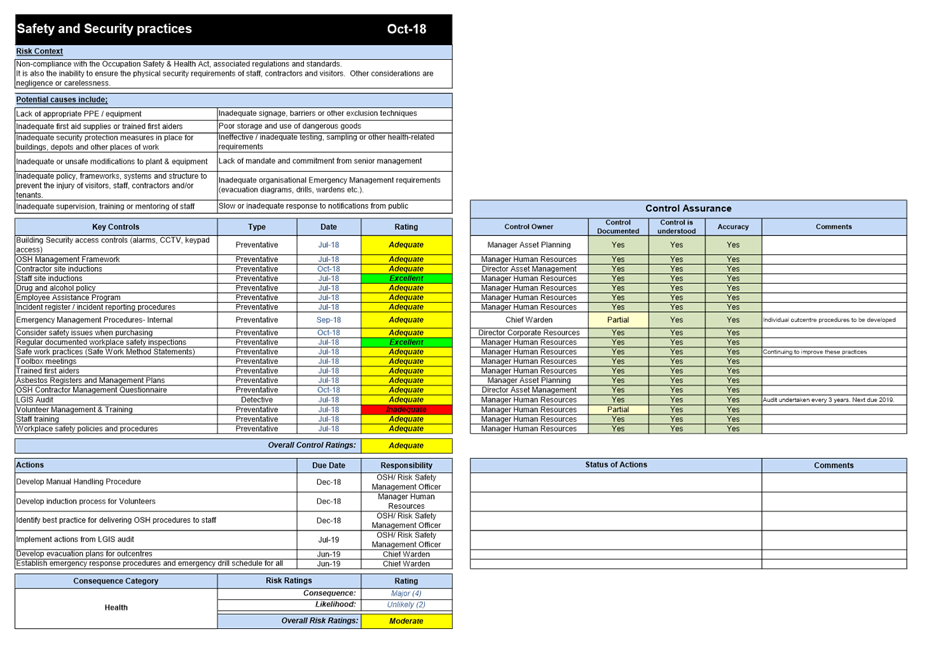
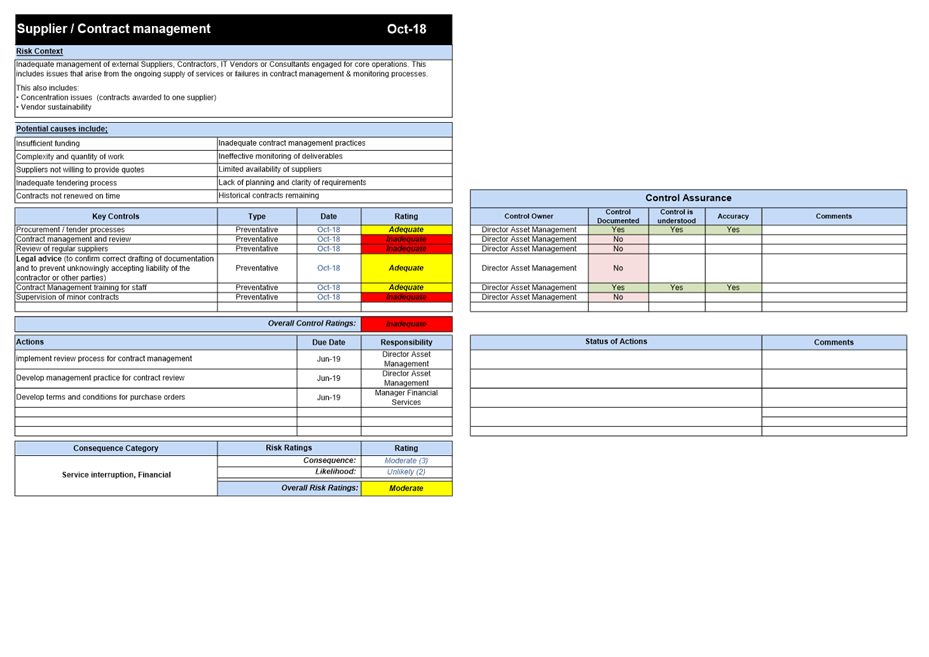
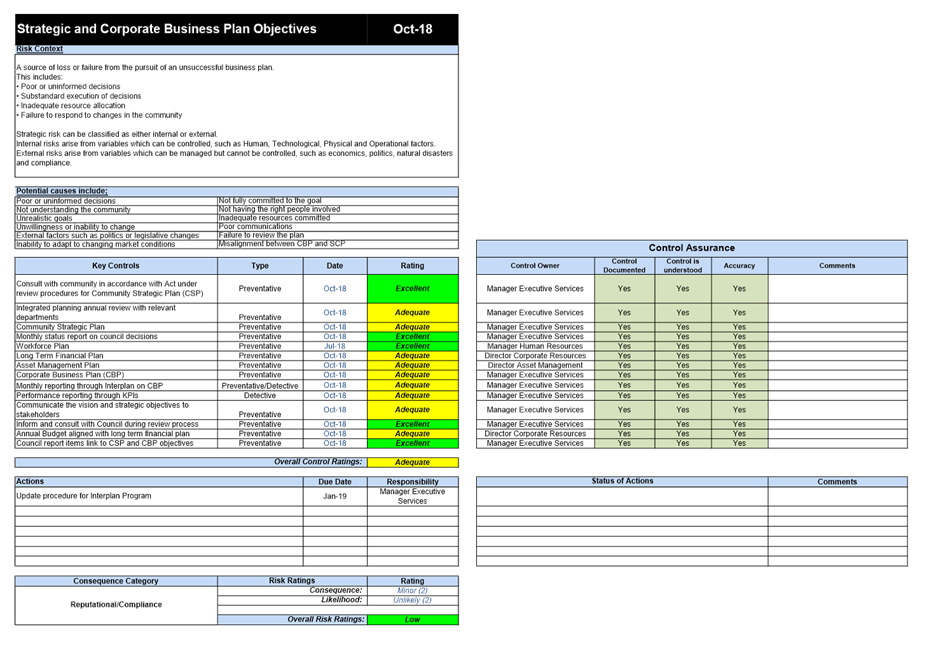
Attachment B has the risk management report and the
process that the Shire has worked through to determine the level of risk for
each risk theme and to what level the risk is being managed. The executive
summary provides a brief snapshot of each risk profile with appropriate colour
coding to easily identify the risk rating along with the level of control. The
executive summary also outlines those actions that are proposed to improve the
level of control for the risk theme. The full analysis for each profile is then
attached listing all the controls and the effectiveness of each control.
Actions have been suggested to improve controls and therefore reduce the risk.
It has been identified that the only area where there
is an inadequate level of controls in place is with regard to the supplier and
contract management risk profile. This is due to a lack of established
procedures for;
· reviewing contracts;
· monitoring minor contracts; and
· reviewing regular supplier’s
performance.
These procedures should be developed by the end of the
current financial year.
The treatment or action that is proposed will depend
upon the cost or resources required to improve the control. It may be
determined that some control measures are too resource intensive to implement
compared to the level of increased control that will be obtained.
Prioritisation and analysis of cost/benefit will be required in some instances
due to resource or budget constraints.
The risk management analysis has been a useful
exercise to evaluate the Shire’s business practices and determine how
effective they are operating. The process is used to communicate to staff who
have responsibility for the areas around areas of improvement or efficiency. It
is expected that this high level risk analysis will also provide guidance in
future decision making and resource allocation where business practice needs
improvement or the Shire is exposed to an unacceptable level of risk.
Consultation
OSH/Risk Officer
Middle Management
Directors
Financial Implications
Although there are no direct financial implications
arising from this report the actions that have been identified to increase controls
or reduce risk may have financial or resource implications for the
organisation. The cost of implementing the controls to reduce or manage risk
will need to be weighed up against the risk appetite of the organisation to
determine the most appropriate course of action.
Asset Management Implications
Nil
Statutory Implications
Local Government (Audit) Regulations
1996
– r.17 CEO to review certain systems and procedures
Policy Implications
EXE019: Risk Management
Strategic Implications
Strategic Community Plan 2017 - 2027
Community
Leadership
A financially
sustainable and supportive organisation achieving operational excellence
Provide
responsible resource and planning management for now and the future
Corporate Business Plan 2017/2018
– 2020/2021
Manage Risk Management System
Environmental Considerations
Nil
Attachments
|
a⇩.
|
Risk Management Policy
|
|
|
b⇩.
|
Risk Register Report
|
|
|
Officer’s Recommendation
That the Audit
Committee;
1. Accept
the CEO’s review of the appropriateness and effectiveness of the Shire of Esperance systems
and procedures in relation to risk management, internal control and
legislative compliance; and
2. Recommend the review to Council for
endorsement.
Voting Requirement Simple Majority
|